

Advertise where the traffic is real and the moderation is active. That means reputable adult directories and niche marketplaces that publish traffic data, verify listings, and sell targeted ad inventory instead of dumping you into a link farm. Adult directory advertising works best when you treat the platform like a business partner you're vetting, not a form you fill out once. Kinkykorner is one direct option worth putting on your shortlist.
TL;DR:
- Verify that traffic reports are transparent and conduct a short test using UTM links to confirm real visitor and lead numbers before investing heavily.
- Prioritize adult directories with active moderation, clear disclosure policies, and recent content updates to ensure audience quality and brand safety.
- Focus on a small selection of platforms with verified traffic and strong moderation rather than spreading across many unvetted directories to maximize ROI.
- Use metrics like profile views, click-through rates, geographic data, and time on page to evaluate listing performance and avoid relying solely on raw visit counts.
- Choose advertising plans based on actual lead generation, balancing subscription fees, Featured placements, and pay-per-lead models aligned with your local and niche market needs.
Table of Contents
- What Types of Adult Directories Should You Advertise On?
- How Do You Vet an Adult Directory Before You Pay?
- How to Create a Directory Listing That Actually Converts
- What Does Adult Directory Advertising Cost, and What's the Payoff?
- What Metrics Should You Track to Verify Directory Performance?
- Why Moderation and Disclosure Determine Advertiser Trust
- Why "More Listings" Isn't the Strategy Most Advertisers Think It Is
- Getting Listed on Kinkykorner: Plans and Next Steps
- Sources
- FAQ
What Types of Adult Directories Should You Advertise On?
Not every listing site does the same job, and picking the wrong category wastes your budget before you even launch a campaign. Adult classified ads, creator aggregators, niche marketplaces, and straight-up banner networks each pull a different kind of visitor, and each rewards a different kind of advertiser.
- General adult directories organize businesses by category and location. They're the workhorse for strip clubs, retailers, studios, and professional services that want steady local discovery rather than a single traffic spike.
- Classified-style boards favor fast turnover: events, gigs, one-off promotions, or short-term services where you need eyes now, not a slow-building profile.
- Creator aggregators index profiles at scale, sometimes numbering in the millions, and blend automated scraping with human review to keep listings current, as sites like OnlyFindr demonstrate. These suit performers and OnlyFans Creators who want cross-platform discovery without managing five separate profiles.
- Niche marketplaces built around a specific interest (fetish gear, kink events, podcasts) convert better for advertisers whose product only makes sense to a narrow audience.
- Pure ad inventory (banner placements, sponsored city pages) works when you already have brand recognition and just need volume.
Judge platform health before you judge platform fit. A directory updated weekly, with deep subcategories and visible moderation notes, beats one that hasn't touched its category tree in two years. If you're weighing whether creator platforms fit your promotion plan, this breakdown of platforms for adult creators walks through the tradeoffs in more detail.
How Do You Vet an Adult Directory Before You Pay?
Sales reps will tell you their traffic is great. Your job is to make them prove it before a dollar leaves your account.
Run through this checklist on every directory you're considering:
- Audience fit. Does the category structure match what you sell, or are you one of three listings buried under an unrelated niche?
- Content freshness. Pull up ten random listings. If half look untouched since last year, the directory isn't maintained.
- Moderation and verification. Ask directly whether listings go through human review. Platforms with visible verification badges tend to command higher advertiser confidence, and that confidence translates into premium pricing power for the directories that do it well.
- Sample analytics. Request real numbers, not a screenshot from someone else's dashboard.
- Geographic breakdown. If you serve one city, national traffic totals mean nothing to you.
- Pricing and refund terms in writing. Verbal promises about "featured for a month" don't hold up when you're disputing a charge.
- Accepted payment processors. Mainstream processors frequently restrict adult content, so confirm the directory works with adult-friendly billing before you assume your card will even go through.
Pro Tip: Ask for a UTM-tagged test link before you commit to anything beyond a free listing. A directory confident in its traffic will hand you one without hesitation; one that stalls or gives vague excuses is telling you something.
Stale directories usually show the same tells: broken image links, dead contact forms on other listings, or a "last updated" footer stuck years in the past. If a rep can't answer a direct question about monthly unique visitors or dodges a request for a short paid trial, that's your answer too.
How to Create a Directory Listing That Actually Converts
Your listing is a landing page, not a business card. Treat it that way.
- Title and category placement matter more than people think. A vague title buried in the wrong subcategory gets skipped even by people looking for exactly what you offer.
- Fill every optional field. Contact method, geo tags, hours, and service list all feed the directory's internal search, and skipping them makes you invisible to filtered searches.
- Use real, rule-compliant images. Blurry stock photos or images that violate platform guidelines get your listing flagged or buried in ranking.
- Write copy that states the offer plainly. "Book a consultation" or "message for availability" outperforms vague mission-statement language every time.
- Lead with a specific call to action. Tell the visitor exactly what to do next, whether that's a message button, a booking link, or a phone number.
- Buy premium placement only after your base listing performs. Featured slots and city-page promos amplify a listing that already converts; they don't fix one that doesn't.
For a category-by-category walkthrough of what belongs in each field, the guide to building a successful marketplace listing covers the specifics in more depth than a quick checklist can.
What Does Adult Directory Advertising Cost, and What's the Payoff?
Pricing in this space breaks down into a handful of predictable models, and knowing which one you're buying changes how you budget.
- Tiered subscriptions (monthly or yearly) get you a standing profile with baseline visibility.
- Featured placements cost more but push you to the top of category or city pages.
- Pay-per-lead shifts risk to the directory. You pay only when someone actually contacts you, which suits businesses still testing a market.
- Flat CPM banner buys work for volume plays where brand exposure matters more than direct contact.
Niche demand and city size swing prices hard. A featured slot in a major metro category costs more than the same slot in a smaller market, simply because more advertisers are bidding for the same eyeballs. Directories that package city-level traffic as its own sellable product tend to charge a premium for that localized exposure, and it's often worth paying for if your business is genuinely local.
Run a simple math check before signing anything: divide your monthly listing cost by your average expected leads to get cost per lead, then compare that against what one converted customer is worth to you. If a $50 monthly spend needs just two converted leads to break even, a short trial period tells you fast whether the math works. Most successful directories don't rely on one revenue stream. They mix subscriptions, featured placements, pay-per-lead, and banner ads, which usually means more flexible entry points for you as an advertiser too.
Prefer a short trial over a long commitment whenever a directory is new to you. Lock in the yearly rate only after you've seen at least one billing cycle of real contacts.
What Metrics Should You Track to Verify Directory Performance?
Raw visit counts sound impressive and tell you almost nothing about whether your listing is working. Advertisers who dig into behavior-level metrics get a far clearer read on value.
- Page views and unique visitors for your specific listing, not the directory as a whole.
- Click-through rate to your profile from category and search pages.
- Contacts or leads generated, tracked separately from casual page views.
- Geographic breakdown of who's actually viewing your listing.
- Time on page, which signals whether visitors are reading your offer or bouncing immediately.
Verify these numbers yourself rather than taking a sales deck at face value. A short UTM-tagged test campaign, run for even two weeks, will confirm whether the click volume a directory claims matches what your own analytics record. Directories that hand over transparent, reportable traffic metrics build more advertiser trust than ones that only quote gross visits, and behavior-level data like contact-button CTR and profile time on page is what actually predicts whether your spend is paying off. Ask for a monthly report that includes all five metrics above, broken out by geography if you serve more than one market.
Why Moderation and Disclosure Determine Advertiser Trust
Moderation isn't a compliance checkbox. It's the reason a directory's traffic is worth paying for in the first place. Platforms that actively review listings and remove stale or fraudulent ones keep the browsing environment clean, and that cleanliness is what increases advertiser ROI across the board.
A directory that discloses sponsored placements clearly, and moderates listings consistently, isn't just following the rules. It's protecting the value of every advertiser's spend on the platform, including yours.
Disclosure matters just as much as moderation. Many jurisdictions require clear labeling of sponsored or affiliate placements, and platforms that skip this exposure themselves and their advertisers to regulatory risk. Kinkykorner positions itself as a community-focused marketplace built around this kind of transparency, bringing adult businesses, creators, and events together under one roof with an eye toward keeping listings accurate. If you want a deeper look at how listing safety and moderation intersect, this piece on navigating adult listings safely is worth the read.
Why "More Listings" Isn't the Strategy Most Advertisers Think It Is
The instinct in this industry is to list everywhere and see what sticks. That's backwards, and it's the single most expensive mistake I see adult business owners make. A listing on a dead directory doesn't just fail to generate leads. It actively wastes the hours you spend maintaining it, and it can make your brand look scattered across platforms that don't match your audience.
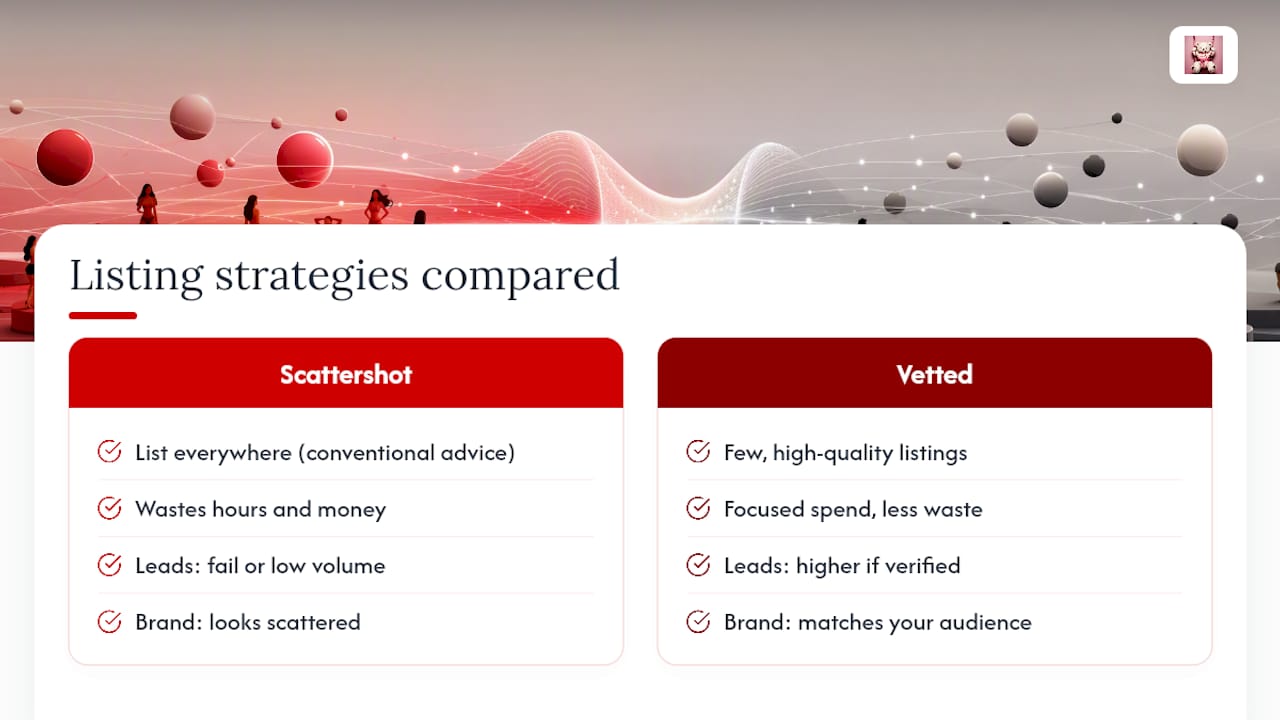
The conventional advice, "get listed on as many directories as possible," ignores the fact that moderation quality and traffic transparency vary wildly between platforms. Two directories with similar-looking traffic numbers can produce completely different lead volumes if one enforces verification and the other doesn't. That gap doesn't show up until you've already paid.
Prioritize verification and reporting quality over sheer directory count. Pick three or four platforms where you can actually confirm real traffic, run a trial on each, and expand only where the numbers hold up. Fewer listings, better vetted, consistently outperform a scattershot approach. The businesses that struggle most in this space aren't underexposed. They're overextended across platforms they never should have paid for.
— Prenston
Getting Listed on Kinkykorner: Plans and Next Steps
Kinkykorner gives adult businesses, performers, and event organizers a straightforward way to get discovered without navigating a maze of unclear pricing or vague promises. You can start with a Free Listing to test the waters, move to a monthly subscription plan for ongoing visibility, or commit to a yearly premium plan for longer-term exposure.

Each tier gets your profile in front of the right audience across categories like Adult Entertainment, Strip Clubs, Professional Services, Podcasts, Retailers & Studios, Only Fans Creators, Kink Events, and Fetish. Higher tiers generally unlock stronger visibility and upgrade options as you grow. Check the full pricing breakdown to compare plans side by side, or browse the category list to see exactly where your business fits before you sign up.
Sources
- Do I have to disclose affiliate links? — Post Affiliate Pro FAQ
- Adult ad networks analysis — Mobidea Academy
- Adent
FAQ
What Is the Best Way to Start Adult Directory Advertising?
Start with a free or low-cost listing on a well-moderated directory, verify its traffic with a UTM test link, then scale into paid tiers once you confirm real leads. A free listing on directories like Kinkykorner is commonly designed as a low-risk starting point for advertisers.
How Much Does Adult Directory Advertising Cost?
Costs vary by model: subscriptions typically run monthly or yearly, featured placements cost more for top visibility, and pay-per-lead shifts risk to the directory. Pricing details for platforms like Kinkykorner are available on their pricing page.
Are Adult Classified Ads Different From Directory Listings?
Yes. Classified ads suit short-term, time-sensitive promotions like events or one-off gigs, while directory listings build ongoing discoverability for an established business or service.
How Do I Know if a Directory's Traffic Numbers Are Real?
Request sample analytics and run a short UTM-tagged test campaign before committing to a paid tier. Directories confident in their numbers will hand over transparent, reportable metrics without pushback.
Do I Need to Worry About Payment Processing for Adult Ads?
Yes. Mainstream processors often restrict adult content, so confirm which payment methods a directory accepts before you commit, since most rely on adult-friendly processors rather than standard providers.