

Most people hear "kink community" and immediately picture something out of a late-night cable movie. Leather, dungeons, maybe a little chaos. The reality is so much more layered than that. Some kink communities aren't even primarily sexual at all. As research into kink communities shows, practices like pet play and furry culture can center entirely on identity expression, creativity, and belonging rather than sex. This guide breaks down what these communities actually look like, how they keep people safe, and how you can find your place in them without the confusion or shame.
Table of Contents
- Understanding kink communities: The basics
- Core mechanics and safety frameworks
- Navigating community spaces and events
- Challenges, stigma, and identity within kink communities
- Advanced practices and edge cases
- What most outsiders miss about kink communities
- Find your community with Kinky Korner
- Frequently asked questions
Key Takeaways
| Point | Details |
|---|---|
| Respect and safety first | Kink communities prioritize consent, boundaries, and structured safety protocols for all participants. |
| Diverse participation | People of all backgrounds join kink communities for connection, growth, and exploration beyond sexuality. |
| Event-driven engagement | Engagement centers around structured events like munches, workshops, and play parties, fostering support and education. |
| Support against stigma | Community spaces provide crucial support to overcome societal misconceptions and create a sense of belonging. |
| Expert guidance for advanced practices | High-risk activities require expert training, strict protocols, and ongoing aftercare to ensure well-being. |
Understanding kink communities: The basics
Let's start at the foundation. A kink community is a group of people who share an interest in alternative sexual or identity-based practices that fall outside mainstream norms. That's a broad definition on purpose. Because "kink" is a wide umbrella covering everything from BDSM (bondage, discipline, dominance, submission, sadism, and masochism) to role play, fetish wear, power exchange dynamics, and more.
Who shows up? Honestly, everyone. Young professionals, retirees, queer folks, straight couples, single people figuring themselves out. The global survey of BDSM practitioners, which studied 810 participants across multiple countries, confirmed what most community members already know: participation is heterogeneous. Different ages, genders, orientations, and backgrounds. There's no single "type."
Why do people join? The motivations are just as varied:
- Sexual exploration: Discovering what turns you on in a space where that's not only accepted but celebrated.
- Identity expression: For some, kink is how they understand and express who they are, not just what they do in bed.
- Community and belonging: Many people find their first real sense of tribe within a kink community.
- Personal growth: Negotiating boundaries, practicing vulnerability, and communicating clearly are skills that bleed into every area of life.
- Fun and creativity: Seriously. A lot of kink is playful, theatrical, and genuinely joyful.
Here's a snapshot of what participation looks like globally:
| Characteristic | Finding |
|---|---|
| Survey size | 810 practitioners across multiple countries |
| Gender diversity | Broad representation across gender identities |
| Sexual orientation | Mixed, including straight, queer, and bisexual participants |
| Primary motivations | Pleasure, identity, connection, and personal growth |
| Age range | Teens to seniors (with adult consent as a baseline) |
The community has also evolved dramatically over the past two decades. What used to be mostly underground, whispered about in back rooms, has moved into mainstream visibility. Apps, online forums, local groups, and international conferences now create infrastructure that would have seemed impossible thirty years ago. That evolution matters because it means more access, more safety resources, and more ways to find your people without risking your privacy or your dignity.
Core mechanics and safety frameworks
With a sense of who joins and why, understanding safe participation is key to exploring further. And here's where the kink community genuinely sets itself apart from a lot of other social spaces. The emphasis on explicit consent, negotiation, and aftercare is baked into the culture at a foundational level. It's not optional. It's the whole point.

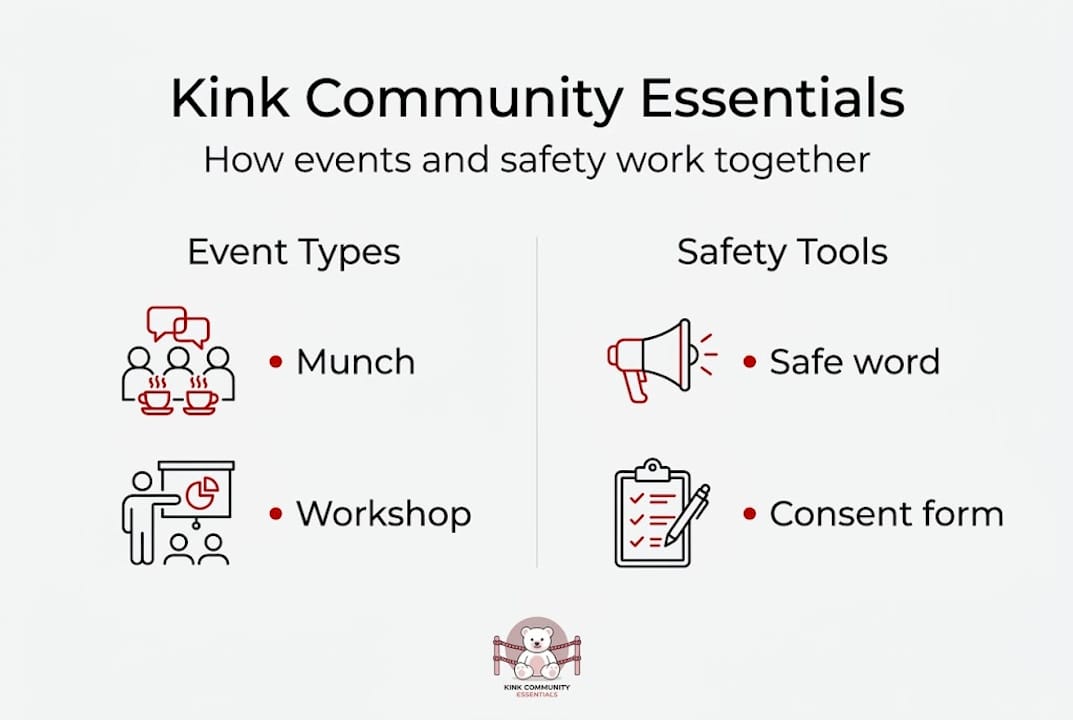
The core mechanics of kink participation include negotiating boundaries before any activity, using safe words during play, and following up with aftercare afterward. These aren't bureaucratic formalities. They're the difference between a meaningful, hot, consensual experience and something that leaves someone feeling wrecked in a bad way.
Here's how a basic negotiation typically works:
- Pre-scene discussion: Both (or all) parties talk through what they want to explore, what's off the table, and any physical or emotional limits.
- Establish a safe word: A word or signal that immediately pauses or stops the scene. "Red" for stop, "yellow" for slow down is a common system.
- Check-in during play: Verbal or non-verbal cues to confirm ongoing consent and comfort.
- Aftercare: Post-scene care that might include physical comfort (blankets, water, snacks), emotional check-ins, or simply holding space for someone to decompress.
The two dominant safety frameworks in kink are SSC and RACK. Here's how they compare:
| Framework | Full name | Core philosophy | Best suited for |
|---|---|---|---|
| SSC | Safe, Sane, Consensual | All activities should be objectively safe and sane | Newcomers and lower-risk play |
| RACK | Risk-Aware Consensual Kink | Acknowledges that some risk is inherent; focuses on informed consent | Experienced participants in edge play |
Neither framework is "better." They serve different contexts. A lot of experienced practitioners use RACK because it's more honest about the fact that certain activities carry real risk, and pretending otherwise doesn't make anyone safer. What it does is put responsibility on participants to be genuinely informed before they agree to anything.
"Consent in kink isn't a checkbox. It's an ongoing conversation that can be revisited, revised, and revoked at any point." This is the baseline expectation in any community worth being part of.
Pro Tip: Before attending your first event or scene, write down your hard limits (things you will not do under any circumstances) and your soft limits (things you're curious about but want to approach slowly). Having that clarity before the conversation starts makes negotiation way less intimidating.
You can find structured kink events that build these safety protocols directly into their programming, which makes them ideal starting points for newcomers who want to learn the culture properly.
Navigating community spaces and events
Once safety protocols are clear, engaging with the community through its events is the next step. And the range of event types might surprise you. This isn't all dungeon parties and leather gear. The structured events within kink communities run the full spectrum from casual coffee meetups to large-scale educational conferences.
Here's what you'll typically encounter:
- Munches: Casual, non-play gatherings at regular venues like restaurants or bars. No kink gear required. These are specifically designed for newcomers to meet people in a low-pressure setting.
- Workshops: Educational sessions covering specific skills, practices, or topics. Rope bondage technique, consent communication, dominant/submissive dynamics. You learn, you ask questions, you go home with actual knowledge.
- Play parties: Events where consensual kink activity happens in a shared space. These have strict rules about consent, observation etiquette, and participation.
- Conferences: Multi-day events like BDSM conventions that combine education, community building, and social events. These are incredible for meeting people from across the country or world.
- Online communities: Forums, Discord servers, and social platforms dedicated to kink discussion, advice, and connection. Especially valuable if you're in an area without a local scene.
Etiquette matters enormously in these spaces. A few things to know before you walk in:
- Don't touch without asking. Ever. This applies to people, their gear, and their partners.
- Don't stare or hover around active scenes. If you're watching, maintain respectful distance and don't interrupt.
- Introduce yourself honestly. You're new. That's fine. Most community members remember being new and will welcome you warmly if you're upfront about it.
- Dress codes exist for a reason. Many play parties have specific attire requirements. Check before you show up in jeans and a t-shirt.
Pro Tip: Your first munch is the single best way to enter any kink community. It's just people talking over food. No pressure, no performance. Go once, listen more than you talk, and let the community show you who it actually is.
If you're not sure where to start, exploring kink community events through a trusted platform gives you a curated starting point rather than stumbling through random internet searches.
Challenges, stigma, and identity within kink communities
Understanding events is one part, but acknowledging community challenges and identity issues is just as vital. Because let's be real: the outside world isn't always kind about this stuff. And even inside the community, there are complicated conversations happening.
The stigma is real. Media portrayals and religious frameworks have historically painted kink practitioners as broken, deviant, or dangerous. That narrative causes genuine harm. It pushes people into shame spirals, keeps them from accessing mental health support, and makes it harder to be honest with partners or doctors about their lives.
Common misconceptions that the community constantly has to fight:
- "It's always about sex." Not true. Many people in kink communities are there for identity, community, or creative expression.
- "Kink practitioners are damaged." Research consistently shows no higher rates of psychological distress in kink communities compared to the general population.
- "Consent doesn't really exist in BDSM." This one is particularly frustrating because kink communities often have more explicit consent culture than mainstream dating.
- "It's a phase or a fetish to be fixed." For many people, kink is a core part of who they are, not a symptom.
"Shame thrives in silence. The kink community, at its best, is a place where people stop being silent about who they are."
There are also internal debates worth acknowledging. Feminist perspectives on kink are genuinely divided. Some argue that power exchange dynamics, particularly those involving submission, reinforce harmful gender hierarchies. Others argue that consensual power exchange is a radical act of agency, especially for people who've been told their desires are wrong. Both perspectives deserve space in the conversation.
What the community does well is provide scaffolding for people working through shame and identity. Peer support, mentorship from more experienced practitioners, and community norms that center respect and autonomy all contribute to an environment where people can actually figure themselves out without judgment.
Advanced practices and edge cases
Beyond stigma and identity, those exploring further should understand high-risk and advanced practices. This is where things get genuinely serious, and where the community's emphasis on education becomes non-negotiable.
Edge play refers to activities that carry significant physical or psychological risk. Examples include breath play (restricting airflow), fire play, needle play, electroplay, and certain forms of extreme bondage. These are not beginner activities. Full stop.
Here's how responsible practitioners approach edge play:
- Extensive education first. Workshops, mentorship from experienced practitioners, and thorough research before attempting anything.
- Spotters and safety tools. Many edge play activities require a trained third party present. Medical scissors for rope emergencies. Fire safety equipment for fire play. These aren't optional accessories.
- Health screening. Certain activities are contraindicated for specific medical conditions. Knowing your own health status and your partner's is essential.
- Psychological preparation. Edge play can trigger intense emotional responses. Both participants need to understand this going in.
- Robust aftercare protocols. The clinical guidelines for kink specifically address "sub drop" and "dom drop," the psychological crash that can follow intense scenes. Aftercare isn't just nice to have here. It's medically relevant.
Sub drop and dom drop are worth understanding even if you're not doing edge play. Sub drop is the emotional and physical low that submissives sometimes experience hours or days after an intense scene, when the adrenaline and endorphins wear off. Dom drop is the same phenomenon for dominants, often compounded by the responsibility they carried during the scene. Knowing these states exist means you can plan for them rather than being blindsided.
Pro Tip: If you're curious about edge play, find a mentor in your local community who has years of experience in the specific practice you're interested in. Reading about it online is not sufficient preparation. Hands-on learning under supervision is the standard, not the exception.
What most outsiders miss about kink communities
Here's the thing that genuinely surprises people when they actually spend time in kink spaces: the level of governance. There are community standards, accountability processes, and in many established groups, actual mechanisms for addressing violations. Someone who violates consent doesn't just get a stern look. They get banned. Their behavior gets documented and shared across community networks to protect others.
This is what kink clinical guidelines point to when they emphasize that consent is ongoing and specific, not a one-time agreement. The community has built procedural infrastructure around this principle in a way that most mainstream social environments simply haven't.
The misconception I see constantly is that kink communities run on emotional trust alone. "We're all friends here, so we're safe." That's naive, and experienced practitioners know it. Real safety comes from procedural security: clear rules, documented agreements, community accountability, and the willingness to enforce standards even when it's uncomfortable. Emotional trust is wonderful. But it's not a safety protocol.
What this means for newcomers is that the best communities to join are the ones with visible structure. Event rules posted publicly. Clear codes of conduct. Accountability processes that aren't just theoretical. If a community can't tell you how they handle consent violations, that's information.
Find your community with Kinky Korner
Ready to stop reading and start connecting? The Kinky Korner community is built exactly for this moment. Whether you're trying to find local events, connect with vetted practitioners, or explore erotic literary and artistic content that reflects your interests, it's all in one place. You don't have to piece together your entry into kink culture from random forums and sketchy apps.

Kinky Korner brings together people, businesses, and resources across the kink spectrum in a marketplace that takes safety and community seriously. Browse listings, find events near you, and connect with others who've already done the work of building something real. Your people are out there. This is where you find them.
Frequently asked questions
What is the main purpose of a kink community?
A kink community provides a safe, supportive environment for exploring alternative lifestyles, practices, and identities, as confirmed by international research on BDSM practitioners showing diverse, global participation centered on connection and personal growth.
What are some examples of kink community events?
Kink communities host structured events including munches (casual social meetups), skill-based workshops, consensual play parties, and large multi-day conferences.
How do kink communities ensure safety?
Safety is built on negotiation, safe words, aftercare, and adherence to frameworks like SSC and RACK that establish clear expectations for consent and risk awareness.
Can kink communities help overcome stigma?
Yes, kink communities actively counter the shame caused by media and religious stigma by providing peer support, identity affirmation, and spaces where people can be honest about who they are.
What is edge play in kink communities?
Edge play refers to high-risk activities like breath play or electroplay that require expert training, spotters, and strict aftercare protocols, as outlined in kink clinical guidelines addressing both physical safety and psychological recovery.