

Let's be real for a second. Most people outside the kink world assume that BDSM is this wild, dangerous free-for-all where anything goes and someone always ends up hurt. That couldn't be further from the truth. In fact, kinksters report higher levels of communication, trust, intimacy, and relationship satisfaction than many mainstream couples. The secret isn't the toys or the titles. It's the talking. This guide breaks down exactly how communication works in kink, why it's your most powerful safety tool, and how to actually use it.
Table of Contents
- Why communication matters in kink
- Essential communication tools for kink relationships
- Handling edge cases: Consensual non-consent and complex emotions
- Making communication work: Everyday practices for kinksters
- The uncomfortable truth most guides skip: Over-communication isn't always safer
- Explore, learn, and connect with a supportive kink community
- Frequently asked questions
Key Takeaways
| Point | Details |
|---|---|
| Communication boosts safety | Clear negotiation, safe words, and aftercare significantly reduce risks in kink. |
| Handle edge cases carefully | CNC or trauma histories require extra steps and community resources for true safety. |
| Practical skills matter | Daily practices like check-ins and clear agreements keep kink satisfying and secure. |
| Over-communication isn’t automatic safety | Listen, attune, and act with care instead of relying on words alone. |
Why communication matters in kink
Here's the thing about kink that nobody in the mainstream conversation seems to get: the negotiation, the check-ins, the safe words, the aftercare, all of it is what makes the intensity possible. You can't have a power exchange without a foundation of trust. And trust doesn't appear out of thin air. It gets built, word by word, conversation by conversation.
A lot of people come into kink assuming that because something is "consensual," the communication work is basically done. Nope. Consent is the floor, not the ceiling. What separates a mediocre kink experience from a genuinely transformative one is the depth of communication that happens before, during, and after a scene. That's not just my opinion.
Empirical evidence links communication in kink with trust, intimacy, and safety outcomes that regularly outperform what researchers find in vanilla relationship studies. The misconception that kink is inherently reckless or irresponsible collapses pretty fast when you look at the actual data.
"The kink community has developed its own robust set of communication protocols that many relationship therapists could learn from. Negotiation, safe words, aftercare, and explicit boundary setting are standard practice, not exceptions."
Here's a quick snapshot of what the research actually shows:
| Outcome | Kinksters with strong communication protocols | General population |
|---|---|---|
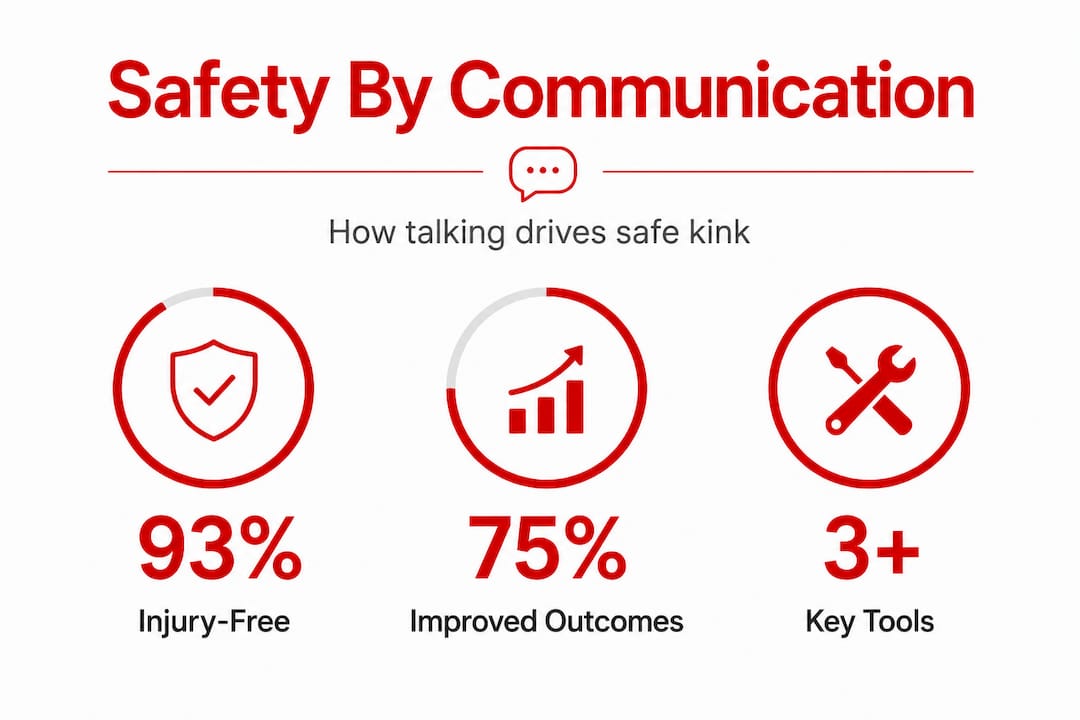
| Injury-free experiences | 93% | Not systematically tracked |
| Therapist-reported improved communication skills | 75% of clients | Varies widely |
| Reported relationship satisfaction | Elevated | Average to moderate |
| Trust and intimacy scores | Higher than comparison groups | Baseline |
That table should raise some eyebrows. We're talking about a community that has essentially built a grassroots framework for healthy communication in kink that the rest of the relationship world is still catching up to.
The misconception I want to specifically kill here is the idea that kink relationships are secretive or uncommunicative by nature. The opposite tends to be true. Because the stakes feel higher, the conversations get richer. People get specific. They ask hard questions. They actually listen to the answers.
Essential communication tools for kink relationships
Okay, let's get into the actual mechanics. Because knowing that communication matters is one thing. Knowing how to do it well is another.
The core toolkit breaks down into four main areas:
- Negotiation before play: This is the pre-scene conversation where you map out desires, boundaries, hard limits (things you will not do under any circumstances), and soft limits (things that might be okay with the right context). It's not a mood-killer. It's foreplay for your brain.
- Safe words and non-verbal signals: Safe words are your emergency brake. The classic traffic light system (red for stop, yellow for slow down, green for keep going) works well for beginners. But safe words aren't enough on their own, especially in scenes involving bondage or gags. Non-verbal signals like tapping out or dropping an object become essential when verbal communication isn't possible.
- Aftercare: This is the recovery period after a scene, and it is non-negotiable for emotional well-being. Aftercare looks different for everyone. Some people need physical comfort, a blanket, some water, being held. Others need space. Some need to laugh and decompress. The point is to check in with your person and provide what they actually need, not what you assume they need.
- Regular check-ins: Not just during scenes, but between them. How are you feeling about where things are going? Are your needs being met? Has anything shifted for you? These ongoing conversations prevent the slow drift that can turn a healthy dynamic into a confusing one.
Protocols like safe words and explicit negotiation contribute to 93% of kink experiences being injury-free. That's not luck. That's structure working the way it's supposed to.
Pro Tip: Create a "Yes/No/Maybe" list together. This is basically a catalog of activities where each person independently marks what they're enthusiastic about, what's off the table, and what they're curious but uncertain about. Then you compare notes. It sparks conversations you might never have had otherwise and takes a lot of the awkward guesswork out of negotiation.
One thing I've learned the hard way? Assuming your partner is okay because they didn't say otherwise is a trap. Silence is not consent. It's just silence. Build the habit of asking directly, and build the kind of relationship where honest answers feel safe to give.

Handling edge cases: Consensual non-consent and complex emotions
Now we get into the territory that requires even more care and intentionality. Some kink dynamics involve scenarios that look, on the surface, like a breakdown of consent. Consensual non-consent, or CNC, is one of them. Understanding how to communicate around these scenes is critical.
CNC is a dynamic where partners agree in advance to simulate a non-consensual encounter. The keyword there is agree in advance. CNC requires extra negotiation for safe words, non-verbal signals, and aftercare precisely because the scene involves simulated resistance. When someone's playing a role that involves saying "no" as part of the scene, you need a completely separate, pre-agreed signal for when they genuinely need to stop.
Here's a comparison of standard play communication versus CNC-specific communication:
| Communication element | Standard kink scene | CNC or high-intensity scene |
|---|---|---|
| Safe word | Standard (red/yellow/green) | Must be pre-agreed, unique to the scene |
| Non-verbal signal | Optional | Mandatory backup system |
| Pre-scene negotiation | Recommended | Absolutely required, in detail |
| Aftercare plan | Recommended | Required, agreed in advance |
| Check-in post-scene | Good practice | Critical, often extended |
For CNC specifically, here are the additional steps I'd recommend layering in:
- Have a detailed conversation about the specific scenario, what it includes, what it absolutely does not include, and where the line is.
- Establish at least two independent stopping mechanisms (one verbal, one non-verbal).
- Discuss your emotional state going into the scene. If either of you is already stressed, dysregulated, or carrying something heavy, it may not be the right time.
- Agree on the aftercare plan before the scene starts, not after, when you might both be in a vulnerable state.
- Build in a debrief 24 to 48 hours later, when the emotional dust has settled.
When trauma histories are involved, the stakes get even higher. In BPD or trauma contexts, kink communication can be genuinely protective, but when boundaries fail, the fallout can link to self-harm or significant emotional dysregulation. This isn't a reason to avoid kink if you have a trauma history. It's a reason to go slower, communicate more thoroughly, and have community resources for safety and professional support on standby.
Pro Tip: Before any high-intensity scene, especially CNC, agree on an aftercare contact person outside the dynamic. This is someone both of you trust who can be reached if either person needs external support after the scene.
Making communication work: Everyday practices for kinksters
Theory is nice. Daily practice is what actually keeps people safe and satisfied. Let's talk about how to make this stuff stick.
- Debrief after every scene. Not a huge formal conversation every time, but at least a brief check-in. "How are you feeling? What worked for you? Is there anything that came up for you that we should talk about?" Make it a ritual, not a big deal.
- Use clear, specific language. "I like intensity" tells your partner almost nothing. "I like impact play on my back and thighs, starting slow and building, and I need you to check in if anything leaves a mark" gives them something to work with. Be specific. Specificity is kindness.
- Avoid assumptions, even in established dynamics. Just because something was fine last month doesn't mean it's fine today. People change. Needs shift. Bodies go through things. Keep checking in, even when you think you already know the answers.
- Use written checklists and safety agreements, especially when starting with a new partner or exploring new territory. Writing things down removes ambiguity and creates a reference point you can both return to.
- Normalize renegotiation. Changing your mind about something isn't failure. It's growth. Create a dynamic where updating the agreement is expected and welcomed, not treated as a crisis.
Screening for trauma-linked distress is something clinicians are increasingly recommending when working with kink-engaged clients, and the research supports that strong communication habits correlate with positive outcomes across the board. Standards for safe kink communication aren't just community etiquette. They are evidence-based practices.
Here's the stat that keeps knocking me out: 75% of therapists who work with kink-engaged clients report seeing improved communication skills compared to clients in conventional relationships. Seventy-five percent. That's not a fluke. That's a pattern.
The uncomfortable truth most guides skip: Over-communication isn't always safer
Here's where I'm going to say something that might ruffle some feathers. Communication is essential. Full stop. But more communication is not always better communication.
I've seen people use the language of negotiation as a kind of armor, talking endlessly about everything while actually listening to very little. There's a version of "doing the work" in kink that becomes performative, where the checklist gets completed and the words get said, but nobody is actually present in the conversation. That's not safety. That's theater.
Being attuned to your partner sometimes means reading what they can't say out loud, noticing when they're shutting down mid-scene even if their safe word hasn't been used, feeling the shift in the room before it becomes a crisis. Emotional intelligence and attunement are not replacements for communication. They're the part of communication that lives in the body, not the mouth.
I've also seen "process loyalty" do real damage. That's when someone pushes past their own emotional limits or their partner's because they feel committed to completing the agreed-upon scene. The scene is not more sacred than the person. It never is. Evidence supports communication's role in positive outcomes, and that same evidence flags the need to screen for distress, not just tick communication boxes.
My honest perspective is this: the goal is a dynamic where both people feel genuinely seen, where talking is real and listening is real, and where the structure of communication serves the relationship rather than performing safety for its own sake. Resources for attuned kink relationships matter here, because community wisdom fills gaps that no checklist ever will.
Explore, learn, and connect with a supportive kink community
You've got the framework. You understand the tools. But there's something about learning this stuff in community that no article can fully replicate, the real stories, the hard-won wisdom, the specific knowledge that comes from people who've actually lived these dynamics.

Kinky Korner community is a space built for exactly this. Whether you're brand new to kink and trying to figure out how to start the conversation, or you're deep in a dynamic and looking to sharpen your practice, Kinky Korner gives you access to real people, vetted information, erotic literary content, and a marketplace of adult-themed services where people and businesses show up to share their expertise. The combination of community connection and high-quality resources means you're not navigating this alone. Come find your people.
Frequently asked questions
What are the most important communication steps before a kink scene?
Discuss desires, hard limits, soft limits, safe words, non-verbal signals, and aftercare plans before any play. Explicit negotiation like this contributes directly to injury-free experiences 93% of the time.
How do I navigate communication if trauma is involved?
Take extra time with negotiation, clarify all boundaries in detail, check in frequently during and after scenes, and consider connecting with professional support if old wounds get activated. Boundary failures in trauma contexts carry higher risk, so slow down and prioritize aftercare.
Is using safe words always enough to prevent problems?
Safe words are essential, but they're one layer of a complete safety system. CNC and high-intensity scenes especially require non-verbal backup signals and agreed-upon aftercare, because safe words alone can't cover every situation.
Can good communication make kink safer than "vanilla" sex?
Research strongly suggests yes. BDSM practitioners with strong protocols report 93% injury-free experiences and measurably higher relationship satisfaction and trust compared to general population benchmarks.