

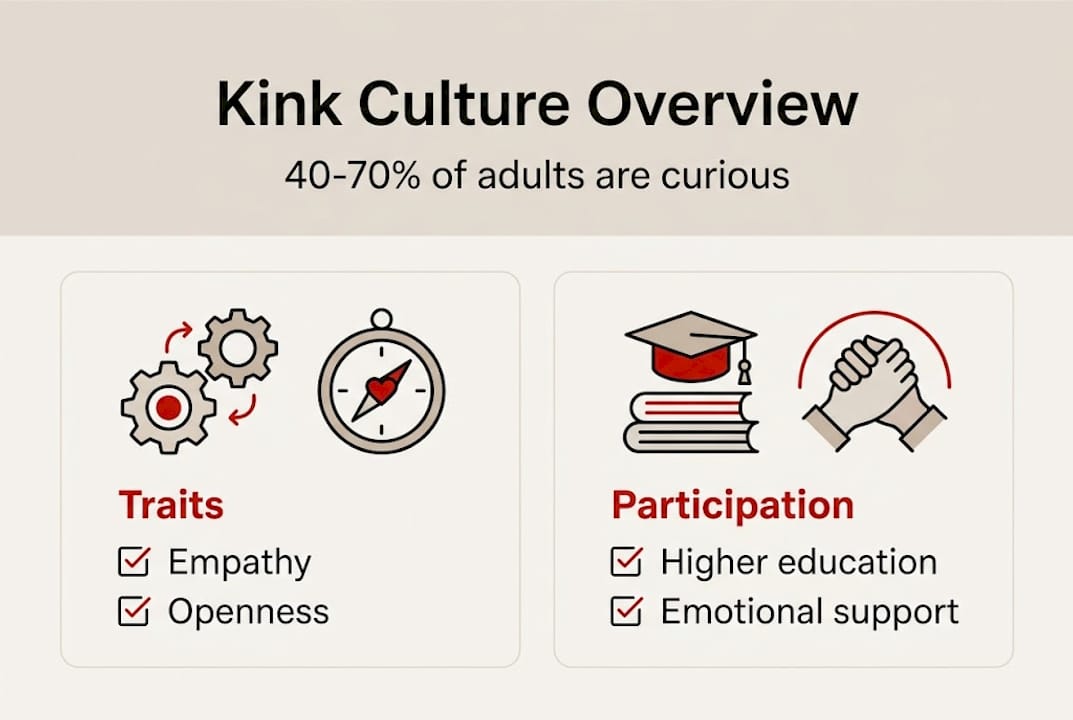
Most people assume kink is a niche thing. A dark corner of the internet, maybe. Something for "those people" who are into something weird. But here's the reality: 40-70% of adults report having kink or BDSM fantasies, and around 20% have actually acted on them. That's not a fringe group. That's your coworkers, your neighbors, maybe you. Kink culture is more layered, more psychologically rich, and more community-driven than most people realize. This guide breaks it all down: what kink culture actually is, what the research says about its benefits, how safety and consent work, and how to find your footing if you're curious.
Table of Contents
- What is kink culture? Definitions, roots, and misconceptions
- The psychology of kink: Motivation, benefits, and misunderstandings
- Risks, boundaries, and consent: Navigating the safety spectrum
- Community, support, and overcoming stigma
- Why understanding kink culture helps everyone, whether you participate or not
- Discover more and connect with the kink community
- Frequently asked questions
Key Takeaways
| Point | Details |
|---|---|
| Kink is common | Most adults have at least some kink fantasies, making it far more mainstream than people think. |
| Psychological benefits | Kink participation is linked to less anxiety, greater empathy, and higher relationship satisfaction. |
| Consent is essential | Safety and consent are the foundation of all healthy kink experiences. |
| Community matters | Engaging with a supportive kink community boosts learning, safety, and enjoyment for new and experienced participants. |
| Stigma persists | Despite growing acceptance, kink culture still faces misunderstanding and judgment—a challenge that open dialogue can address. |
What is kink culture? Definitions, roots, and misconceptions
Kink culture is, at its core, a set of sexual and relational practices, identities, and communities that fall outside what's typically called "vanilla" sexuality. Vanilla just means conventional sex without power exchange, role play, or specific fetish elements. Kink is the everything else: bondage, discipline, dominance, submission, sadism, masochism (BDSM), fetishes (specific objects or scenarios that are sexually charged), and a whole spectrum of erotic experiences in between.
This isn't new. Power exchange and erotic ritual have roots in ancient cultures, and organized kink communities in the West began forming in the mid-20th century, particularly around leather subcultures in the 1940s and 50s. By the 1990s, the internet blew the doors open. Suddenly, people who thought they were alone in their desires could find thousands of others who felt the same way.
Some key terms worth knowing:
- BDSM: An umbrella term covering Bondage/Discipline, Dominance/Submission, and Sadism/Masochism
- Kink: Any non-conventional sexual interest or practice
- Fetish: Sexual arousal tied to a specific object, body part, or scenario
- Dominant/Submissive (D/s): A dynamic where one partner leads and the other yields, by mutual agreement
- Edge play: High-risk kink activities that require advanced negotiation and experience
Now, the myths. The biggest one: kink is a sign of psychological damage. It isn't. Another: kink is mostly about pain. It's not. Most kink is about trust, sensation, and power dynamics. And the idea that submissives are somehow disempowered? That gets it completely backwards. Submission is a choice. A deliberate, negotiated, often deeply empowering one.
"Kink isn't what happens when something goes wrong in someone's life. Often, it's what happens when someone gets really honest about what they want."
As for who participates, prevalence data shows kink practitioners tend to skew toward higher education levels, strong empathy, and above-average emotional intelligence. The stigma and normalization in kink conversation is shifting, and for good reason.
The psychology of kink: Motivation, benefits, and misunderstandings
So why do people do it? The motivations are more varied and more human than most people expect. Pleasure and sensation seeking are obvious ones. But dig deeper and you find intimacy, emotional regulation, stress relief, and sometimes even trauma processing. Kink creates a structured space where people can surrender control or take it, feel intensely present, and experience a kind of psychological release that's hard to replicate elsewhere.

Research has been catching up to what practitioners already knew. People in the kink community support space consistently report higher relationship satisfaction, stronger communication skills, and a greater capacity for empathy. And the clinical picture? Practitioners often show higher empathy and lower anxiety than the general population. That's not what the stereotypes would have you believe.
| Trait | General population | Kink practitioners |
|---|---|---|
| Empathy levels | Average | Often above average |
| Relationship satisfaction | Variable | Frequently higher |
| Anxiety levels | Variable | Often lower |
| Communication openness | Moderate | Typically high |
The research is clear that there is no meaningful link between kink participation and psychopathology. In fact, the structured negotiation and aftercare (post-scene emotional support) that kink culture emphasizes may actively support emotional health.
Dominants and submissives also show different psychological profiles. Dominants often score higher on conscientiousness and leadership traits. Submissives tend toward high openness and trust. Neither profile is disordered. Both are just different ways of engaging with intimacy.
Pro Tip: If you're exploring kink for the first time and notice it's helping you feel more grounded or less anxious, that's not a coincidence. The focused presence required during kink scenes is similar to mindfulness practice. Your nervous system is doing something real.
Risks, boundaries, and consent: Navigating the safety spectrum
Okay, let's be honest. Kink is not without risk. The range goes from light bondage and role play (lower risk, widely practiced) all the way to edge play like breath play or consensual non-consent (CNC), which carry serious physical and psychological risks. Knowing where you are on that spectrum matters.
Consent is not just a checkbox here. It's the entire architecture. Kink practitioners negotiate scenes in advance, establish safe words (verbal signals to pause or stop), and check in throughout. This is more structured consent than most vanilla sex involves, which is worth sitting with for a second.
CNC and breath play are high-risk edge cases that require significant experience and advanced negotiation. Breath play in particular carries injury risks that even experienced practitioners take seriously.
Steps for safe exploration:
- Research your interests thoroughly before acting on them
- Communicate openly with any partner about desires, limits, and hard stops
- Establish clear safe words and signals before any scene
- Start slow, especially with new partners or new activities
- Practice aftercare: emotional and physical check-ins after a scene
- Seek out experienced mentors or community resources when learning new skills
| Aspect | Vanilla rough sex | BDSM/edge play |
|---|---|---|
| Consent structure | Often implicit | Explicit, negotiated |
| Safe words | Rarely used | Standard practice |
| Risk awareness | Usually informal | Deliberate and discussed |
| Aftercare | Uncommon | Expected and valued |
Pro Tip: Exploring kink safely means going slower than you think you need to. The urge to dive in is real, but experienced practitioners will tell you that the best scenes come from the most thorough prep.
Community, support, and overcoming stigma
Here's something that surprises a lot of newcomers: kink culture is intensely community-oriented. Platforms like FetLife, local munches (casual meetups, no play involved), and kink events create spaces for education, mentorship, and genuine connection. This isn't just about finding play partners. It's about finding people who get it.
Community engagement and education are central to how kink culture maintains safety and supports its members. Mentorship from experienced practitioners dramatically reduces risk for newcomers. And the sense of belonging? It's real and it matters.
How to find safe, welcoming spaces:
- Look for local munches through FetLife or community boards
- Attend kink culture events that have clear codes of conduct
- Join online forums focused on education, not just hookups
- Seek out communities that center consent explicitly in their guidelines
- Ask questions. Good communities welcome them.
"The kink community taught me more about communication and boundaries than any relationship I'd had before it. That's not what I expected, but it's what I found."
Stigma is still real, though. It comes from cultural and religious frameworks that pathologize non-conventional sexuality, from media portrayals that lean into shock value, and from plain old misunderstanding. People lose jobs over kink identities. Relationships end. Custody battles get ugly.
Overcoming stigma starts with education. Not just for practitioners, but for therapists, employers, and the broader public. Empowerment and normalization aren't about forcing kink on anyone. They're about making space for honest, adult conversations about desire without shame.
Why understanding kink culture helps everyone, whether you participate or not
Here's my honest take: even if you never tie anyone up or get tied up yourself, understanding kink culture makes you better at relationships. Full stop.
The prevalence numbers alone should shake loose the idea that kink is a fringe thing. When nearly half of all adults report kink fantasies, we're talking about something deeply human. And the practices that kink culture has systematized, explicit consent, negotiated boundaries, aftercare, open communication about desire, are things every relationship could use more of.
Most relationship problems I've seen come down to people not saying what they actually want. Kink culture, at its best, forces that conversation. It makes the unsaid said. And that's uncomfortable, sure, but it's also where real intimacy lives.
Destigmatizing kink doesn't mean endorsing every practice. It means creating enough cultural safety that people can be honest about who they are without losing everything. Secrecy and shame don't protect anyone. They just drive things underground where there's less accountability and less support.
The lessons here are universal. Consent isn't just a kink thing. Communication isn't just a kink thing. Knowing what you want and asking for it isn't just a kink thing. These are the building blocks of any honest relationship, and kink culture has spent decades developing frameworks for them that the rest of us could genuinely learn from.
Discover more and connect with the kink community
If any of this landed for you, whether you're new to the idea or have been exploring for years, you don't have to figure it out alone.

The Kinky Korner network is built for exactly this: a judgment-free space where you can explore erotic content, connect with like-minded people, and access real community support. Whether you're looking for educational resources, creative adult content, or a marketplace to find services that match your interests, it's all there. No shame, no gatekeeping. Just honest, adult exploration done right. Come find your people.
Frequently asked questions
Is kink culture only about sex?
No. Community, identity, and consent are just as central to kink culture as sexual acts, and many people engage primarily for the emotional connection and sense of belonging.
Is participating in kink risky?
All kink carries some level of risk, but most common practices are far safer than their reputation suggests. Edge play carries higher risks, but with experience, communication, and consent, risks across the board can be significantly reduced.
Are people in the kink community more likely to be psychologically unhealthy?
No. No link between kink and psychopathology has been established by research, and many practitioners actually report lower anxiety, higher empathy, and stronger relationship satisfaction than average.
How can someone new to kink get involved safely?
Start with reputable reading, connect with educational online communities, and make open communication about limits and consent your non-negotiable foundation before anything else.