

Let's be honest. Most people stumble into kink language the same way they stumble into kink itself: curious, a little turned on, and completely lost. You hear words like "edgeplay," "SSC," or "subspace" and either nod along like you totally get it or quietly Google them later hoping nobody notices. Here's the thing though: the language of kink isn't just vocabulary. It's the architecture of safety, trust, and genuine pleasure. Get the words wrong, or skip them entirely, and you're building something on sand. Get them right, and you've got a foundation solid enough to explore just about anything.
Table of Contents
- Kink basics: Key terms and their meanings
- Consent and safety frameworks: SSC, RACK, PRICK, and more
- Common behaviors, prevalence, and safety realities
- Building safer spaces: Community, resources, and ongoing education
- What most guides miss: Real-life nuance and negotiation
- Explore more: Connect, learn, and grow with your kinky community
- Frequently asked questions
Key Takeaways
| Point | Details |
|---|---|
| Kink terms build trust | Learning community language helps set expectations and boundaries in erotic exploration. |
| Consent frameworks vary | SSC, RACK, and PRICK shape kink negotiations but offer different approaches to risk and responsibility. |
| Safety requires context | Real scene safety depends on careful communication and ongoing education, not just knowing acronyms. |
| Communities support well-being | Engaging with kink groups, events, and resources can enhance safety and satisfaction. |
| Nuance matters | Population data guides expectations, but personal negotiation and informed consent are key. |
Kink basics: Key terms and their meanings
Before you can negotiate a scene, write a profile on an exploring kink community platform, or even have a real conversation with a potential play partner, you need to know what words actually mean. Not the pop-culture version. The real version.
Let's start with the big one. BDSM is a combined acronym that covers Bondage and Discipline, Dominance and Submission, and Sadism and Masochism. Each pairing represents a different axis of power, sensation, and control. Bondage involves physical restraint. Discipline refers to rules, punishment, and structure within a dynamic. Dominance and Submission describe who holds power and who yields it. Sadism is deriving pleasure from giving pain or control; Masochism is deriving pleasure from receiving it. You can be into one without the others, and many people are.

Then there's "kinky sex," which is defined as any generally unconventional sexual act relative to mainstream norms. That definition is slippery on purpose, because what's kinky shifts depending on culture, generation, and personal history. Spanking might feel transgressive to one person and completely vanilla to another. The point isn't to rank kinks by how "extreme" they are. The point is to recognize that "kinky" is a relational term, not an objective one.
Some other terms worth knowing right now:
- Top/bottom: The person giving sensation or control versus the person receiving it. These are scene-specific roles, not permanent identities.
- Dom/sub: Short for Dominant and Submissive. These often describe ongoing relational dynamics rather than just in-scene roles.
- Switch: Someone who enjoys both topping and bottoming, depending on the situation or partner.
- Safeword: A pre-agreed word or signal that pauses or stops a scene immediately. Common choices include "red" for stop and "yellow" for slow down.
- Aftercare: The care, comfort, and emotional support given after a scene. This is not optional. It's essential.
- Edgeplay: Activities that push the edges of physical or psychological safety, like breath play or fire play. High risk, high negotiation required.
- Hard limit: Something a person will not do under any circumstances. Non-negotiable.
- Soft limit: Something a person is hesitant about but might consider under the right conditions with the right partner.
"Knowing the language isn't about sounding experienced. It's about being able to say exactly what you want, what you won't do, and what you need after. That clarity is what makes everything else possible."
Terminology sets the table. It lets you walk into a negotiation, a dungeon, or a conversation with a partner and actually communicate. Without it, you're guessing. And in kink, guessing is where things go sideways.
Consent and safety frameworks: SSC, RACK, PRICK, and more
Once you've got the vocabulary down, the next layer is understanding the ethical frameworks that shape how kink communities think about consent and risk. These aren't just acronyms to memorize. They're philosophies. And they disagree with each other in ways that matter.
The most widely used frameworks in kink communities include SSC, RACK, PRICK, and the 4Cs. Here's what each one actually means:
| Framework | Full name | Core emphasis |
|---|---|---|
| SSC | Safe, Sane, Consensual | Mutual safety and mental clarity |
| RACK | Risk-Aware Consensual Kink | Acknowledging that some kink carries real risk |
| PRICK | Personal Responsibility, Informed, Consensual Kink | Individual accountability and informed decision-making |
| 4Cs | Caring, Communication, Consent, Caution | Relational and emotional dimensions of kink |
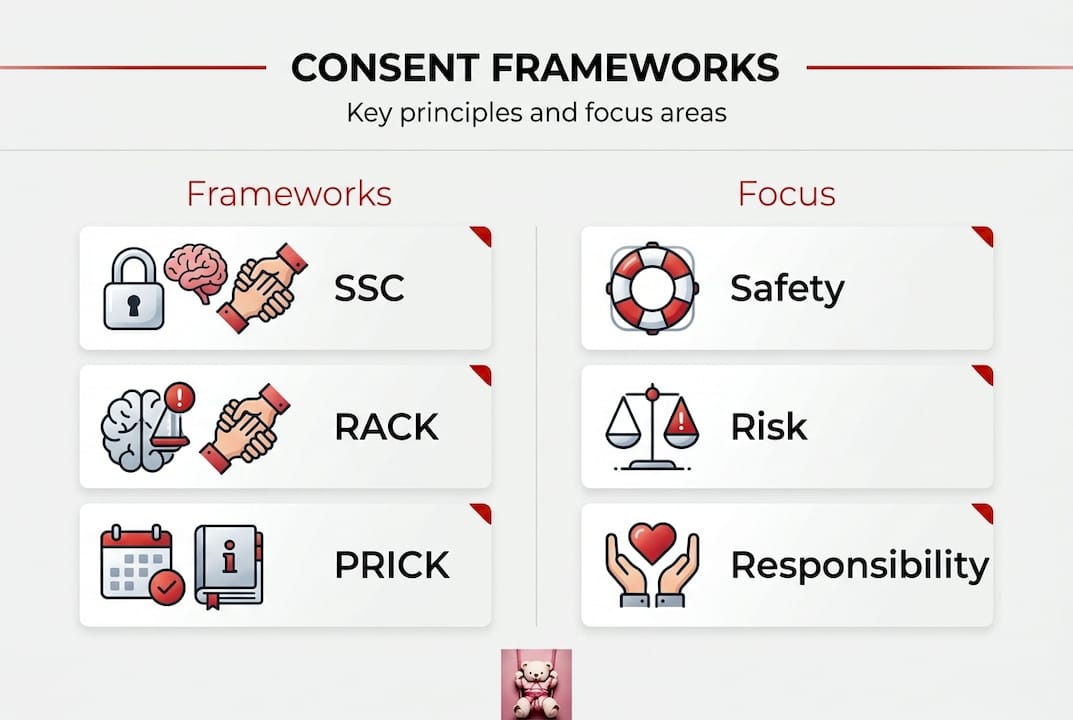
SSC is the oldest and most widely recognized. It says that all kink should be safe, sane, and consensual. Clean, simple, easy to remember. The problem? "Safe" is subjective. Breath play is never truly safe, but plenty of experienced practitioners do it. SSC can create a false sense that risk can always be eliminated.
RACK was developed partly in response to that limitation. It acknowledges that risk-aware consensual kink involves real, sometimes unavoidable risk. The emphasis shifts to awareness and informed consent rather than a promise of safety that can't always be kept. RACK is more honest, some would argue.
PRICK goes further by centering personal responsibility. It says that each individual is accountable for their own choices, their own research, and their own risk assessment. It's the most autonomy-focused framework and appeals to people who resist the idea that communities should police what consenting adults do together.
4Cs adds an emotional and relational layer. Caring, communication, consent, and caution together suggest that kink isn't just about rules but about the quality of connection and ongoing dialogue between partners.
Here's how to think about choosing a framework for your own scenes:
- Identify your risk tolerance. If you're new, SSC's emphasis on safety is a good starting point. If you're exploring more intense activities, RACK's honesty about risk is more realistic.
- Talk to your partner about which framework resonates. This conversation itself is part of negotiation.
- Understand that frameworks are guides, not guarantees. No acronym replaces actual communication.
- Revisit your framework as your practice evolves. What worked at the beginning of your exploration might not fit a year in.
Pro Tip: Don't pick a framework because it sounds cool or because your community uses it. Pick one that actually reflects how you think about risk, consent, and responsibility. Then explain it to your partner in plain language, not just the acronym.
The risk and consent in kink conversation is ongoing in communities everywhere. These frameworks are living documents, not commandments.
Common behaviors, prevalence, and safety realities
Here's something that might surprise you: rough sex and kink-adjacent behaviors are far more common than most people admit out loud. Research published in a peer-reviewed journal found population-level prevalence data for ten specific rough sex behaviors among U.S. adults, with breakdowns across men, women, and transgender and gender nonbinary participants.
The numbers are striking. 60.8% of men, 47.8% of women, and 67.3% of TGNB participants reported engaging in at least one rough sex behavior with a partner. That's not a fringe activity. That's a majority of people across multiple demographics.
Common behaviors reported in the study included:
- Hair pulling
- Spanking or slapping
- Choking or breath restriction
- Biting
- Scratching
- Restraint using hands or objects
- Name-calling or verbal degradation
- Slapping the face
- Rough penetration
- Using objects to cause sensation or pain
What the data also shows is that consent status varied significantly across these behaviors. Some acts were consistently reported as fully consensual and desired. Others showed higher rates of non-consent or ambiguity, particularly choking, which has become a major safety concern in both clinical and community discussions.
The BDSM and kink safety conversation has to include this data because it changes how we think about "common" versus "safe." Just because something is prevalent doesn't mean it's being done safely or consensually. Popularity is not a proxy for best practice.
This is where scene-specific safety planning becomes critical. A few things to build into your practice:
- Negotiate explicitly before the scene, not during. In-the-moment negotiations are less reliable because arousal affects judgment.
- Discuss medical history and physical limitations. Choking, for example, carries different risks for someone with a history of neck injury or cardiovascular issues.
- Establish check-ins for longer or more intense scenes. A simple "color?" (expecting red, yellow, or green) keeps communication open without breaking immersion.
- Plan aftercare before you start. Know what your partner needs to come down from the scene. Some people need physical touch. Others need space. Ask in advance.
The data on prevalence is useful because it normalizes the conversation. But normalization without safety education is just permission to repeat mistakes at scale. Know the numbers, and then go deeper than the numbers.
Building safer spaces: Community, resources, and ongoing education
Knowing terms and frameworks is one thing. Being part of a community that practices them consistently is something else entirely. The good news is that kink communities, at their best, are genuinely structured around safety, consent, and education in ways that mainstream sexual culture often isn't.
Research supports what many practitioners already know from experience: kink communities provide structures for safety, consent, and communication that include events, workshops, mentorship, and peer accountability. This isn't accidental. It developed because kink practitioners had to build their own safety infrastructure when mainstream institutions wouldn't.
Ways that communities actively foster safer practice:
- Munches: Low-key social gatherings, usually at a restaurant or cafe, where kinksters meet in a vanilla setting. Great for newcomers because there's no pressure and no play.
- Workshops and demos: Hands-on or observational sessions covering everything from rope bondage technique to negotiation skills to aftercare practices.
- Dungeon monitors (DMs): Experienced community members who supervise play spaces at events, intervening if consent appears to be violated.
- Mentorship relationships: Pairing newer practitioners with experienced ones for guidance, not play necessarily, but education and accountability.
- Online forums and groups: Spaces like FetLife, Reddit communities, and platforms built specifically for kink education where people share resources, ask questions, and process experiences.
The kink educational resources available today are more accessible than ever. You don't have to show up to a dungeon to start learning. But in-person community has something online spaces can't fully replicate: real-time feedback, body language, and the kind of attunement that only comes from being in the room with someone.
Pro Tip: When evaluating whether a workshop, event, or educator is genuinely educational versus just an opportunity for predatory behavior, look for a few things. Do they have clear consent policies posted? Is there a designated person to report concerns to? Do they encourage questions without pressure? Legitimate educational spaces welcome scrutiny. They don't deflect it.
The community piece matters because kink doesn't happen in a vacuum. It happens between people, and people need support structures, accountability, and ongoing learning to do it well.
What most guides miss: Real-life nuance and negotiation
Most kink guides give you the acronyms and call it a day. Learn SSC, practice RACK, use a safeword. Done. Except it's not done, and that's the part nobody wants to say out loud.
The terminology and frameworks in kink spaces are designed to support informed consent and risk communication, but there is meaningful nuance and real disagreement about what each slogan implies in practice. I've watched people hide behind "we negotiated" as a shield when the negotiation was rushed, one-sided, or conducted under social pressure. Knowing the right words is not the same as using them honestly.
Real negotiation is messy. It involves saying "I don't know if I want that" and sitting with the discomfort of uncertainty. It involves checking in after a scene and being willing to hear that something didn't land the way you intended. It involves changing your mind, revisiting limits, and sometimes walking away from a dynamic that looked good on paper but felt wrong in practice.
The most experienced practitioners I know don't lead with their framework. They lead with curiosity and honesty. The acronym comes later, as a shorthand for a much longer conversation they've already had.
Explore more: Connect, learn, and grow with your kinky community
You've got the foundation now. The terms, the frameworks, the data, the community structures. That's more than most people bring to their first real conversation about kink. But knowledge without application is just trivia.

The next step is finding a space where you can keep learning, connect with others who take consent and safety seriously, and explore at your own pace. At explore Kinky Korner, you'll find a marketplace where adults can list services, discover erotic literary and artistic content, and connect with a community that gets it. Whether you're just starting out or looking to go deeper, there's a place for you here. Come curious. Come honest. Come ready to learn.
Frequently asked questions
What does SSC mean in a kink context?
SSC stands for Safe, Sane, Consensual, a framework guiding ethical kink play by emphasizing mutual consent and safety as non-negotiable conditions for any scene.
What is the difference between RACK and PRICK?
RACK emphasizes risk awareness in consensual kink by acknowledging that some activities carry unavoidable risk, while PRICK centers personal responsibility and informed decision-making as the foundation of ethical play.
How common are 'rough sex' behaviors among adults?
In a U.S. survey, 60.8% of men, 47.8% of women, and 67.3% of transgender and gender nonbinary participants reported engaging in at least one rough sex behavior with a partner.
Are kink communities safer than mainstream environments?
Many practitioners report greater safety and consent structures in kink communities, with events and educational resources built specifically to support informed, consensual practice.
Where can I learn more about kink-friendly terms and safety?
Reputable community sites, local munches, workshops, and online networks are your best starting points for connecting with experienced practitioners and building a solid foundation in kink education.