

Online escorting is the practice of arranging companionship or adult services through internet platforms, ranging from fully virtual interactions to in-person meetings that begin with an online connection. The escort industry generated $149 billion in 2025, with an average session costing $300. That scale tells you this is not a fringe market. It's a structured, evolving industry shaped by technology, regulation, and real human need. This guide breaks down what online escorting actually looks like in 2026, including its models, how clients engage, the legal frameworks that govern it, and the safety practices that keep everyone involved protected.
What is online escorting, and what are its main models?
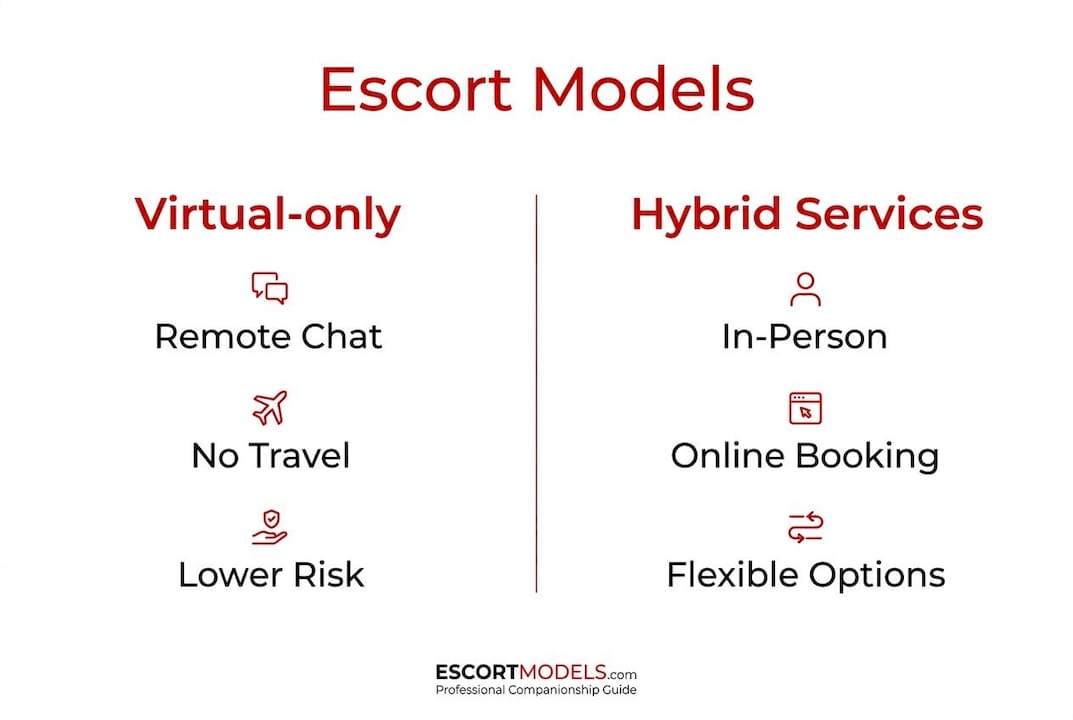
Online escorting covers two distinct service structures. The first is fully virtual: providers offer companionship through chat, voice calls, or video sessions without any physical meeting. The second is the hybrid model, where the internet acts as the front desk and the actual service happens in person. Both models operate under different pricing norms, safety expectations, and client dynamics.

Virtual-only services have grown sharply because they remove geographic barriers and reduce physical risk for providers. A client in Chicago can book a video companionship session with a provider based anywhere. Pricing for virtual sessions typically runs lower than in-person rates, though premium providers charge comparable rates for exclusivity and personalization.
Hybrid models are more complex. The online phase handles discovery, screening, and booking. Encrypted messaging apps and profile-based platforms serve as the primary communication channels before any physical meeting is confirmed. This structure gives providers more control over client vetting before committing to an in-person arrangement.
Here is how the two models compare across key dimensions:
- Virtual-only: No physical meeting, lower overhead, broader geographic reach, easier to scale
- Hybrid: Online booking with in-person follow-through, higher earning potential, requires stronger safety protocols
- Client expectations: Virtual clients often seek emotional connection or entertainment; hybrid clients typically want a more complete companionship experience
- Pricing: Virtual sessions average lower than hybrid or in-person rates, though niche virtual services can command premium pricing
Pro Tip: If you are a provider new to the industry, starting with virtual-only services lets you build a client base and refine your screening process before moving into hybrid arrangements.
How do clients find and engage with online escorts?
Client discovery follows a clear pattern. 45% of clients find escorts through websites or apps, 35% through word of mouth, and 20% via social media. Online platforms dominate because they offer privacy, search filters, and the ability to review profiles before making contact.
A provider's online profile functions as a digital storefront. Photos, written bios, listed rates, and availability windows all shape a client's first impression. Profiles on well-maintained platforms also include verified reviews, which carry significant weight in a market where trust is everything.
Payment behavior reflects the industry's tension between discretion and convenience. 70% of transactions remain cash-based for privacy reasons, though app-based bookings grow at 22% annually. That growth signals a generational shift: younger clients prefer digital payment trails they can manage discreetly through fintech apps rather than ATM withdrawals.
Safety features built into reputable platforms include:
- Age verification: Mandatory on compliant platforms to meet regulatory standards
- Encrypted messaging: Protects both client and provider communication from third-party access
- Profile screening: Some platforms require ID verification before a provider can list services
- Review systems: Mutual feedback builds accountability and filters out bad actors on both sides
70% of clients hire escorts primarily for companionship rather than explicit services. That statistic reframes the common assumption about what clients actually want. Emotional connection, social presence, and conversation are the primary drivers for the majority of bookings.
Pro Tip: Clients who safely navigate erotic platforms by reading profiles carefully and using verified platforms report significantly better experiences than those who rely on unvetted listings.
What legal and regulatory frameworks affect online escorting?
The legal environment for online escorting is fragmented by jurisdiction and evolving fast. Three frameworks define the current landscape for providers and platforms operating in 2026.
FOSTA-SESTA, passed in the U.S. in 2018, holds online platforms criminally liable if they knowingly facilitate sex trafficking. The practical effect has been significant: platforms that host escort listings must implement content moderation, age verification, and reporting mechanisms or face federal prosecution. Many platforms exited the U.S. market entirely rather than absorb that compliance cost.
In the UK, Ofcom's Online Safety Act 2023 applies to escort websites under a broad definition of "online service provider." Even small operators must meet compliance standards that include Child Risk Assessments and Illegal Content Assessments. Regulators interpret this definition broadly, meaning even a solo provider with a personal website can fall under its scope.
"Regulators like Ofcom interpret 'online service provider' broadly, meaning even small escort providers must meet enterprise-level compliance standards. Non-compliance carries fines up to £18 million for UK-based escort agencies, a figure that has forced rapid professionalization across the industry."
Payment processing adds another layer of complexity. Non-compliance with Merchant Category Code rules enforced by major card networks can result in account termination and processor fines. Escort and dating merchants are classified under MCC 7273, which carries heightened scrutiny. Providers who accept card payments must work with processors that specialize in high-risk merchant accounts.
Key compliance requirements for platforms and providers include:
- Age verification systems that meet the technical standards set by Ofcom and equivalent bodies
- Content moderation policies documented and actively enforced
- FOSTA-SESTA compliance protocols for any U.S.-accessible platform
- High-risk merchant account setup for card-based payment acceptance
- Child Risk and Illegal Content Assessments for UK-regulated operators
Providers who want to advertise adult services legally in 2026 need to treat compliance as a core business function, not an afterthought.
What safety practices protect providers and clients?
Safety in online escorting is operational, not accidental. Client screening is the single most important practice for provider safety and business longevity. Screening means verifying a client's identity before confirming any booking, whether virtual or in-person.
A practical safety framework for providers looks like this:
- Separate your personal and work identity. Use a dedicated work phone number, a separate email address, and a distinct social media presence for professional activity.
- Screen every client before booking. Request a government-issued ID, a professional reference, or a verifiable social media profile. Decline bookings from clients who refuse to provide any verification.
- Use encrypted communication. Apps with end-to-end encryption protect your conversations from third-party access and reduce exposure if a platform is compromised.
- Maintain a personal website. Diversifying your online presence protects against platform bans and policy changes that can wipe out a provider's entire client pipeline overnight.
- Establish safe-call protocols for in-person meetings. Designate a trusted contact who knows your location and checks in at set intervals during any physical appointment.
- Document your terms clearly. Written terms of service, even informal ones, set expectations and reduce disputes before they escalate.
For clients, safety means using verified platforms, respecting provider boundaries, and understanding that discretion is a two-way obligation. Clients who approach bookings professionally get better service and build the kind of reputation that opens access to higher-quality providers.
Pro Tip: Erotic marketplace risks are significantly lower when both parties use platforms that enforce identity verification and maintain active moderation teams.
Treating escort work as a professional business with diversified revenue streams and clear security protocols is the strategy that supports long-term success in this industry. That is not just advice. It is the difference between a sustainable career and a precarious one.
Key Takeaways
Online escorting is a structured, technology-driven industry that requires clear model selection, regulatory compliance, and active safety practices to operate successfully in 2026.
| Point | Details |
|---|---|
| Two core models exist | Virtual-only and hybrid escorting serve different client needs and carry different safety requirements. |
| Clients discover providers online | 45% of clients use websites or apps, making a strong digital profile the most important business asset. |
| Cash still dominates payments | 70% of transactions are cash-based, though app bookings grow 22% annually as digital preference rises. |
| Regulation is non-negotiable | FOSTA-SESTA in the U.S. and Ofcom's Online Safety Act 2023 in the UK impose real legal obligations on platforms and providers. |
| Safety requires active systems | Client screening, encrypted communication, and a personal website are the foundation of sustainable provider operations. |
The part nobody tells you about online escorting in 2026
Here is what I keep coming back to after watching this industry shift over the past few years. The conversation around online escorting is still stuck in a 2010 frame. People hear the phrase and immediately picture something shady, transactional, and underground. The reality in 2026 is genuinely different, and the gap between perception and reality is where most of the confusion lives.
The professionalization of this space is real. Providers are building personal websites, filing taxes, navigating MCC codes, and running compliance audits. That is not the behavior of people operating in the shadows. That is small business ownership, and it deserves to be called what it is.
What strikes me most is how the hybrid model has changed the power dynamic. When the entire discovery and booking process happens online, providers hold more control than they ever did in street-based or agency-driven models. They choose who they respond to. They set the terms before anyone meets in person. The internet did not just move escorting online. It restructured who has leverage in the transaction.
The regulatory pressure from FOSTA-SESTA and Ofcom is real and sometimes brutal in its effects. Platforms have shut down. Providers have lost income overnight. But the response from serious operators has been to build more resilient businesses, not to disappear. Personal websites, encrypted channels, diversified income streams. The industry is adapting, and the people who treat it like a profession are the ones still standing.
The cultural stigma is the last wall. Transparency and education chip away at it slowly. Articles like this one matter because they replace assumption with information. You cannot have an honest conversation about safety, regulation, or rights in this industry if the starting point is shame.
— Prenston
Kinkykorner: your space in the adult services world
Adult services are moving online fast, and finding a safe, well-organized space to list or browse them matters more than ever.
Kinkykorner is a marketplace built for exactly this. Whether you are a provider looking to list your services or a curious adult wanting to read erotic literary content and understand what the industry actually offers, Kinkykorner gives you a structured, privacy-conscious environment to do it. The platform covers adult-themed services, business listings, and original erotic content in one place. If you are ready to explore adult listings with real safety and transparency built in, Kinkykorner is where that starts. Check out the 2026 guide to managing an adult business online for a deeper look at what running a compliant adult service actually involves.
FAQ
What is online escorting exactly?
Online escorting is the practice of arranging companionship or adult services through internet platforms. It includes fully virtual services like video or chat companionship, and hybrid models where online contact leads to in-person meetings.
Is online escorting legal in the United States?
Legality depends on the specific services offered and how they are arranged. FOSTA-SESTA holds platforms liable for facilitating sex trafficking, and individual state laws vary widely on what constitutes legal escort activity.
How do clients typically pay for online escorting services?
70% of escort transactions are cash-based for discretion, though app-based bookings grow at 22% annually as digital payment options become more common.
What do most clients actually want from an escort?
70% of clients hire escorts primarily for companionship rather than explicit services. Emotional connection and social presence are the leading motivations for most bookings.
How do providers stay safe when working online?
Client screening protocols, encrypted communication, and maintaining a personal website are the core safety practices. Separating personal and professional identities is the first and most critical step.