

Adult content legalities are defined as the body of federal, state, and international laws that govern the production, distribution, access control, and record-keeping of sexually explicit material. If you create, sell, or host adult content, these laws apply to you directly. Ignorance is not a defense, and the penalties are real. This adult content legalities guide breaks down what you actually need to know in 2026, from 18 U.S.C. § 2257 record-keeping mandates to age verification technology requirements, so you can operate legally and protect yourself, your performers, and your business.
What federal and state laws govern adult content production?
Adult content law in the United States operates on two levels: federal statutes and a fast-growing body of state laws. Both carry teeth, and both apply to you whether you run a full studio or post solo content from your bedroom.
At the federal level, 18 U.S.C. § 2257 is the cornerstone statute. It requires every producer of sexually explicit content to verify and document the age of every performer before that content is published or distributed. The law covers primary producers, secondary producers, and anyone who republishes explicit material. Violating § 2257 is a federal crime, not a civil matter.

State laws have moved fast. 26 states now have age verification laws effective as of june 2026, requiring platforms with at least 33% sexually explicit content to verify user age before granting access. That threshold matters. Wyoming, for example, sets no minimum content threshold at all, meaning any platform with explicit material must comply. That patchwork of state rules means you cannot assume one standard covers you everywhere.
The constitutional question was settled in 2025. The Supreme Court ruled in Free Speech Coalition v. Paxton that states can require adult content creators to verify user age without violating the First Amendment. Adults have no constitutional right to bypass age verification when accessing legal adult content. That ruling cleared the path for aggressive state enforcement.
Penalties for non-compliance range from civil fines to federal criminal prosecution. Failing § 2257 record-keeping requirements can result in up to five years in federal prison per violation. State-level fines vary but are escalating as enforcement matures.
Pro Tip: Document every compliance step with timestamps. If a federal inspector or state regulator ever audits you, your paper trail is your only defense.
- Maintain performer age records before any content goes live, not after.
- Track which state laws apply to your platform based on your content percentage.
- Consult an adult entertainment attorney if you operate across multiple states.
How do age verification requirements work for adult websites?
Simple age gates are dead. Clicking a checkbox that says "I am 18" no longer satisfies any regulator in 2026. Regulators now demand commercially reasonable, highly effective age assurance technologies that actually work.
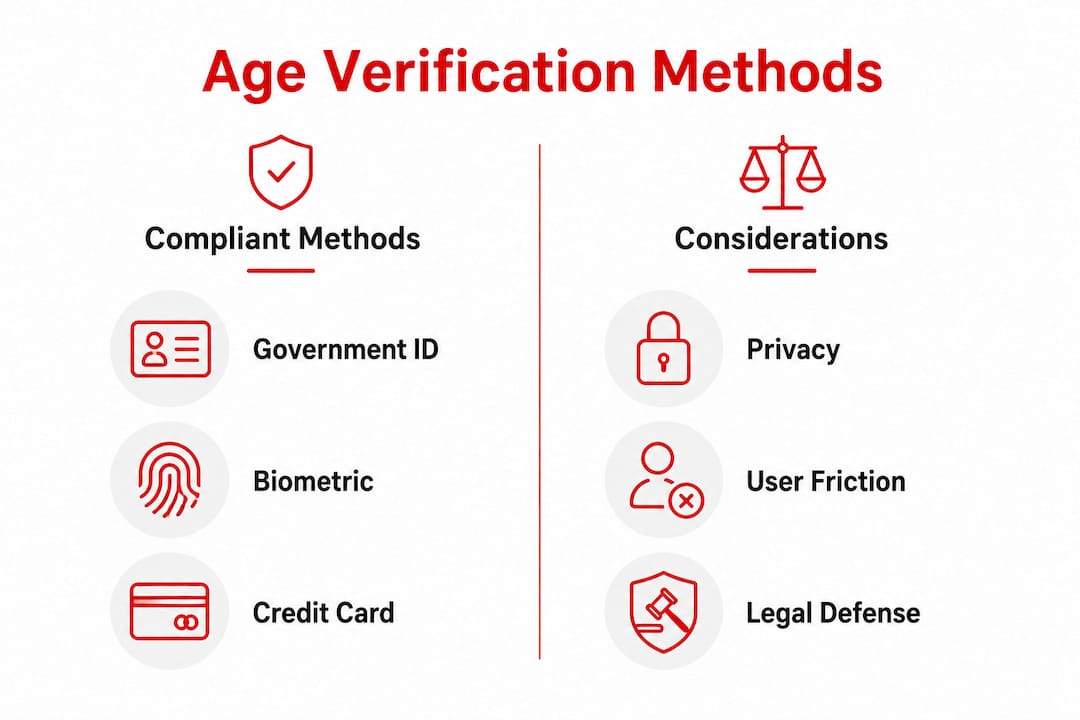
The compliant methods fall into four main categories. Government ID checks require users to upload a photo ID, which a third-party service validates. Digital ID verification uses state-issued digital credentials. Facial age estimation uses biometric analysis to estimate age from a selfie. Financial transactional verification confirms age through credit card or bank account ownership, since financial accounts require age verification at opening.
Each method carries trade-offs. Government ID checks are the most legally defensible but create privacy friction for users. Facial age estimation is faster but faces scrutiny over accuracy and data storage. Financial verification is low-friction but does not work for users without bank accounts. The right choice depends on your audience, your content threshold, and which states you serve.
Internationally, the bar is even higher. The UK's Online Safety Act gives Ofcom authority to fine up to £18 million or 10% of worldwide revenue for non-compliance. Australia's new laws, effective march 2026, carry similar severity. The EU's Digital Services Act adds another compliance layer for platforms serving European users. If your platform has any international traffic, you need to know which jurisdictions apply.
Pro Tip: Choose an age verification provider that stores minimal user data and publishes a clear privacy policy. Regulators care about how you handle verification data, not just whether you collect it.
| Verification method | Legal defensibility | User friction | Data privacy risk |
|---|---|---|---|
| Government ID check | High | High | Medium |
| Digital ID | High | Medium | Low |
| Facial age estimation | Medium | Low | High |
| Financial verification | Medium | Low | Low |
What are the record-keeping responsibilities for adult content creators?
Record-keeping under 18 U.S.C. § 2257 is not optional, and it applies to solo creators just as much as it applies to major studios. Solo adult content creators must maintain age verification records of themselves, including their own government-issued photo ID, cross-referenced with every piece of content they produce. That surprises a lot of independent creators who assumed the law only targeted large operations.
The records you must keep include government-issued photo IDs for every performer, a cross-referenced index linking each performer to every piece of content they appear in, and any aliases or stage names used. Under § 2257 retention rules, you must keep these records for at least seven years after production, or five years after you cease producing content entirely.
The Custodian of Records is a legally designated individual responsible for maintaining these documents and making them available for inspection under 28 CFR 75.5. Every production operation must designate one. For solo creators, that person is you. For studios, it must be a named individual with a physical address listed in every piece of content's compliance statement. Failing to designate a Custodian of Records is one of the most common compliance failures in the industry.
Payment processors enforce this independently of the law. Mastercard's AN 5196 mandates documented proof of age and consent for every piece of monetized adult content. Failure to comply risks losing payment processing entirely, which effectively kills your revenue stream. The financial system enforces compliance even when federal inspectors are not knocking. For more on managing these obligations as a business, the adult business management guide at Kinkykorner covers enforcement dynamics in detail.
- Collect a government-issued photo ID from every performer before shooting begins.
- Create a content index linking each performer's legal name and ID to every piece of content they appear in.
- Designate a Custodian of Records with a physical address and list that address in your compliance statement.
- Store records securely for a minimum of seven years post-production.
- Review your records annually to confirm they remain complete and accessible.
Pro Tip: Use encrypted cloud storage with access logs for your compliance records. If your records are ever subpoenaed, access logs prove you maintained them properly.
What legal issues arise from AI-generated adult content?
AI-generated adult content sits in a legal gray zone that is shrinking fast. The core rule is absolute: AI-generated sexual imagery that depicts or implies a minor is a federal crime under the PROTECT Act and the 2025 ENFORCE Act, with no exceptions. It does not matter that no real child was involved. The law targets the imagery itself.
The "barely legal" aesthetic is a legal trap. If an AI-generated character looks underage, even if you label them as an adult, you face federal criminal exposure. Prosecutors do not need to prove the character was intended to be a minor. They only need to show the imagery implies it. That is a low bar, and courts have upheld it.
Real person likenesses create a separate problem. Using AI to generate sexual content featuring a real person's face or likeness without their explicit consent violates multiple laws, including right of publicity statutes, defamation law, and in some states, specific deepfake legislation. The 2025 ENFORCE Act added federal criminal penalties for non-consensual intimate imagery, including AI-generated versions.
Purely synthetic AI content without any real person's likeness may fall outside § 2257 compliance requirements, since no actual performer exists to verify. That does not mean it is risk-free. It means the legal risk shifts from record-keeping violations to content-based criminal liability. The legal cautions around AI performers are evolving rapidly, and staying current is non-negotiable.
- Never generate AI content featuring characters that could be interpreted as under 18.
- Do not use real people's likenesses in AI-generated sexual content without written consent.
- Consult legal counsel before publishing any AI-generated explicit content commercially.
- Monitor federal and state AI legislation, which is updating faster than most creators realize.
Key Takeaways
Compliance with adult content laws in 2026 requires documented age verification, a designated Custodian of Records, and strict avoidance of AI-generated content that implies minors or uses real likenesses without consent.
| Point | Details |
|---|---|
| Federal law is non-negotiable | 18 U.S.C. § 2257 applies to every producer, including solo creators posting independent content. |
| 26 states now mandate age verification | Platforms with 33% or more explicit content must verify user age; some states set no threshold at all. |
| Age gates are legally insufficient | Regulators require government ID checks, digital IDs, biometric tools, or financial verification. |
| Records must be kept for seven years | Retain performer IDs and content indexes for at least seven years post-production under federal law. |
| AI content carries criminal risk | Generating sexual imagery that implies a minor is a federal crime regardless of whether a real child was involved. |
My take on navigating adult content law in 2026
The regulatory environment shifted harder in 2025 than most creators expected. Free Speech Coalition v. Paxton was the moment a lot of people realized the legal ground had moved permanently under their feet.
Here is what I have seen trip people up repeatedly: they treat compliance as a one-time setup rather than an ongoing practice. You get your records in order, designate your Custodian, and then forget about it for two years while state laws multiply and payment processors tighten their rules. That gap is where careers end.
The privacy tension is real and uncomfortable. Age verification that actually works requires collecting sensitive user data. Users push back. Platforms resist. But the law does not care about friction. The Supreme Court made that clear. Your job is to find verification methods that satisfy regulators while minimizing data exposure, not to avoid the requirement entirely.
AI content is the wildcard nobody has fully figured out yet. The ENFORCE Act moved fast, and enforcement is still catching up. My honest read: the platforms and creators who treat AI-generated content as legally equivalent to real performer content, and document accordingly, will be the ones still operating in three years.
Stay educated. Laws in this space update faster than almost any other industry. What was compliant in january 2025 may not be compliant today.
— Prenston
Kinkykorner: resources for adult content creators
Kinkykorner is built for creators and businesses who take their work seriously, and that includes the legal side of it.

Whether you are listing adult-themed services, publishing erotic literary content, or building a business in the adult space, Kinkykorner gives you a platform that understands what you actually need. The Kinkykorner marketplace connects creators with audiences while giving you access to guides, tools, and community knowledge that help you stay on the right side of the law. From age verification best practices to managing your compliance records, the resources on Kinkykorner are written for people who are serious about doing this right. Visit Kinkykorner and see what a platform built for the adult industry actually looks like.
FAQ
What is 18 U.S.C. § 2257 and who does it apply to?
18 U.S.C. § 2257 is a federal law requiring all producers of sexually explicit content to verify and document performer ages before publishing. It applies to studios, independent creators, and solo performers equally.
Is adult content legal in the United States?
Adult content is legal in the United States when produced and distributed in compliance with federal and state laws, including age verification and record-keeping requirements. The Supreme Court confirmed in Free Speech Coalition v. Paxton (2025) that states can mandate age verification without violating the First Amendment.
How long must I keep performer age verification records?
Federal law requires you to retain performer age verification records for at least seven years after production, or five years after you stop producing content entirely.
Are AI-generated explicit images subject to the same laws?
AI-generated content that depicts or implies a minor is a federal crime under the PROTECT Act and 2025 ENFORCE Act, regardless of whether a real child was involved. Purely synthetic content without real likenesses may fall outside § 2257 but still carries significant criminal risk.
What happens if I fail to comply with age verification laws?
Non-compliance can result in federal criminal prosecution, civil fines, and loss of payment processing. State-level penalties vary, and international violations carry additional fines such as up to 10% of worldwide revenue under the UK's Online Safety Act.