

Erotic art submission means preparing compliant, high-quality assets and required proofs, then uploading them to an adult marketplace built to actually support NSFW listings. It's not gallery curation, it's not a juried competition, and it's not a coy euphemism for something else. It's the practical, unglamorous work of getting your art or writing in front of paying buyers without tripping a moderation bot.
The single action that saves you the most grief: run a compliance check before you upload anything.
- Age verification and consent documentation on hand
- Clean files with no watermarks, no stolen characters, no text overlays
- A title and description that say exactly what the piece is
Get those three right, and you'll clear most first-pass rejections before they happen.
Key Takeaways
Compliant erotic art submission depends on age verification, ownership proof, watermark-free files, and literal metadata that matches the content exactly.
| Point | Details |
|---|---|
| Documentation comes first | Gather age verification and ownership proof before preparing any files for upload. |
| Files must be clean | Remove watermarks and text overlays, and avoid copyrighted characters entirely. |
| Titles should be literal | Use a who/what/format structure instead of coded or vague language. |
| Read it like a moderator | Reread your listing text for anything that could resemble an illegal offer before publishing. |
| Kinkykorner supports NSFW listings | Kinkykorner offers adult-aware moderation, dedicated discovery, and free and paid listing tiers for creators. |
Table of Contents
- What You Need Before You Attempt Any Erotic Art Submission
- Getting Your Files Ready for Automated Review
- How Should You Title and Tag an Erotic Art Submission?
- Why Do Listings Get Removed, and How Do You Appeal?
- Turning One Listing Into a Real Revenue Stream
- What Kinkykorner's Moderation Team Actually Flags
- What the Conventional Advice Gets Wrong
- Ready to List Your Work on Kinkykorner?
- Frequently Asked Questions
- Sources
What You Need Before You Attempt Any Erotic Art Submission
Marketplaces reject listings fast when creators skip the paperwork. Age verification usually means a government ID check confirming you're 18 or older, plus, for depicted subjects, some form of date-of-birth or model release documentation. This isn't bureaucratic theater. It's the difference between a legitimate business and a legal liability, and platforms treat it that way.
Ownership matters just as much. You need proof you created the piece, or a license permitting you to sell it, along with a clear plan for how you'll deliver the file to a buyer (instant download, email, cloud link). KinkyKorner's listing guide stresses that mismatched ownership claims and vague deliverability terms are among the fastest ways to get flagged.
Do not submit if any of the following apply:
- You can't document that every person depicted is 18 or older
- You don't have documented consent from a real subject who appears in the work
- Any element (character design, reference photo, base image) was used without a license
Pro Tip: Keep a dated folder for every submission with your ID verification, consent forms, and original source files. When a platform asks for proof, minutes matter more than you'd think.
Getting Your Files Ready for Automated Review
Automated review systems scan for specific, predictable signals, and most rejections come down to a handful of fixable mistakes. High-resolution files (aim for at least 2000 pixels on the longer edge) read as professional; anything visibly upscaled from a low-quality source reads as a scam attempt, even when it isn't one. Reverie's image guidelines list low-quality images, visible watermarks, text overlays, copyrighted characters, and mismatched contexts as automatic rejection triggers, while confirming illustration styles are welcome when the rest of the file is clean.
Here's what that means in practice:
- Strip watermarks and signature overlays before you upload the final asset (keep a separate signed version for your own portfolio)
- Skip any character pulled from an existing franchise unless you have explicit licensing
- Match the image style to what your description promises. A "digital painting" tagged as a "photo set" gets flagged for context mismatch
AI-generated work carries its own rules. Disclose that a piece is AI-assisted where the platform requires it, and prompt explicitly for adult-only subject descriptors rather than leaving age ambiguous. According to Picasso IA's guide to selling adult AI art, outputs that get upscaled and cleaned up after generation convert noticeably better than raw, unedited renders. Save your prompt history and generation timestamps. If a reviewer ever questions the work, that record is your evidence.
Build one SFW teaser per piece for public discovery, then hold the full NSFW version behind the paywall. It's the standard funnel structure for a reason: buyers need something to click before they'll pay for what's underneath.

How Should You Title and Tag an Erotic Art Submission?
Vague titles get ignored. Coded titles get flagged. The winning formula is boring and literal: who, what, format. Something like "Illustration: 5-Image Fetish Set, Digital Download" tells both the buyer and the reviewer exactly what they're looking at, with zero room for misinterpretation.
Your description should cover four things without exception:
- Exact deliverables (how many images, file type, resolution)
- Delivery timeframe (instant download vs. manual send)
- Content boundaries (what's depicted, what isn't)
- Buyer instructions (how to redeem, contact for support)
Tags and categories deserve the same literal treatment. Pick the category that actually matches your content rather than the one with more foot traffic. Miscategorized listings, say, a fetish illustration tagged under a general art category, get pulled far more often than accurately tagged ones, and KinkyKorner's visibility guide notes that accurate tagging tends to outperform broad, hopeful tagging over time anyway.
Pro Tip: Read your own title and description as if you're the moderator, not the artist. If a phrase could plausibly describe an illegal service instead of a piece of art, rewrite it before you hit publish.
Keep your visual style and your written description in lockstep. Every version of a listing, thumbnail, teaser, and full description, should describe the same product.
Why Do Listings Get Removed, and How Do You Appeal?
Three triggers cause most removals: visible watermarks, keywords that read as offering an illegal service, and media that doesn't match its own metadata. Run this sequence before you ever hit submit:
- Reread your title and description as a moderator would, checking for anything that could pass as coded or illegal
- Confirm the thumbnail, teaser, and full asset all show the same content
- Check every file for leftover watermarks, embedded text, or stray metadata from editing software
- Verify your age and ownership documents are current and attached to the right listing
If a listing gets pulled anyway, the appeal moves faster when you already have your paperwork organized: original files with timestamps, consent documentation, and a copy of the exact listing text as submitted. Scrile's guide to selling adult content legally points out that creators who keep organized records resolve disputes considerably faster than those scrambling to reconstruct proof after the fact. Submit your evidence in the order the reviewer will ask for it: identity first, ownership second, content compliance third.
Turning One Listing Into a Real Revenue Stream
A single upload is a start, not a strategy. The creators who actually make money treat the marketplace listing as the front door, not the whole house.
- Use SFW teasers (cropped previews, line art, silhouettes) to funnel browsers toward paid NSFW sets
- List on a marketplace for discovery, but keep an owned channel (a subscription page, a mailing list) for revenue you don't lose if one platform changes its rules
- Track views versus actual conversions on your tags and thumbnails, then adjust the ones that underperform
- Keep your legal name off public listings; use a consistent alias tied only to your verification documents on the back end
KinkyKorner's strategy guide frames this as diversification: marketplace exposure for new buyers, owned channels for retention. Platforms that enforce real age verification also tend to carry less account risk than general-purpose sites, which matters more the longer you plan to do this work.
What Kinkykorner's Moderation Team Actually Flags
Most rejected listings share the same three problems: a watermark someone forgot to remove, a description that oversells what's actually in the file, or a category that doesn't match the content. None of that is mysterious once you've seen a hundred submissions come through.
A complete profile, an accurate category, and a description that matches the thumbnail will clear review faster than almost anything else a creator can do. The listings that get flagged twice are almost always the ones where the seller tried to be clever with the title instead of specific.
On KinkyKorner, finish your profile before your first submission. Incomplete profiles draw more scrutiny than finished ones, category by category, because reviewers have less context to judge intent.
What the Conventional Advice Gets Wrong
Most guides to erotic art submission treat compliance as an obstacle to route around. That's backwards. The paperwork, the age verification, the literal titling, isn't friction standing between you and sales. It's the actual product differentiation on a marketplace flooded with sloppy, mislabeled listings.
The overrated advice is "just describe it however sells best." Coded language and clever euphemisms don't move more units, they just move your listing into the review queue more often, and every removal resets your visibility to zero.
What deserves more attention than it gets: recordkeeping. Creators treat their prompt histories, consent forms, and ID checks as an afterthought until a listing gets pulled, and then they're rebuilding proof from memory under time pressure. Build the folder before you need it.
If there's one thing to prioritize first, it's this: a boring, accurate, literal listing will outlast a clever one every time. Save the creativity for the art itself.
Ready to List Your Work on Kinkykorner?
Kinkykorner gives creators something most general marketplaces won't: moderation that actually understands adult content instead of nuking anything remotely NSFW on sight. You're not fighting a platform designed for family photo albums, you're listing on one built around kink and fetish content from the ground up, with dedicated discovery for buyers actually looking for what you make.

The free basic tier works fine if you're testing the waters with a handful of pieces. Once you're publishing regularly or running a real catalog, a paid listing tier gets you more visibility and room to build out a full storefront instead of a single scattered post. Either way, the setup is the same: verify your identity, prep your compliant files, write a literal description, and publish.
Start your first listing on Kinkykorner's marketplace and get your work in front of buyers who are already looking for it.
Frequently Asked Questions
Does erotic art submission require professional credentials? No. Marketplaces care about compliance and quality, not formal training. Amateur illustrators and self-taught digital artists submit successfully as long as their files meet resolution standards and their documentation is complete.
Can I submit AI-generated erotic art? Yes, on platforms that allow it, provided you disclose the generation method where required and confirm every subject reads as clearly adult. Upscale and edit raw outputs before uploading, since unedited AI renders tend to convert worse and draw more scrutiny.
How long does moderation review typically take? This varies by platform and submission volume, so check the specific marketplace's stated review window rather than assuming a fixed timeline. Complete documentation and clean files tend to move through review faster than incomplete submissions.
What's the fastest way to get a listing rejected? Mismatched metadata. A description that promises something different from what the actual file shows, or a category that doesn't match the content, triggers manual review almost immediately.
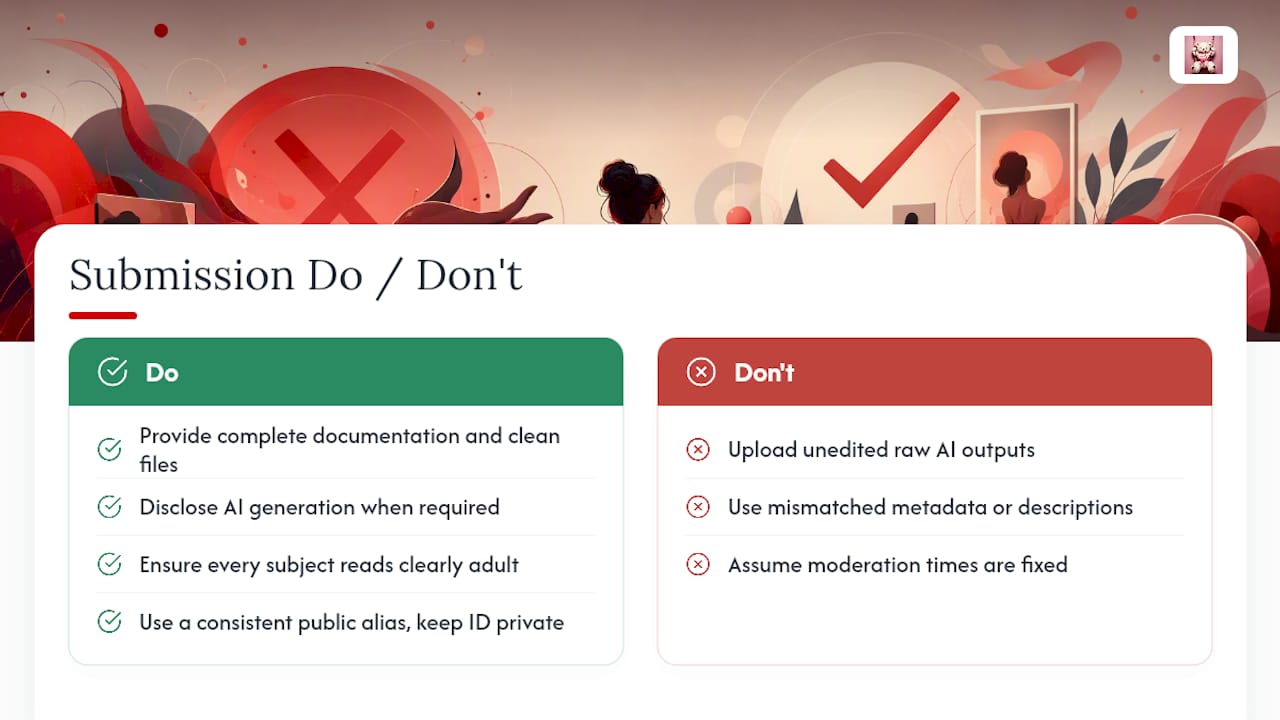
Should I use my real name on an erotic art submission? Most creators use a consistent alias for public listings while keeping verified identity documents on file with the platform. This protects your privacy without compromising the compliance paperwork platforms require.
Sources
- Reverie — Image guidelines for characters
- How to Sell Nudes Online Safely and Legally in 2026
- How to Make Adult AI Art That Sells Online | Blog Picasso IA