

You've got a finished story and no idea where it belongs. Here's the honest breakdown: your five real venue options are publisher imprints, anthology calls for submissions (CFS), niche magazines, curated erotica platforms, and self-publishing. Three moves separate acceptance from a form rejection. Finish your edits so the manuscript is actually clean. Match your story's heat level and kink to a publisher's existing catalog instead of blasting it everywhere. Then send exactly what the guidelines ask for, formatted right, with the metadata that platform requires.
Skip any of that and you're gambling with your own time.
- Polish it. A line-edited manuscript beats a raw one every time.
- Match it. Research the publisher's back catalog before you send anything.
- Send it right. Correct file format, correct subject line, correct age-clarity language.
Pro Tip: Age ambiguity is the fastest way to get bounced. Every character engaged in sexual content needs to be unmistakably an adult, both in the text and in how you describe them in your query.
Key Takeaways
Successful erotic story submission depends on matching a well-edited manuscript to a publisher whose catalog already fits your voice, then following their exact formatting and rights requirements.
| Point | Details |
|---|---|
| Match venue to goal | Pick imprints for editorial polish, anthologies for speed, self-publishing for control. |
| Format before you send | Use standard manuscript format, correct file naming, and hit stated word counts. |
| Read rights language carefully | Confirm exclusivity terms, reversion clauses, and payment model before signing. |
| Verify before you trust | Check a publisher's real catalog and payment history before submitting. |
| List your work publicly | A Kinkykorner listing gives your catalog a permanent, discoverable home alongside traditional credits. |
Table of Contents
- Where Should You Submit an Erotic Story Submission?
- How Do You Format an Erotic Story Submission Package?
- What Does the Actual Submission Process Look Like?
- What Payment and Rights Terms Should You Expect?
- What Are the Red Flags in an Erotic Story Submission?
- Prenston's 8-Step Submission Workflow
- Why Targeted Submissions Beat Mass Submissions
- List Your Work Where Readers Are Already Looking
- Where to Find Current Calls for Submissions
- Sources
Where Should You Submit an Erotic Story Submission?
Every venue type trades something for something else. Publisher imprints and small presses like Deep Desires Press offer editorial polish and a built-in readership, but they're selective and slow. Anthology CFS give you a fast, defined target with a hard deadline. Magazines pay less but publish quickly and build your credit list. Curated platforms split the difference between visibility and payment. Self-publishing hands you full control and full risk.
Publisher imprints and small presses typically ask for exclusive rights during a contract term, pay either a flat fee or royalties in the 25 to 50 percent range on digital sales, and expect a genuinely finished manuscript. They're worth targeting when you want an editor's name behind your work and a readership that already exists. The tradeoff is response time. Some presses take three to six months just to get back to you.
Anthology calls for submissions run on tight windows, usually 30 to 90 days, with a specific theme and word count. Editors like Rachel Kramer Bussel run these regularly with concise, specific guidelines that tell you exactly what she wants and doesn't. This is the most efficient venue type if your story already fits a theme, because the editor has told you upfront what gets accepted.

Magazines and community-run collectives move fast and pay modest, often flat, fees. Threads on Reddit's writing community and listing services aggregate these calls along with payout details, which makes them useful for finding quick, low-stakes credits while you build a track record.
Self-publishing through platforms puts you in full control of pricing, cover art, and timing, but it also puts the compliance burden entirely on you. Short erotica in the 5,000 to 10,000 word range works well here. Pricing it between $0.99 and $1.99, or releasing it free to build an audience, is a common strategy for testing which themes land with readers.
Run every submission decision through this checklist before you send:
- Does the venue's existing catalog already include stories with your voice, heat level, or kink focus?
- What's the actual payment model, and does it match the effort the story took?
- What rights are they asking for, and for how long?
- How fast do they respond, and can you live with that wait?
If you want fast validation and full control, self-publish. If you want an editor's stamp and slower, steadier payment, target imprints and anthologies.
How Do You Format an Erotic Story Submission Package?
Editors reject clean, well-written stories all the time because the package around them is sloppy. Here's what actually needs to happen before you hit send.
- Set your file format. Use .docx or .rtf unless the guidelines explicitly ask for something else. Standard manuscript format means 12-point Times New Roman, double-spaced, one-inch margins, with your last name and page number in the header.
- Build a clean title page. Story title, your name or pen name, word count, and contact information in the top left or centered, depending on the publisher's stated preference.
- Name your file correctly. LastName_StoryTitle.docx is the safest default. Some portals reject submissions outright for missing this.
- Hit the right word count. Flash erotica runs under 1,500 words. Short stories land in the 5,000 to 10,000 word range, which also happens to be the sweet spot for building a catalog fast if you're self-publishing. Novellas start around 20,000 words and open up different payment structures entirely.
- Write your blurb. One to two sentences, present tense, naming the core tension or kink without giving away the ending. Think jacket copy, not summary.
- Write your bio. Twenty-five to fifty words. Name or pen name, genre focus, one credit if you have one, and a link if the publisher allows it.
- Line-edit before you submit. Read it aloud once. Cut every "very," "really," and "just" you don't need. Check consent language is unambiguous and every participant's adult status is clear.
- Get a second set of eyes. A beta reader who reads genre erotica will catch pacing problems and consent ambiguity you've gone blind to.
Pro Tip: Keep a master document with your standard bio, blurb template, and formatted title page. Recycling those saves you twenty minutes per submission and keeps your presentation consistent across every publisher.
What Does the Actual Submission Process Look Like?
A Call for Submissions is a contract disguised as a blog post. Read every line before you write a word of your query, because CFS documents bury mandatory fields inside casual language: word count range, theme requirements, banned content, formatting rules, and the submission deadline. Miss one and you're rejected before an editor reads your prose.
Your query or cover letter needs five things in this order:
- A one-sentence hook that captures tone and premise without spoiling the story.
- Your exact word count.
- Relevant market credits, if you have them (skip this line entirely if you don't).
- A short bio, matching what you'd put on a title page.
- Links to previous work or a portfolio, only if the guidelines invite them.
Submission portals like Duotrope's Submission Manager standardize this process with structured fields for genre, word count, and attachments, which makes discovering active calls with clear payment terms faster than hunting publisher websites one by one. Direct email submissions demand more precision from you. Follow the subject line format exactly as written in the guidelines, usually something like "SUBMISSION: Story Title (Word Count)," and attach files in the requested format only.
Follow-up etiquette is simple: wait until the response window stated in the guidelines has fully passed, then send one polite, brief check-in. Never follow up twice. Never submit the same story to two markets at once unless the guidelines explicitly allow simultaneous submissions.
What Payment and Rights Terms Should You Expect?
Payment models vary more than most new writers expect, and the differences matter. Flat fees are common for anthologies and magazines, often paid on acceptance or on publication. Royalty splits show up mostly in self-publishing and some small-press ebook deals, typically in the 25 to 50 percent range of net or list price. Contributor copies, meaning you get paid in printed books instead of cash, are still common in smaller anthologies. Entry fees exist for some contests and should always raise a flag if the "publisher" is charging you to read your own submission.
Rights language is where writers get burned. Exclusive rights mean the publisher controls where else your story can appear, usually for a set term. Nonexclusive rights let you publish the same story elsewhere immediately. Always ask about reversion clauses, the point at which rights return to you if the publisher goes inactive or the book goes out of print.
- Flat fee: paid once, rights terms vary widely by publisher.
- Royalty split: ongoing payment tied to sales, common on self-publishing platforms and some presses.
- Contributor copies: no cash, but a credit and a print copy.
- Entry fee: a red flag unless it's a well-established, juried contest.
Watch buyout language closely. A total buyout means you're selling all rights permanently for one payment, which can be fine for a flat anthology fee but a bad deal for a novella you could reissue later. If a contract's rights language confuses you, a one-time consult with a literary rights attorney costs far less than losing control of your own work for years.
What Are the Red Flags in an Erotic Story Submission?
Every legitimate publisher lists banned content clearly: no minors, no bestiality, no necrophilia, and explicit adult-age clarity for every character engaged in sexual content. If a call is vague about what's off-limits, that vagueness is itself a warning sign.
Watch for these patterns before you submit anywhere new:
- Opaque or unexplained fees to "read" or "consider" your submission.
- Rights language that's deliberately vague about duration or scope.
- Promises of "massive exposure" with no payment details attached.
- No verifiable back catalog, author list, or online presence you can check.
- Reviews or writer forums mentioning missed or delayed payments.
Verify a publisher the same way you'd vet a landlord: check their actual catalog, search their name plus "payment" or "complaint" in writer communities, and confirm the entity legally exists.
Pro Tip: If a publisher can't point you to three real books or issues they've actually released, treat that as a bigger red flag than any contract clause.
Prenston's 8-Step Submission Workflow
Consistency beats talent when it comes to acceptance rates. This workflow keeps every submission organized and every deadline visible.
- Finalize the manuscript and run your line-edit pass.
- Draft your reusable blurb, bio, and title page template.
- Build a shortlist of five to ten target venues that match your voice.
- Log each submission in a tracking sheet with date sent, response deadline, and rights requested.
- Send the submission exactly per each venue's stated format.
- Note the expected response window and mark a follow-up date.
- Update your log on acceptance, rejection, or timeout, and resubmit elsewhere immediately.
For anthology calls, compress this timeline to match the CFS deadline. For publisher submissions, expect the tracking phase to stretch several months, so your log matters more, not less. A workflow built for managing ongoing content creation applies the same discipline here.
| Point | Details |
|---|---|
| Track every submission | Log send date, deadline, and rights requested for each venue. |
| Match voice to catalog | Target publishers whose existing work resembles yours in tone and heat level. |
| Set a follow-up date | Mark your calendar for the day after the stated response window closes. |
Why Targeted Submissions Beat Mass Submissions
Writers who research a publisher's catalog before submitting land acceptances more often than writers who blast the same story to twenty markets. It's simple math: an editor who already publishes your tone and kink is far more likely to say yes. Keep a submission log, celebrate small acceptances, and don't let one rejection kill your momentum for the next query.
— Prenston
List Your Work Where Readers Are Already Looking
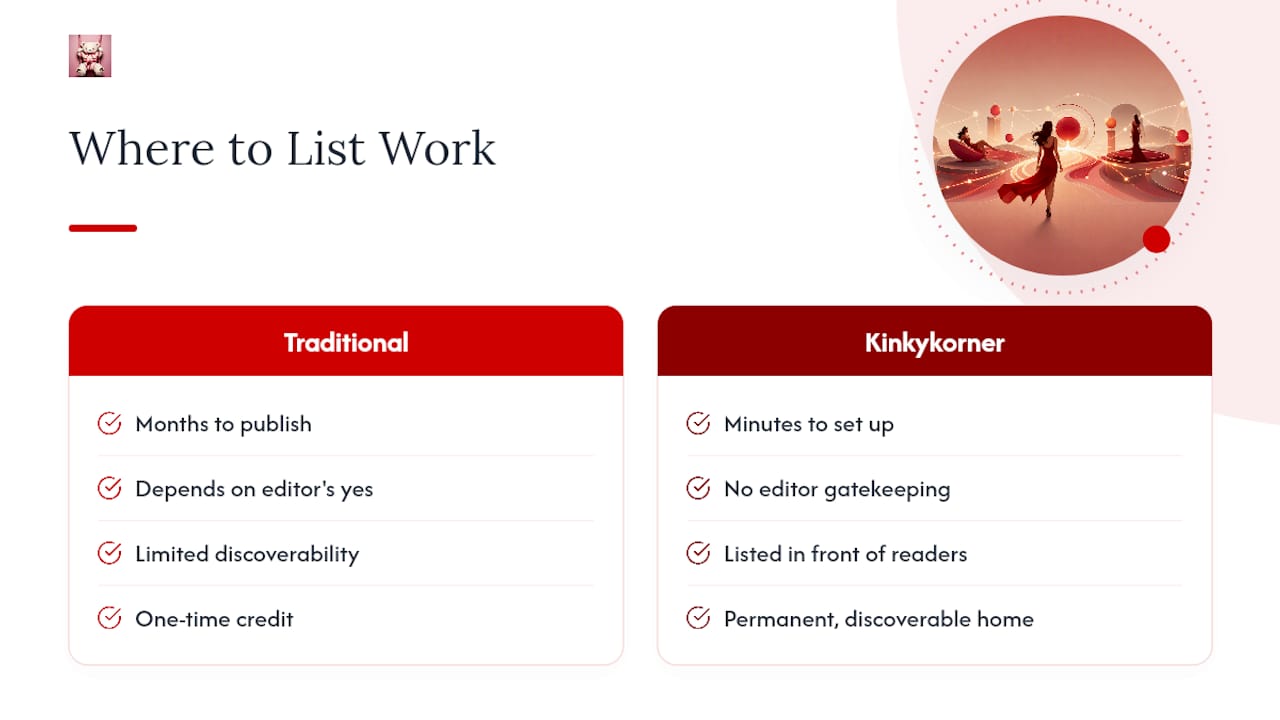
Traditional publishing routes take months and depend entirely on someone else's yes. Kinkykorner works differently: it's a marketplace where you list your erotic writing directly in front of readers actively browsing kink and fetish content, with no editor gatekeeping whether your story gets seen at all.
A listing gives your published or self-published work a permanent, discoverable home alongside your portfolio, so a reader who finds one story can find your whole catalog in the same click. Stories you've placed with a magazine or anthology can point back to your Kinkykorner listing, and your listing can promote the anthology in return, which turns every acceptance into ongoing traffic instead of a one-time credit. If you're building toward a long-term writing career rather than a single sale, that kind of cross-promotion between platforms compounds over time in a way a single magazine credit never will.
Setting up a listing takes minutes: create your profile, upload your portfolio or story links, and set your listing live at Kinkykorner.
Where to Find Current Calls for Submissions
Keep a running list of places that regularly publish open calls, and check them on a schedule rather than only when you have a finished story.
- Rachel Kramer Bussel's submission page for curated anthology calls with clear guidelines.
- Duotrope's Submission Manager for portal-based markets with stated payment terms.
- Writer community threads, including genre-specific subreddits, for community-run calls and payout transparency.
- Marketing guides like how to market erotic fiction for building an audience between submissions.
Sources
- Five Steps To Getting Your Erotica Published – Sugarbutch
- How to Write Erotica That Actually Sells | Maliven
- Erotica anthology call for submissions - Rachel Kramer Bussel