

A sexual fetish is a persistent, focused attraction to a non-sexual object, material, body part, or scenario that plays a central role in an individual's arousal. The American Psychiatric Association defines these as specific, persistent interests not inherently erotic on their own. The fetishist assigns the erotic value. That distinction matters because it separates fetish from general preference, and it's the foundation for everything else in this guide on fetish types explained.
What are the main fetish types explained?
Fetish categories are not random. They cluster around materials, body parts, sensations, objects, and scenarios. Knowing the categories makes it easier to name what you want, talk about it with a partner, and find community without feeling like you're the only one.
Material-based fetishes
Material fetishes center on the texture, smell, or feel of a specific substance. Leather, latex, and rubber are the most recognized examples. The appeal is tactile and often olfactory. The material itself carries the erotic charge, not the person wearing it or the situation around it.
Body part fetishes
Body part fetishes, clinically called partialism, focus sexual interest on a specific part of the body. Feet are the most commonly cited example. Hands, hair, and necks also appear frequently. The attraction is to the part itself, not just as a feature of an attractive person.
Sensation-based fetishes
Olfactory fetishes are a distinct subtype where scent drives arousal. Tactile fetishes involve specific physical sensations like temperature, pressure, or texture. These are less visible than material or body part fetishes, which is why they often go unnamed longer.

Object-based fetishes
Medical fetishism is a clear example here. The attraction extends to clinical environments, equipment, and the power dynamics associated with medical settings. Footwear fetishes, one of the most common object-based types, focus on shoes or boots as the primary erotic object rather than the foot inside them.
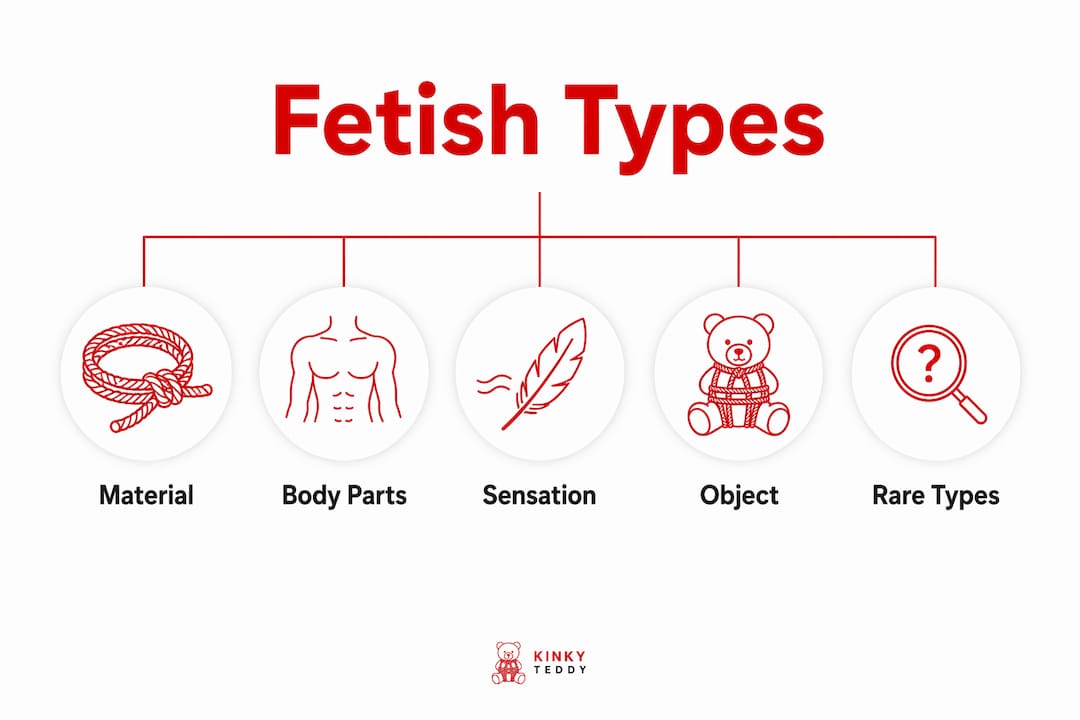
Rare and unusual fetishes
Rare fetishes include mechanophilia (attraction to machines or vehicles), formicophilia (arousal from insects crawling on the body), and vorarephilia (fantasy of being consumed). These illustrate how wide the range of human erotic imagination actually runs. Most are fantasy-based and cause no harm.
| Fetish category | Example | Core driver |
|---|---|---|
| Material-based | Leather, latex, rubber | Texture, smell, feel |
| Body part (partialism) | Feet, hands, hair | Specific anatomy |
| Sensation-based | Olfactory, temperature | Sensory experience |
| Object-based | Footwear, medical gear | Object association |
| Rare or unusual | Mechanophilia, formicophilia | Fantasy or novelty |
- Material fetishes often overlap with sensation fetishes because texture and smell work together.
- Body part fetishes are among the most common and least stigmatized types.
- Object fetishes frequently involve power or role associations tied to the object.
- Rare fetishes are mostly fantasy-based and rarely acted out literally.
Pro Tip: If you recognize yourself in more than one category, that's normal. Fetish interests often layer and combine rather than fitting neatly into one box.
How do fetishes develop psychologically?
Fetishes develop through a complex interplay of biology, memory, and emotional associations tied to sensation and environment. Research links brain patterns connecting emotions and sensations to objects or environments, forming what some researchers call unique desire "maps." These maps are built over time, often starting in early experiences where a sensation, object, or scenario became linked to arousal or intense emotion.
The object itself is neutral. A pair of latex gloves is just latex gloves. The fetishist's personal association is what makes it erotic. This is a key point that gets overlooked: the object carries no inherent erotic charge. It only becomes charged through the individual's psychological projection.
Cultural and personal experience shape which associations form. Someone who grew up around a particular material during a formative emotional moment may find that material appearing in their erotic imagination years later. That's not pathology. That's how human desire works.
"Fetishes are not signs of brokenness. Psychology experts confirm that fetishes are normal, linked to positive emotional states, and only become a clinical concern if they cause genuine distress or harm to the person or others. The stigma around fetishes causes more suffering than the fetishes themselves."
Insight drawn from psychiatric consensus on fetish and paraphilia
Stigma and shame around fetishes arise largely from societal attitudes, not from the fetishes themselves. Once stigma is addressed, fetishists are often psychologically healthier than population averages. That's a finding worth sitting with.
What is the difference between a fetish and a kink?
A fetish is specific and object-focused. A kink is a broader category that covers sexual practices, scenarios, and preferences that fall outside conventional sex. The difference is one of specificity and necessity. A fetish vs kink comparison comes down to this: a fetish is often required for arousal, while a kink is something you enjoy but don't necessarily need.
Here's how that plays out practically:
- Bondage is a kink. It's a practice, a scenario, a dynamic. You can enjoy it without it being the only thing that gets you there.
- Rubber is a fetish. If the material itself is what drives arousal and its absence makes sex feel flat or impossible, that's fetish territory.
- Role play is a kink. It's a context or scenario, not a fixed object or material.
- Feet are a fetish when they are the primary erotic focus, not just a nice bonus.
The distinction matters for communication. Knowing whether you have a kink or a fetish helps you tell a partner what you actually need versus what you'd enjoy. That clarity makes negotiation easier and sex better. For a deeper look at the practice side, the guide on types of kink practices covers the broader territory well.
Pro Tip: Ask yourself: "Can I have satisfying sex without this?" If the answer is consistently no, you're likely describing a fetish. If it's "I'd prefer it but I can work without it," you're probably in kink territory.
How do you safely explore your fetish interests?
Safe exploration starts with self-assessment. Before bringing a fetish into a shared space, get clear on what you want, what your limits are, and what you're actually asking for. Vague requests lead to mismatched experiences.
- Know your own comfort level first. Spend time understanding what specifically appeals to you. Is it the material, the scenario, the power dynamic, or the sensation? The more specific you can be, the easier it is to communicate.
- Find community. Fetish communities exist online and in person. Being around people who share your interests without shame is one of the fastest ways to reduce internalized stigma. Platforms like Kinkykorner exist specifically to support this kind of connection.
- Talk before you play. Consent negotiation is not a buzzkill. It's what makes the experience actually work. Discuss what you want, what's off the table, and what a stop signal looks like.
- Reduce shame through knowledge. A fetish only becomes a clinical issue if it causes distress or harm. If yours doesn't, you don't owe anyone an apology for it.
- Use reliable resources. The guide on real benefits of exploring fetishes is a solid starting point for adults who want to move from curiosity to informed exploration.
The goal is not to perform your fetish for anyone else's approval. The goal is to understand it clearly enough to act on it safely, consensually, and without shame dragging you down every step of the way.
Key takeaways
Fetishes are specific, persistent sexual interests in objects, materials, or body parts, and they are a normal part of human sexuality when practiced with consent and self-awareness.
| Point | Details |
|---|---|
| Fetish definition | A fetish is a focused erotic interest in a non-sexual object, material, or body part assigned erotic value by the individual. |
| Main fetish categories | Categories include material-based, body part, sensation-based, object-based, and rare or unusual fetishes. |
| Fetish vs kink | A fetish is specific and often necessary for arousal; a kink is a broader practice or preference that enhances but doesn't define sex. |
| Psychological origins | Fetishes form through brain associations between sensation, emotion, and memory, not through disorder or dysfunction. |
| Safe exploration | Clear self-knowledge, consent negotiation, and community support are the three pillars of healthy fetish exploration. |
Fetishes deserve better than the shame we pile on them
Here's what I've come to believe after spending real time in these conversations: the shame around fetishes does more damage than the fetishes ever could. People spend years hiding something that is, by clinical consensus, completely normal. They avoid partners, avoid honesty, avoid pleasure, all because they internalized the idea that wanting something specific makes them broken.
It doesn't. Fetishists are generally healthy, and the distress most of them carry comes from stigma, not from the desire itself. That's not a minor footnote. That's the whole story.
What I've seen work, again and again, is knowledge plus community. When you understand why you want what you want, and you find people who get it without flinching, the shame loses its grip. Platforms like Kinkykorner exist for exactly that reason. Not to make fetishes into a spectacle, but to give them a home where they don't have to be a secret.
The most honest thing I can tell you is this: naming your desire clearly is an act of self-respect. It's also the first step toward actually getting what you want.
— Prenston
Kinkykorner: a space built for real exploration

Kinkykorner is a marketplace where adults can list adult-themed services, connect with others who share their interests, and access erotic literary and artistic content without judgment. Whether you're just starting to name what you want or you've known for years and are ready to act on it, the platform is built for people who take their desires seriously.
The Kinkykorner community covers a wide range of fetish interests, from the most common to the rarely discussed. You can browse listings, read content, and find your people without performing for anyone. If you want to understand what a supportive adult space actually looks like, the guide on navigating erotic platforms is worth your time before you dive in.
FAQ
What is a fetish, exactly?
A fetish is a persistent, focused sexual interest in a non-sexual object, material, body part, or scenario. The American Psychiatric Association recognizes these as specific interests where the individual assigns erotic value to something not inherently sexual.
Are fetishes a sign of a mental health problem?
No. Clinical consensus holds that a fetish is only a clinical concern if it causes genuine distress or harm. Most fetishists are psychologically healthy, and stigma causes more distress than the fetish itself.
What are the most common types of fetishes?
The most common fetish categories include material-based fetishes like leather and latex, body part fetishes like feet and hands, and object-based fetishes like footwear. Olfactory and tactile fetishes are also well-documented subtypes.
How is a fetish different from a kink?
A fetish is specific and often necessary for arousal, focused on an object or material. A kink is a broader preference or practice that enhances sex but isn't required for it. Bondage is a kink; rubber as the primary erotic focus is a fetish.
How do I explore a fetish safely?
Start with self-assessment, then communicate clearly with any partner before acting on it. Consent negotiation and community support are the two most effective tools for safe, shame-free fetish exploration.