

Fetish content is defined as specialized digital media created to trigger sexual arousal through specific objects, body parts, or scenarios that are not inherently sexual. It differs from general adult content in one critical way: the stimulus itself is the point. A video of feet, a photo of leather gloves, or an audio recording of a dominant voice are not incidental. They are the entire erotic focus. Understanding fetish content means recognizing that it operates through a distinct psychological mechanism, serves devoted communities, and spans everything from mainstream adult content to deeply niche interests with their own platforms, creators, and cultures.
What is fetish content and how does it differ from kink?
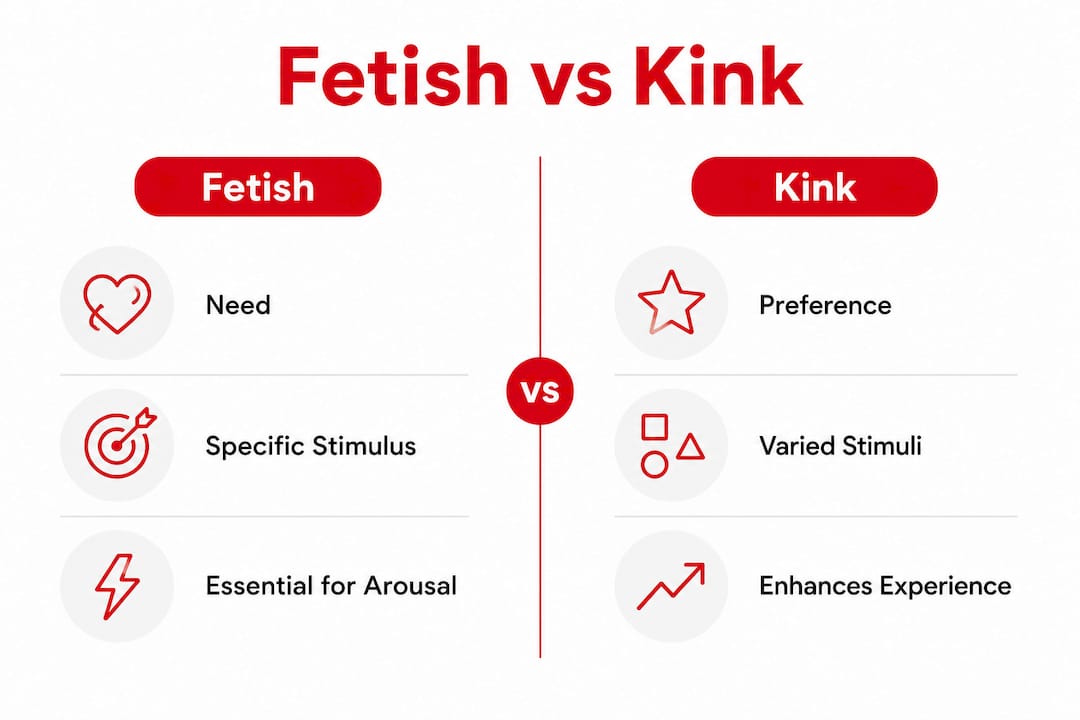
Fetish content and kink content are not the same thing, even though people use the words interchangeably. The difference is functional, not just semantic.
A fetish is a sexual "need" rather than a preference. A person with a foot fetish may find it difficult or impossible to reach arousal without that specific stimulus present. A kink, by contrast, is a preference. Someone who enjoys bondage can still have satisfying sex without it. That gap between "need" and "want" is the line that separates fetish content from general kink material.

General adult content, meanwhile, focuses on conventional sexual acts between people. It does not require a specific object or non-sexual body part to function as the primary erotic trigger. Fetish content is built around that trigger. The act is secondary, or absent entirely.
Pro Tip: If you are trying to figure out whether something qualifies as a fetish or a kink for you personally, ask yourself this: can you reliably reach arousal without it? If the answer is no, you are likely in fetish territory.
| Category | Core function | Arousal dependency |
|---|---|---|
| Fetish content | Specific object, body part, or scenario as primary trigger | High. Often required for arousal |
| Kink content | Preferred activity or dynamic | Optional. Enhances but does not define arousal |
| General adult content | Conventional sexual acts between people | No specific non-sexual stimulus required |
What are the most common types of fetish content?
Fetish content spans a wide spectrum, from categories with millions of followers to niche communities with a few thousand devoted members. The breadth is genuinely surprising.
The most recognized categories include:
- Partialism: Sexual focus on non-genital body parts. Feet are the most documented example. Celebrity foot photo platforms attract over 3 million monthly visitors, which tells you everything about the scale of this category.
- Object fetishism: Arousal tied to specific materials or items. Leather, latex, shoes, and silk are common. The object carries the erotic charge, not the person wearing it.
- Sensory fetishes: Content built around touch, smell, sound, or texture. ASMR-adjacent audio content has created a crossover audience here.
- Power dynamic fetishes: Dominance and submission scenarios where control itself is the stimulus. This overlaps with BDSM but the fetish is specifically the power exchange, not the physical acts.
The emotional drivers behind these categories vary just as much as the content itself. Sensory fetishes often center comfort and grounding, while power dynamic fetishes center control and surrender. That emotional specificity is part of why fetish communities are so loyal. The content speaks to something precise inside the person consuming it.
Fetish businesses and creators have built entire professional models around these categories, with dedicated platforms, subscription tiers, and custom content offerings that serve each niche on its own terms.
How does fetish content creation actually work?
Fetish content creation is not just filming or photographing a specific object. It is behavioral engineering. Creators who succeed in this space understand that they are conditioning arousal responses through repeated pairing of a neutral stimulus with sexual reward.
This mirrors classical conditioning in behavioral psychology. The stimulus, say a specific type of shoe or a particular vocal tone, gets paired consistently with arousal cues. Over time, the stimulus alone triggers the neurochemical response. Skilled creators know this and design their content to reinforce that loop deliberately.
The practical challenges for creators are real:
- Audience specificity: Fetish audiences know exactly what they want. Vague or generic content gets ignored fast.
- Creative sustainability: Over-catering to audience demands risks creative exhaustion. Ignoring those demands kills engagement. The balance is genuinely difficult to maintain.
- Emotional calibration: Different fetish audiences need different emotional tones. A sensory fetish audience may want warmth and intimacy. A power dynamic audience may want cold authority. Getting the tone wrong breaks the conditioning loop.
Pro Tip: If you are creating fetish content professionally, study your audience's comment patterns and repeat requests before you produce anything new. The language they use to describe what they want tells you exactly how to frame your next piece. Check out adult content creation strategies for a deeper breakdown of this approach.
The most effective fetish creators treat their work like a craft. They are not just producing content. They are building a conditioned experience, one piece at a time.
When does a fetish become a clinical disorder?
Most people with fetishes are psychologically healthy. That is not a reassuring platitude. It is the clinical position of the American Psychiatric Association.
The APA classifies fetishistic disorder as a diagnosable condition only when specific criteria are met. Having a fetish does not qualify on its own. The disorder classification requires:
- Intense, recurrent sexual arousal from non-sexual objects or body parts, present for at least 6 months.
- Significant distress or functional impairment in social, occupational, or other important areas of life.
- The arousal is not better explained by another condition.
The key word in that list is distress. A person who enjoys a foot fetish as part of a consensual, satisfying sex life does not meet the criteria. The fetish is integrated, not disruptive. Clinical diagnosis requires that the interest causes real functional harm, not just social awkwardness or embarrassment.
"Experts emphasize that distress related to fetishes is often a result of external stigma rather than the fetish itself." — Out.com
That distinction matters enormously. Shame about a fetish, driven by social judgment, can look like disorder-level distress from the outside. It is not the same thing. Minor fetishistic behavior integrated into consensual sexual activity is a normal part of human sexuality. The clinical line is drawn at impairment, not at the fetish itself.
Key Takeaways
Fetish content is defined by its specific stimulus, its psychological conditioning mechanism, and its clear separation from both general adult content and clinical disorder.
| Point | Details |
|---|---|
| Fetish vs. kink | A fetish is a sexual need; a kink is a preference. The distinction shapes how content is made and consumed. |
| Common categories | Partialism, object fetishism, sensory fetishes, and power dynamics each serve distinct emotional needs. |
| Creation mechanics | Effective fetish content uses classical conditioning to pair a neutral stimulus with arousal, building audience loyalty. |
| Clinical threshold | Fetishistic disorder requires distress and functional impairment for at least 6 months, not just the presence of a fetish. |
| Stigma vs. disorder | Most fetish-related distress comes from social stigma, not the fetish itself. Healthy integration into consensual sex is normal. |
Why fetish content deserves more honest conversation
I have spent enough time around adult content communities to say this plainly: the silence around fetish content does more damage than the content itself. People carry real shame about interests that are, by every clinical measure, completely normal. That shame does not come from the fetish. It comes from the culture around it.
What strikes me most is how precise fetish content is as a form of expression. It is not vague or generic. It is specific to the point of being almost architectural. A creator who understands their audience's fetish is building something that speaks to a very particular wiring inside that person. There is craft in that. There is intimacy in it, too.
The stigma conversation also gets muddled because people conflate "unusual" with "harmful." A foot fetish is unusual by mainstream standards. It is not harmful. A leather fetish is unusual. It is not harmful. The harm framework only applies when consent is absent or when the interest causes genuine impairment. Outside of those conditions, the judgment is cultural, not clinical.
What I think is genuinely worth paying attention to is the creator side of this. The people making fetish content professionally are navigating something most creative industries never have to think about: they are engineering neurochemical responses in their audience. That is a real responsibility. The best creators I have seen take it seriously. They know their audience is not just entertained. They are, in a very real sense, being conditioned. Doing that with care and honesty is what separates good fetish content from exploitative content.
The role of art in adult content is bigger than most people give it credit for. Fetish content, at its best, is a form of that art.
— Prenston
Kinkykorner: where fetish content finds its community
Kinkykorner is a marketplace built for adults who take their erotic interests seriously. Whether you are a creator looking to reach a niche audience or a reader searching for literary and artistic content that actually speaks to your specific interests, Kinkykorner is the place to start.
The platform lists adult-themed services, businesses, and creators across a wide range of fetish categories. You can read erotic literary content, connect with creators who specialize in your interests, and find businesses that serve your community without judgment. Visit Kinkykorner to see what is available and find your corner of the adult content world.
FAQ
What is the definition of fetish content?
Fetish content is specialized digital media designed to trigger sexual arousal through specific objects, body parts, or scenarios that are not inherently sexual. The stimulus itself is the primary erotic focus, not the sexual act.
How is a fetish different from a kink?
A fetish is a sexual need, meaning arousal depends on the specific stimulus. A kink is a preference that enhances sex but is not required for arousal.
What are the most common types of fetish content?
The most common categories include partialism (body parts like feet), object fetishism (leather, shoes, latex), sensory fetishes, and power dynamic fetishes involving dominance and submission.
Is fetish content harmful?
Fetish content is not inherently harmful. The American Psychiatric Association only classifies a fetish as a disorder when it causes significant distress or functional impairment lasting at least 6 months.
How do fetish content creators build loyal audiences?
Effective creators use classical conditioning principles, pairing specific stimuli with arousal cues consistently over time. Audience loyalty builds because the content reliably triggers the precise neurochemical response the viewer is seeking.