

Yes, you can collect payments discreetly and legally in the U.S. right now. Three moves get you there fast: pick an adult-specialist processor or ISO that explicitly supports your content type, set a neutral billing descriptor registered to your legal DBA, and lock in chargeback-alert integrations like Ethoca or Verifi alongside 3D Secure authentication. That's the whole skeleton. Everything else is detail.
"Discreet" here means your customer's card statement won't scream what they bought. It does not mean untraceable. Every transaction must link back to a real, licensed business entity — that's non-negotiable under card-brand rules. Visa's VIRP framework, correct MCC assignment (MCC 5967 for adult content, MCC 7273 for escort/dating services), and PCI DSS compliance are the three pillars holding this up.
Neutral billing descriptors can reduce privacy-driven disputes by an estimated 30–50%, according to industry guides. That's not a small number. A single descriptor tweak can be the difference between a stable processing relationship and a chargeback spiral.
- Pick an adult-specialist processor or ISO before you do anything else
- Register a neutral DBA and configure it as your hard and soft descriptor
- Enable Ethoca/Verifi dispute alerts and 3D Secure from day one
- Get your age-gate, TOS, privacy policy, and refund page live before applying
Pro Tip: Tell your processor exactly what you sell during the application. Processors who specialize in adult accounts expect candor and reward it with faster approvals. Hiding content type is the single fastest way to get terminated later.
Key Takeaways
Adult businesses in the U.S. can collect payments discreetly and legally by combining adult-specialist processors, neutral registered billing descriptors, correct MCC assignment, and documented compliance controls.
| Point | Details |
|---|---|
| Choose the right processor | Use adult-specialist processors (CCBill, SegPay, Epoch) or high-risk ISOs; avoid mainstream aggregators. |
| Set a neutral descriptor | Register a neutral DBA, include contact info, and keep descriptor wording consistent across all recurring charges. |
| Meet compliance requirements | Assign MCC 5967 or 7273 correctly, complete PCI DSS SAQ, and maintain performer consent and age-verification records. |
| Budget for high-risk costs | Expect transaction rates of 3–7%+, rolling reserves of 5–15%, and reserve holds of 90–180 days. |
| Kinkykorner for discovery | List your adult business on Kinkykorner to reach U.S. kink consumers alongside your compliant payment setup. |
Table of Contents
- How to collect payments discreetly without breaking card-brand rules
- Which payment providers actually work for U.S. adult and kink businesses?
- How do you set a discreet billing descriptor that actually works?
- Compliance checklist: MCCs, PCI, Visa VIRP, and recordkeeping
- What do underwriting timelines and fees actually look like?
- Day-to-day operational practices that protect customer privacy
- What you must never do
- When should you bring in a specialist or attorney?
- What running an adult marketplace actually taught me about payments
- Kinkykorner gives adult providers a compliant place to be found
- Sources
How to collect payments discreetly without breaking card-brand rules
The foundational tension here is real: your customers want privacy, but card networks want traceability. You can satisfy both, but only if you understand where the line sits.
Discreet billing is a privacy control, not a concealment strategy. Visa and Mastercard require that descriptors accurately represent the merchant. A neutral name like "COASTAL MEDIA LLC" is fine. "INTERNET CHARGE" is not — it looks fraudulent and triggers disputes. The descriptor must be honest and traceable even when it's low-key.
Visa's updated VIRP guidelines treat MCC coding as a primary enforcement lever. Merchants offering adult content who use a generic retail MCC get flagged as noncompliant — and that escalates them into Tier 1 scrutiny regardless of how clean their chargeback ratio is. The MCC isn't just a category label; it's a compliance signal.
- Discrete ≠ anonymous. Transactions must trace to a legal entity with accurate descriptors.
- MCC assignment drives your risk tier. Wrong MCC means elevated scrutiny, fines, and possible termination.
- Processors expect documentation. Age verification, performer consent records, and fraud screening are underwriting requirements, not optional extras.
- Privacy protections must be honest. Pre-charge notifications and neutral descriptors reduce friendly fraud — but only when they're accurate and traceable.
Industry stat: Adult payment compliance guides consistently note that PCI DSS noncompliance can trigger fines, increased audits, and higher processing fees — costs that compound fast for high-volume merchants.
Which payment providers actually work for U.S. adult and kink businesses?
Mainstream aggregators are a dead end. Stripe and PayPal's acceptable-use policies typically prohibit explicit adult content, and merchants who try to slip through often face sudden account terminations with funds held. A dedicated merchant account placed with a U.S. acquiring bank is the stable path.
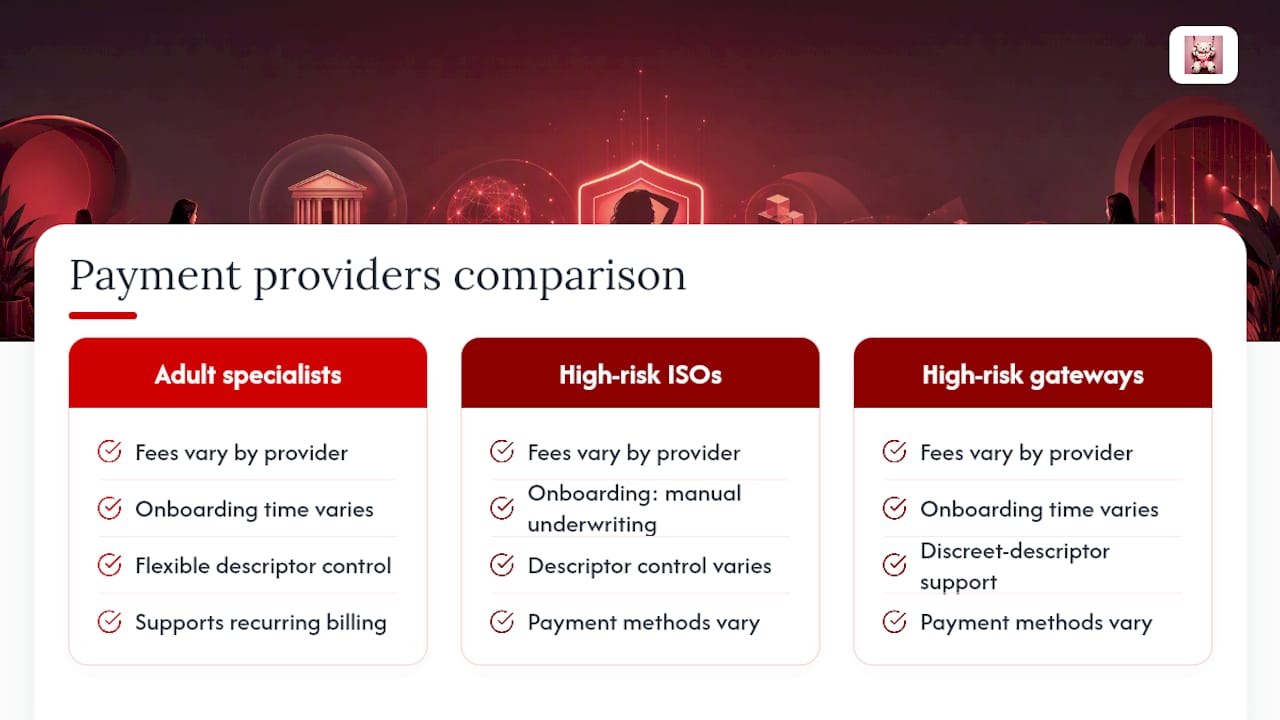
Three realistic categories exist for adult and kink providers:
Adult-specialist processors are platforms built from the ground up for this space. CCBill and SegPay are the most established names, with decades of adult-industry infrastructure, robust recurring billing, and descriptor flexibility. Epoch operates similarly and has long served content subscription models. These processors handle MCC assignment, VIRP registration, and chargeback management as part of their core offering.
High-risk ISOs and merchant account providers like PaymentCloud and Durango Merchant Services place dedicated accounts with U.S. acquiring banks. They offer more flexibility on integration (API vs. hosted checkout) and can sometimes negotiate better reserve terms for established businesses. Underwriting is manual and thorough.
High-risk gateways with discreet-descriptor support sit between the two, offering gateway infrastructure that connects to multiple acquiring banks. The advantage is redundancy; the tradeoff is that you're managing more relationships.
When evaluating any provider, run them through these dimensions: transaction fees and effective cost, onboarding timeline, descriptor control (soft vs. hard), supported payment methods (cards, ACH, recurring subscriptions), chargeback support quality, integration options, and whether they actively help with MCC and VIRP documentation.
How do you set a discreet billing descriptor that actually works?
Two descriptor types matter: the soft descriptor (what appears during pending transactions) and the hard descriptor (what settles on the statement). Both need to match your registered DBA and include a customer-service phone number or short URL.
Choose a neutral but real business name. "COASTAL MEDIA LLC" or "REDWOOD DIGITAL SERVICES" works. Avoid anything suggestive, but also avoid anything generic that looks like a scam charge. The goal is: a cardholder sees it, doesn't immediately know what they bought, but can call the number and confirm it's legitimate.
For subscription billing, the descriptor must stay consistent across every recurring charge. Changing it mid-cycle is a fast track to friendly fraud — customers who don't recognize a new name dispute the charge. Pre-charge notifications sent 3–7 days before each billing date, with the exact descriptor wording included, cut that risk sharply.
- Keep descriptors under 22 characters (the Visa/Mastercard character limit for hard descriptors)
- Include a working phone number or short URL in the descriptor field
- Test how your descriptor displays across at least three major issuing banks before going live
- Configure dynamic descriptors only when your gateway supports and documents them properly
- Make cancellation genuinely easy — a buried cancel flow is a chargeback waiting to happen
Pro Tip: Run a test charge on a personal card at three different banks (Chase, Bank of America, Wells Fargo) before launch. Statement display varies by issuer, and you want to see exactly what your customer sees.
Compliance checklist: MCCs, PCI, Visa VIRP, and recordkeeping
This is the stuff that keeps your account alive long-term. Work through it before you go live, not after your first dispute.
- MCC assignment: Confirm your processor registers you under MCC 5967 (adult content) or MCC 7273 (escort/dating/matchmaking) as appropriate. Miscoding is an enforcement trigger under Visa's VIRP framework.
- PCI DSS scope: Complete the correct SAQ for your integration type, run quarterly scans if required, and never store raw card data. PCI noncompliance carries real financial consequences for adult merchants.
- Performer documentation: Link every performer to their ID and model-release records at the time content is captured. Processors will ask for this during underwriting.
- Age verification: Implement a compliant age gate before checkout and retain verification records. This is both a legal requirement and an underwriting expectation.
- Dispute management: Keep your chargeback ratio under 1%. Enroll in Ethoca and Verifi dispute-alert services to intercept disputes before they formalize.
- Site readiness: Age gate, TOS, privacy policy, and refund/cancellation pages must be live and clearly linked before you apply to any processor.
What do underwriting timelines and fees actually look like?
Honest answer: slower and more expensive than you want, but predictable once you know the ranges.
Adult merchant account underwriting is manual and thorough. Expect a few days to a few weeks depending on your documentation readiness and the processor's queue. Having your site live, your performer records organized, and your business documents ready cuts that timeline significantly.
On fees, adult processing typically runs at a higher rate than standard processing. Rolling reserves are commonly required and held for an extended period depending on your risk profile. Card networks also levy registration fees for high-risk categories, and processors pass those through.
| Fee category | Typical range | Notes |
|---|---|---|
| Transaction rate | 3–7%+ | Higher for content subscriptions |
| Rolling reserve | — | Released after an extended period. |
| Monthly gateway fee | Varies by processor | Ask for written schedule |
| Chargeback fee | — | Varies by acquirer |
| Card-network registration | Passed through | Ask processor for current figures |
Ask every processor for written underwriting criteria, a reserve release schedule, and a complete fee schedule before signing. Any vendor who won't provide those in writing is telling you something important.
Day-to-day operational practices that protect customer privacy
Before purchase: display your billing descriptor and a customer-service contact on the checkout page. Customers who know what will appear on their statement don't dispute it later.

During and after purchase: send a receipt with neutral service language that matches your descriptor exactly. Automated emails should use your DBA name, not your content brand. Store only the PII you actually need — data minimization limits your exposure in a breach and keeps PCI scope manageable.
Ongoing: run monthly descriptor-display checks across sample issuing banks. Integrate age verification before checkout, not as an afterthought. Keep fraud screening active and review your chargeback ratio weekly.
Pro Tip: Build a simple "billing FAQ" page at a neutral URL that matches your descriptor. Link it in your descriptor field and in every receipt. Customers who can self-serve their billing questions almost never file disputes.
What you must never do
- Don't use mainstream aggregators for explicit adult content. The termination is coming; the only question is when and how much of your funds get held.
- Don't miscode your MCC. Intentionally hiding your content type from underwriters invites fines, termination, and a MATCH listing that follows your business for years.
- Don't use generic or misleading descriptors like "INTERNET CHARGE" or "ONLINE SERVICES." These look fraudulent and generate disputes regardless of how legitimate your business is.
- Don't change descriptors frequently. Consistency is the whole point. Frequent changes confuse cardholders and signal instability to acquirers.
- Don't skip performer documentation. Missing consent records are an underwriting dealbreaker and a legal liability.
When should you bring in a specialist or attorney?
Bring in a payments specialist when your monthly volume climbs, when you need complex creator payouts or splits, or when you're processing internationally. The fee structures and compliance requirements multiply fast at scale.
Engage an attorney before you launch if your content model touches escort-adjacent services, if you're operating across multiple states with different adult content laws, or if you're unsure whether your content type requires specific licensing. Legal compliance for adult services varies by state in ways that can surprise even experienced operators.
When you talk to any advisor, ask for written underwriting criteria, MCC recommendations specific to your content type, sample reserve schedules, and references or case studies from adult or high-risk merchants they've actually worked with. Vague answers are a red flag.
Use a compliance specialist to build your age-verification workflow, structure your consent recordkeeping, and reduce your PCI scope. These aren't one-time tasks — they need periodic review as card-brand rules evolve.
What running an adult marketplace actually taught me about payments
The operators who get terminated aren't usually doing anything malicious. The payment relationship is fragile in this space, and it rewards obsessive attention to small details.
The single most effective thing I've seen adult businesses do is build a one-page underwriting packet before they ever apply to a processor. Model-consent samples, age-check screenshots, your refund policy, your site URL, your DBA registration. Hand it over proactively. Processors who specialize in adult accounts have seen every flavor of disorganized application. Showing up prepared signals that you're a merchant worth keeping.
Descriptor mistakes cause outsized damage. A single ambiguous descriptor on a subscription charge can spike disputes by double digits in a billing cycle. The fix takes five minutes; the recovery takes months.
Kinkykorner gives adult providers a compliant place to be found
You've got the payment infrastructure sorted. Now the question is: who's finding you? Kinkykorner is a marketplace built specifically for adult and kink businesses, performers, and service providers in the U.S. — a place where your listing reaches an audience that's already looking for exactly what you offer, without the content-policy anxiety of general platforms.

Paid listing tiers give you real visibility: premium and yearly plans put your business, services, or events in front of kinky consumers who are actively browsing. Your listing pairs naturally with the compliant payment setup this article covers — you handle the billing infrastructure, Kinkykorner handles the discovery. No guessing whether your content fits the platform's rules. It does.
List your adult business on Kinkykorner and start reaching the audience that's already looking for you.
Sources
- How to Get an Adult Merchant Account: Requirements & Setup Process
- Adult Payment Processing | 2026 | Unison Payment Solutions
- Adult Payment Processor: How to Get a Stable Merchant Account in 2026
- Adult Payment Compliance: Rules, Risks & Best Practices
This article is general information, not a substitute for advice from a qualified financial advisor. Consult a qualified financial professional about your own circumstances before acting on anything here.