

Privacy in adult marketplaces is the combination of technical safeguards, platform policies, and user behaviors that protect sensitive personal data and transactional confidentiality in a uniquely vulnerable environment. The stakes here are higher than on a typical e-commerce site. Your browsing habits, payment details, real name, and physical address can all surface if a platform cuts corners. Understanding what good protection actually looks like, and what gaps to watch for, is the first step toward keeping yourself safe. Regulations like GDPR set baseline expectations, but compliance alone does not guarantee real confidentiality. What matters is how a platform is built and how you use it.
What does privacy in adult marketplaces actually mean?
Privacy in adult marketplaces covers three layers: technical security, platform design, and user behavior. Strip away any one of those layers and the whole thing gets shaky. A platform can have military-grade encryption and still expose you if it stores your real name next to your purchase history in a poorly secured database.
The adult content space carries specific risks that general e-commerce does not. Your activity on these platforms is sensitive by definition. A data breach does not just mean someone gets your email address. It can mean exposure of your sexual preferences, your identity, and your financial patterns to people who had no business seeing any of it. That kind of exposure has real-world consequences: job loss, relationship damage, targeted harassment.

Regulatory bodies like GDPR in Europe and emerging frameworks in the United States push platforms toward data minimization and user consent. But enforcement is uneven, and many adult platforms operate across multiple jurisdictions, making compliance a patchwork. Knowing the adult content legalities that apply to the platforms you use gives you a clearer picture of what protections you can actually expect.
How do technical measures protect your data on adult platforms?
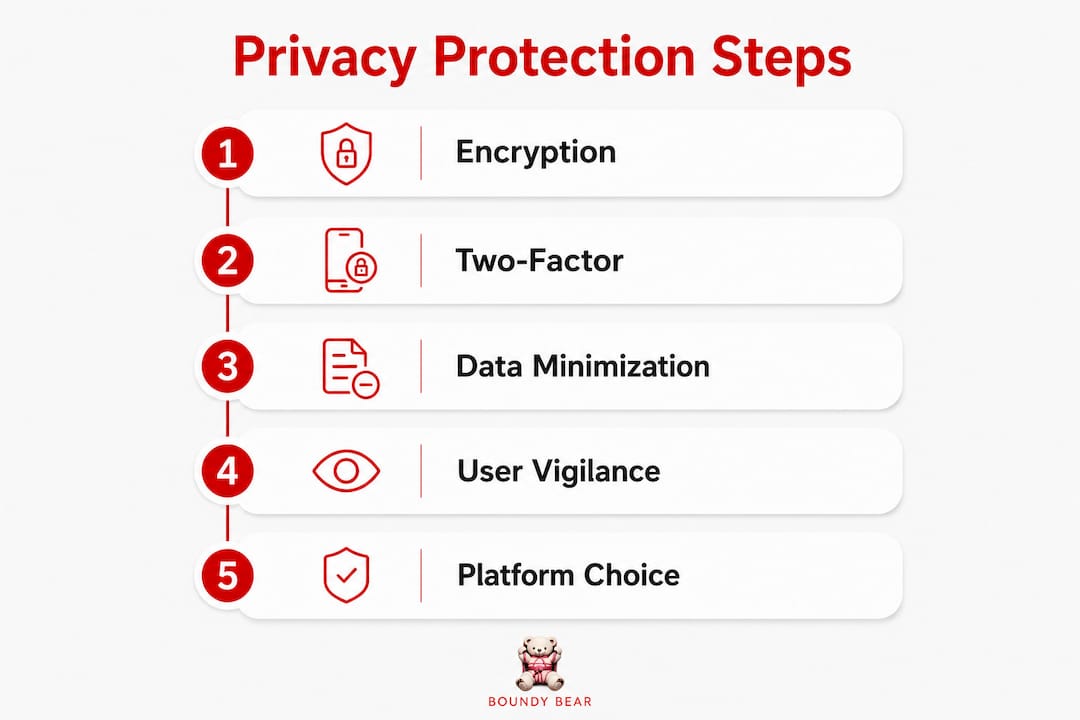
End-to-end encryption is the baseline for any adult platform worth trusting. It means your messages and sensitive data fields are scrambled in transit and at rest, so even if someone intercepts the data, they get noise. Platforms that cannot confirm end-to-end encryption for private communications are a red flag.
Botnets target adult platforms to scrape user data and run credential stuffing attacks, where stolen username and password combinations are tested at scale. That means multi-factor authentication is not optional. It is the difference between a compromised account and a secure one. Platforms that offer two-factor authentication and automated bot-mitigation tools are actively defending you, not just checking a compliance box.
Age verification is another area where privacy-first design matters. A privacy-first verification flow returns only a signed confirmation token, something like "age_verified: true," to the marketplace without storing raw ID images or photographs. That approach minimizes data exposure at the point of entry. Platforms that store your government ID image are holding a liability that could blow back on you.
Audit trails and access controls round out the technical picture. A well-built platform logs who accessed what data and when, limits internal access to sensitive fields, and runs regular security reviews. You cannot see these systems from the outside, but you can ask about them and read privacy policies carefully for specifics.
Pro Tip: Look for platforms that explicitly state they use end-to-end encryption, offer two-factor authentication, and describe their age verification process in plain language. Vague language like "we take your privacy seriously" without technical specifics is a warning sign.
How do tracking and cookies affect your anonymity?
Tracking on adult sites is actually less aggressive than most people assume. An audit of 95 adult sites found that 61% had zero trackers and 23% had just one, with a median of one cookie per site. That compares favorably to mainstream news sites, which routinely run dozens of trackers. Canvas fingerprinting and session recording were nearly nonexistent across those 95 sites.
That said, the picture is not entirely clean. First-party analytics run by the platforms themselves are invisible to most third-party scanner tools. A site can show zero external trackers and still be collecting detailed behavioral data on you internally. That data can include session duration, content preferences, and click patterns, none of which shows up in a standard privacy audit.
Here is what the main tracking methods actually do to your anonymity:
- Third-party trackers send your behavior data to external ad networks, building a profile that follows you across the web.
- First-party analytics stay on the platform but can still be subpoenaed, breached, or sold if the platform changes ownership.
- Canvas fingerprinting identifies your device by how it renders graphics, bypassing cookies entirely.
- Keystroke logging captures what you type, including passwords and messages, before you hit submit.
- Session recording replays your entire visit, including every scroll and click.
The practical implication is this: a low tracker count does not mean a platform is not watching you. It means external parties are not watching you. The platform itself may still know a lot.
What privacy risks are unique to adult marketplaces?
Identity exposure is the most serious risk. Metadata embedded in photos, shipping addresses attached to physical product orders, and real names on payment records can all connect your marketplace activity to your offline identity. Platforms that allow stage names and keep private data separate from public profiles reduce this risk significantly. Platforms that do not are setting you up for doxxing.
Payment tracing is a close second. Standard credit card transactions create a paper trail that connects your real identity to specific purchases. Visa enforces MCC 5967 for adult content and MCC 7273 for escort and dating services, which means adult transactions are flagged and monitored at the card network level. That monitoring exists for fraud prevention, but it also means your bank and card issuer can see exactly what you bought and where.
Social engineering is a real threat on adult platforms. Scammers build trust over time, then push conversations off-platform to environments without moderation or reporting tools. Once you are off-platform, you lose the protections the marketplace provides. Staying on-platform for all communications is one of the most effective ways to protect yourself.
Regulatory pressure adds another layer of complexity. GDPR compliance requires platforms to document what data they collect, why, and for how long. Platforms that cannot answer those questions clearly are either non-compliant or hiding something. Either way, that is your data at risk.
Pro Tip: Before sharing any personal information on an adult marketplace, search the platform name alongside "data breach" and "privacy policy." Read the policy for specific retention periods and data-sharing clauses. If the policy is vague or missing, walk away.
How can you protect your privacy while using adult marketplaces?
Protecting your privacy starts before you create an account. Here is a practical sequence:
- Use a VPN. A VPN masks your IP address from the platform and your ISP. It does not make you invisible, but it removes one major data point that connects your activity to your physical location.
- Create a dedicated email address. Use a separate email account for adult marketplace activity. Services like ProtonMail offer encrypted email with no personal data required to sign up.
- Choose a username that reveals nothing. No birthdate, no real name, no location. Treat your marketplace identity as a separate persona.
- Keep all communications on-platform. On-platform communication preserves access to moderation and dispute resolution tools. Moving off-platform removes those protections entirely.
- Use privacy-conscious payment methods. Prepaid cards reduce the link between your real identity and your transactions. Blockchain-based options that use zero-knowledge proofs can break the link between sender and recipient entirely, though they require more technical setup.
- Install an ad blocker. uBlock Origin blocks most third-party trackers and ads. It does not stop first-party analytics, but it cuts the external data collection significantly.
- Do not rely on incognito mode. Incognito prevents local storage but does nothing to stop external device identification, ISP logging, or canvas fingerprinting. It is a false sense of security.
Choosing the right platform matters as much as your personal habits. Read the safety risks on erotic platforms before committing to any marketplace. A platform with a transparent privacy policy, clear data retention limits, and visible security features is worth the extra research time.
Pro Tip: To verify a platform's security claims, check whether it has a published bug bounty program or third-party security audit. Platforms that invite external scrutiny are more likely to back up their privacy promises with real infrastructure.
Key Takeaways
Real privacy in adult marketplaces requires end-to-end encryption, first-party tracking awareness, and deliberate user habits working together, because no single measure covers all the gaps.
| Point | Details |
|---|---|
| Encryption is non-negotiable | Platforms must offer end-to-end encryption for messages and sensitive data fields. |
| First-party tracking is invisible | Platforms can collect detailed behavioral data without any external trackers showing up in audits. |
| Incognito mode does not protect you | Private browsing prevents local storage but does not stop ISP logging or canvas fingerprinting. |
| Keep communications on-platform | Moving off-platform removes moderation tools and exposes you to social engineering. |
| Payment methods carry identity risk | Standard card transactions are flagged at the network level; privacy-conscious alternatives reduce exposure. |
The uncomfortable truth about platform privacy promises
I have spent a lot of time reading privacy policies on adult platforms, and most of them are written to protect the platform, not you. They use language like "we may share data with trusted partners" without defining what "trusted" means or who those partners are. That kind of vagueness is a choice, not an oversight.
What I have found is that the platforms doing the real work on privacy tend to be quieter about it. They do not lead with "your privacy is our top priority." They publish specific technical documentation, maintain clear data retention schedules, and make it easy to delete your account and all associated data. That specificity is the tell.
The tracking audit data is genuinely reassuring in one sense: most adult sites run far fewer external trackers than a mainstream news site. But the first-party analytics gap is where I think users get caught off guard. You can have a clean external audit and still be feeding a detailed behavioral profile to a platform that could be acquired, breached, or compelled to hand over data tomorrow.
My honest advice is to treat every adult marketplace as if it will eventually be breached. Use a VPN, a dedicated email, and a username that reveals nothing. Keep your real identity completely separate from your marketplace persona. Platforms like Kinkykorner that build privacy into their design make that separation easier, but the habit of protecting yourself has to come from you first.
— Prenston
Kinkykorner: a marketplace built with your privacy in mind
If you have read this far, you already know that platform choice matters as much as personal habits. Kinkykorner is an adult marketplace where people and businesses list adult-themed services and erotic literary and artistic content, built with the understanding that confidentiality is not a feature. It is the foundation.
Kinkykorner separates private data from public profiles, supports on-platform communication with moderation tools, and takes the security architecture seriously. Whether you are a buyer, a seller, or someone who just wants to read without leaving a trail, explore Kinkykorner and see what a privacy-conscious adult marketplace actually looks like in practice. You can also get a clearer picture of how adult marketplaces work by reading the full marketplace explainer before you sign up.
FAQ
What is privacy in adult marketplaces?
Privacy in adult marketplaces is the protection of sensitive personal data, behavioral information, and transactional details from unauthorized access or exposure. It covers technical security, platform design, and user behavior working together.
Do adult sites track you more than regular websites?
Adult sites generally track users less than mainstream news sites. An audit of 95 adult sites found 61% had zero third-party trackers, though first-party analytics remain a hidden risk.
Does incognito mode protect you on adult platforms?
Incognito mode prevents local browser storage but does not stop ISP logging, canvas fingerprinting, or external device identification. A VPN combined with an ad blocker provides much stronger protection.
How can you tell if an adult marketplace is privacy-conscious?
Look for platforms that publish specific technical details about encryption, offer two-factor authentication, describe their age verification process clearly, and provide transparent data retention policies with real deletion options.
What payment methods protect privacy on adult marketplaces?
Prepaid cards reduce the link between your real identity and purchases. Blockchain-based payment methods using zero-knowledge proofs can break the connection between sender and recipient entirely, offering the strongest transactional anonymity.