

Adult stories are trending right now because psychology, platform algorithms, and creator-economy incentives have locked into a perfect, filthy alignment. Sexual stimuli bypass rational processing entirely, triggering immediate emotional and physiological responses that make erotic narratives almost impossible to scroll past. Layer that onto recommendation engines built to reward novelty and emotional intensity, and you've got a vortex that pulls readers in and keeps them there.
- The psychology is real. Platforms like Archive of Our Own (AO3) and Kinkykorner host millions of erotic works because readers keep coming back, not because of marketing spend.
- The money is real too. The dark-romance and emotionally intense subgenres generated roughly $180M in U.S. print and digital revenue in 2025, signaling a durable commercial trend.
- The audience is hungry and underserved. Demand reports from 2026 show specific tropes receiving thousands of reader requests with almost none of that demand being met.
The sections below break down the core drivers, the platforms amplifying them, what it means for creators and businesses, and the legal lines to navigate carefully.
Table of Contents
- Why adult stories are trending: the core psychological and cultural drivers
- Where these stories live and how distribution has changed
- What this trend means for authors, creators, and small adult businesses
- What creators and platforms must know about U.S. law and ethics
- How marketplaces like Kinkykorner should respond right now
- Key Takeaways
- The part nobody talks about openly enough
Why adult stories are trending: the core psychological and cultural drivers
The simplest answer is that sex sells because the brain is wired that way. Sexual stimuli grab attention before conscious thought even kicks in, flooding the system with dopamine and novelty signals. That's not an opinion; it's the mechanism consumer psychologists point to when explaining why erotic content consistently outperforms other categories for raw engagement.

But it's more than just horniness. Survey research identifies four distinct motivations for consuming adult content: pleasure and sex drive, sexual learning and enhancement, social and instrumental reasons, and coping with loneliness. That last one matters more than people admit. Erotic fiction, specifically, offers emotional stakes and context that pure visual content often lacks, which is why written erotica activates responsive desire so effectively, especially among female readers who make up a disproportionate share of the audience.
Dark romance is the clearest proof of the cultural shift. Morally gray heroes, dubious consent, and power dynamics that would have been shelved in the back corner five years ago are now front-of-store bestsellers. As USA Today's coverage of the genre frames it:
"Readers aren't looking for perfect heroes anymore. They want complicated ones. The darkness is the point — it's a safe container for exploring power, desire, and transgression without real-world consequences."
BookTok accelerated all of this. Short-form video democratizes discovery by rewarding emotional resonance over marketing budgets, which means a debut author writing dark erotica can go viral before a traditional publisher even reads their query letter. Romance is already the highest-grossing fiction genre in the United States, accounting for a significant portion of adult fiction book sales. Adult subgenres are riding that wave hard.
Where these stories live and how distribution has changed
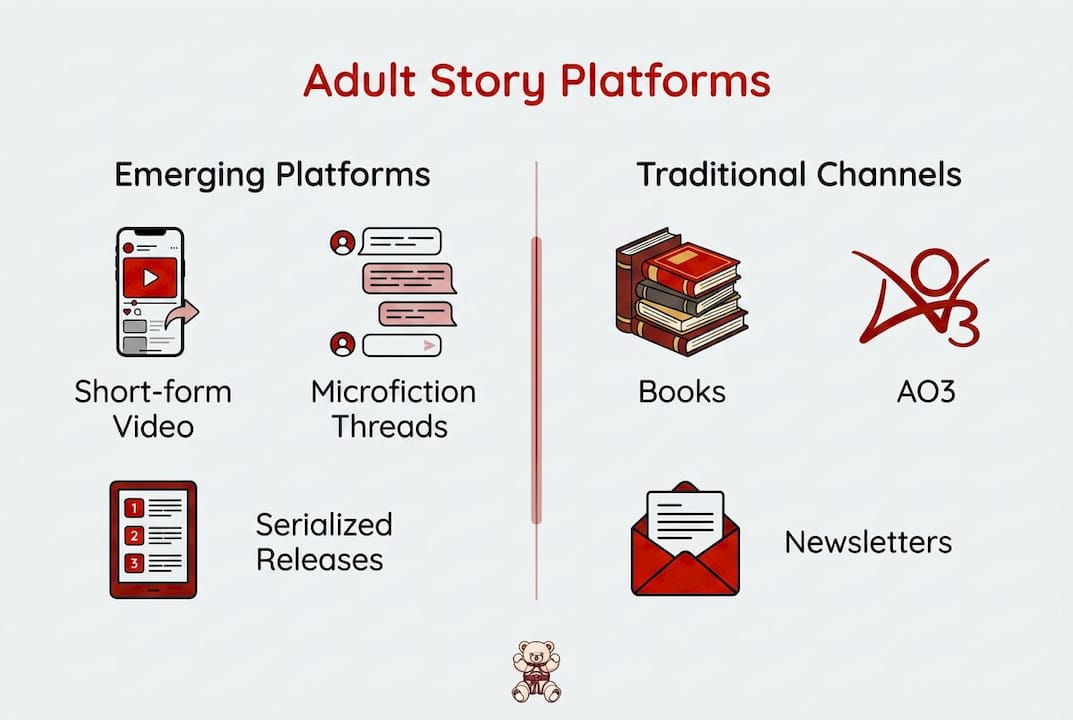
The platforms shaping adult fiction popularity in 2026 are not monolithic. Each one has a different relationship with monetization, moderation, and audience expectation.
| Platform / Channel | What drives engagement | Monetization model | Audience type | Moderation risk |
|---|---|---|---|---|
| Archive of Our Own (AO3) | Community tagging, fandom loyalty, free access | None (nonprofit) | Fanfic readers, niche kink communities | Low; volunteer-moderated, explicit content allowed |
| Literotica | Search-driven discovery, genre depth | Ad-supported, free to read | Broad adult fiction readers | Low; permissive within legal limits |
| Patreon | Subscriber loyalty, serialized releases | Tiered subscriptions | Dedicated fans paying for exclusivity | Medium; policy shifts have affected adult creators |
| Amazon KDP | Retail discoverability, series read-through | Per-sale royalties, Kindle Unlimited | Mainstream romance and erotica buyers | High; strict content policies, frequent delisting risk |
| OnlyFans-style subscriptions | Direct creator-fan relationship, explicit content | Monthly subscriptions, pay-per-view | Fans paying for creator-specific content | Medium; age verification required |
| Newsletters / direct | Zero algorithm dependency | Direct sales, paid tiers | Highly engaged, self-selected readers | Minimal; creator controls everything |
| Kinkykorner | Kink and fetish directory + erotic literary content | Paid listing subscriptions for providers | Adult service seekers, kink-curious readers | Operator-managed; focused on legal compliance |
Serialized microfiction threads on social platforms have become their own discovery engine. A creator drops a chapter, the comments explode, and the algorithm reads that engagement as a signal to push the next post further. Paid chapters on Patreon or direct newsletter tiers then convert that free audience into revenue. The funnel is short and brutal: hook them for free, charge them for the good stuff.
What this trend means for authors, creators, and small adult businesses
If you're a creator right now, the single best move is building a backlist before you go viral, not after. Authors with multiple titles see a viral moment drive purchases across additional backlist titles. Debut authors get a spike. Established authors get a revenue event that compounds.
Discoverability in 2026 runs through emotional resonance, not ad spend. A fifteen-second video of you reading the most charged paragraph from your dark romance will outperform a $200 Facebook ad almost every time. Collaborate with other creators in adjacent subgenres, seed your work in community spaces like AO3 or kink-focused forums, and map your content to underserved tropes. The 2026 demand report shows that certain tropes receive thousands of reader requests with most of that demand going unmet. That's not a niche. That's a gap you can drive a series through.
Pro Tip: Release the first installment of a serialized story for free on a high-traffic platform like AO3 or a newsletter, then gate chapters two onward behind a paid tier. The free chapter does the marketing; the paid tier does the monetizing.
For small adult businesses and service providers, the content trend creates a discovery opportunity. Readers who find you through erotic fiction are already warm. They're in the headspace. Listing your services on a platform like Kinkykorner, where the audience is already kink-curious and actively browsing, puts you in front of people who are not just scrolling past. Check out how to market erotic fiction for tactical steps on converting that readership into clients.
Pro Tip: Time new releases to coincide with genre moments — a trending BookTok trope, a viral author moment, a holiday spike. Algorithmic recommendation systems reward recency and relevance together.
What creators and platforms must know about U.S. law and ethics
Creators and platforms must prioritize explicit age verification, unambiguous consent framing in content, and robust moderation workflows. Full stop. This is not optional, and the consequences of getting it wrong range from platform delistings to federal obscenity charges.
Age verification. Any platform distributing sexually explicit material in the United States must implement meaningful age-gating. Several states have passed or are advancing age-verification laws in 2026, and federal pressure is building. "We assume users are adults" is not a defense.
Consent labeling. Dark romance and dubcon content require clear content warnings. Readers choosing to engage with non-consent themes in fiction is a legitimate creative and consumer choice. Readers stumbling into it without warning is a moderation failure and a reputational liability.
Record-keeping. If your platform or content involves real performers, U.S. law (18 U.S.C. § 2257) requires age verification records for every depicted individual. This applies to visual content; written fiction has different but still real legal exposure under obscenity statutes.
Takedown workflows. Have a documented process. Platforms without clear takedown procedures face amplified liability when content complaints arise.
This article is general information, not legal advice. Confirm current requirements with a qualified attorney for your specific situation.
How marketplaces like Kinkykorner should respond right now
Marketplaces should optimize discovery, safety, and creator monetization pathways at the same time, not sequentially. The adult fiction popularity surge is a traffic opportunity, but only if the infrastructure is ready to convert that traffic.
- Upgrade listing formats to surface serialized erotic stories and written content alongside service listings. Readers who come for fiction stay for the directory.
- Build discovery signals for written erotica: genre tags, trope filters, and content-warning labels that let readers self-select into the content they want.
- Support tiered monetization for creators listing on the platform, including subscription options and paid-chapter mechanics that keep revenue inside the ecosystem.
- Implement visible age verification and consent labeling at the platform level, not just at the creator level. This protects the marketplace and signals trustworthiness to both creators and readers.
- Track catalog pull rate (how often a single piece of content drives views or purchases of other listings), subscriber conversion from free to paid tiers, and repeat engagement with backlist content. These three metrics tell you whether the trend is actually working for your business.
Kinkykorner's adult content trends analysis for 2026 lays out the broader shifts shaping the market. The opportunity for marketplaces is real, but it requires moving on listing infrastructure and moderation simultaneously. Operators who treat safety as a checkbox rather than a feature will lose creators to platforms that take it seriously.
Key Takeaways
Adult stories are trending in 2026 because psychology, platform mechanics, and creator monetization incentives have converged into a single, self-reinforcing cycle that rewards emotionally intense, explicit narratives across every major distribution channel.
| Point | Details |
|---|---|
| Psychology drives the click | Sexual stimuli bypass rational processing, triggering immediate engagement responses that make adult content highly discoverable. |
| Dark romance is a $180M market | The dark-romance and emotionally intense subgenres generated roughly $180M in U.S. print and digital revenue in 2025, signaling a durable commercial trend. |
| Backlist is the real prize | Authors with multiple titles see a viral moment drive purchases across additional backlist titles. |
| Demand outpaces supply | The 2026 demand report shows specific tropes with thousands of unmet reader requests, creating clear content gaps for creators. |
| Legal compliance is non-negotiable | Age verification, consent labeling, and 18 U.S.C. § 2257 record-keeping are baseline requirements for any U.S. adult platform. |
The part nobody talks about openly enough
The adult fiction surge isn't a fluke or a moral panic waiting to happen. It's the logical outcome of a decade of platform mechanics rewarding emotional intensity, a creator economy that finally lets writers get paid directly, and a cultural moment where readers are done pretending they don't want what they actually want.
What I find genuinely underestimated here is the role of safety as a growth driver, not just a compliance burden. The platforms and marketplaces that are winning right now are the ones where readers feel like they can explore without judgment and creators feel protected enough to publish their most interesting work. That combination is rare. Most platforms treat moderation as damage control. The smart ones treat it as product.
For Kinkykorner specifically, the next 30–90 days should look like this: audit the listing format to make written erotic content as discoverable as service listings; add trope and genre tagging to the content layer; publish a clear, visible age-verification and consent-labeling policy; and start tracking catalog pull as a core KPI. The adult marketplace value proposition is strongest when the platform feels like a community, not just a directory. That's the gap worth closing.
Primary sources and further reading
- SMSNA: Why Do People Watch Porn? — Survey-based breakdown of four motivation categories; useful for understanding the psychology behind adult content consumption.
- USA Today: Dark Romance Coverage — Author commentary and genre analysis on why morally gray narratives are mainstream in 2026.
- Thoughts on Life and Love: Why Sex Sells — Consumer-psychology explainer on dopamine, novelty, and attention capture; foundational for the drivers section.
- BookTokTimes: The $180M Pain Economy — Revenue data and growth trajectory for dark romance and emotionally intense subgenres.
- PlotProse: Romance Reader Demand Report 2026 — Trope-level demand data showing underserved reader requests; critical for content-gap strategy.
- Reader Weekly: The Midlist Mutiny — Catalog-pull data and BookTok discovery mechanics for mid-tier and indie authors.
- Second Banana: Why You Read Smut — Analysis of responsive desire, erotic fiction's psychological function, and the female-skewed readership.
- Kinkykorner: Adult Content Trends 2026 — Platform-specific trend analysis for adult marketplace operators.