

Yes, adult-themed marks can be federally registered in the United States, and the path is more open than most owners assume. The old "immoral or scandalous" refusal is dead. What survives is the same gauntlet every brand faces: your name has to be distinctive, it can't step on someone else's turf, and it can't ride the coattails of a famous label. Beat those three tests, and the USPTO doesn't care that your business involves leather, latex, or late-night content.
TL;DR:
- The Brunetti ruling removed the USPTO's ability to reject adult-themed trademarks solely based on obscenity or vulgarity, but other grounds like clarification or confusion still apply.
- Most adult brand trademark applications succeed or fail due to their distinctiveness or risk of confusing or diluting existing marks, not because of content obscenity.
- Building a suggestive or arbitrary brand name, avoiding luxury names or generic terms, and maintaining consistent use in branding significantly improve registration chances.
- International trademark protection varies, with some countries maintaining morality-based refusals, so applicants should prioritize markets where they plan to operate.
- Regular monitoring and evidence collection of actual use are vital to defend a trademark, as registration is an ongoing obligation and disputes are common in the adult industry.
Table of Contents
- What The Brunetti Ruling Actually Changed For Adult Brand Trademarks
- Why Distinctiveness And Confusion Sink More Applications Than Obscenity Ever Did
- The USPTO Filing Process, Step By Step
- Naming Your Brand To Survive Legal Scrutiny
- What Happens After You File: Oppositions And Ongoing Maintenance
- Obscenity Laws And First Amendment Protections You Need To Understand
- How Trademark Protection Changes Once You Sell Outside The U.S.
- What I've Learned Watching Adult Brand Owners File (And Fumble) Trademarks
- How Kinkykorner Helps You Build A Brand Worth Protecting
- Sources
- FAQ
What The Brunetti Ruling Actually Changed For Adult Brand Trademarks
For decades, the USPTO could reject a trademark application simply because an examiner found it vulgar, shocking, or "immoral." That changed with In re Brunetti, the Federal Circuit case that struck down Section 2(a)'s ban on "immoral or scandalous" marks as an unconstitutional restriction on speech. The Supreme Court had already reached a similar conclusion the year before in a case involving a clothing brand's provocative name, and Brunetti extended that logic specifically to the scandalousness clause.
Here's what that means in practice for an adult brand trademark application: the USPTO can no longer refuse your mark just because it's explicit, crude, or taboo. But the ruling didn't hand out blanket approval. It removed one obstacle, not the whole obstacle course.
Trademark attorneys are consistent on this point: marks can still be refused for being generic, merely descriptive, or confusingly similar to something already registered. The bar cleared by Brunetti was narrow. What remains is everything that governs a mattress company or a coffee chain's name:
- The mark must function as a source identifier, not just a description of the product.
- It can't create confusion with an existing registered mark in a related category.
- It can't dilute or tarnish a famous brand, even one from an entirely different industry.
The TTAB and federal courts keep refining how these rules apply case by case, so a cleared constitutional bar is not the same thing as a guaranteed registration.
Why Distinctiveness And Confusion Sink More Applications Than Obscenity Ever Did
Most adult brand trademark applications don't fail because they're explicit. They fail because the name is too generic, too descriptive, or too close to something already on the register.
The USPTO sorts every mark into one of four buckets, and where your name lands determines how easy or hard registration will be:
- Generic names (the common term for the product or service itself) can never be registered, no matter how creative the branding around them.
- Descriptive names (words that simply describe a feature, quality, or function) usually get refused unless you can prove years of exclusive use and consumer recognition.
- Suggestive names (hint at a quality without stating it directly) register far more easily and face fewer early challenges.
- Arbitrary or invented names carry the strongest protection because they have no obvious connection to the product at all.
A composite name built from common industry words faces genericness risk even when the combination feels unique to you. That's exactly the argument that surfaced in litigation over the term "PORNTUBE," where courts had to weigh whether combining two generic words created something protectable, or just a longer generic phrase used the way the marketplace already uses it.
Confusion analysis works differently. Examiners and the Trademark Trial and Appeal Board weigh a multi-factor test that looks at how similar the marks sound and look, whether the goods or services overlap, and whether an average shopper might assume a connection between the two brands. An adult brand doesn't need to compete directly with a mainstream company to trigger this. It just needs to create the impression of an affiliation.
That's where dilution and tarnishment come in, and where the stakes become expensive. Dior successfully opposed the registration of an adult performer's "GIGI DIOR" mark at the TTAB, arguing that the association with adult content would blur and tarnish the luxury house's brand identity, according to The Fashion Law's coverage of the case. The performer didn't sell competing products. The mark didn't need to confuse anyone about where the goods came from. It only needed to create an unwanted mental link between a famous luxury name and adult content for the opposition to succeed.
Pro Tip: Run a quick gut check before you fall in love with a name: if it echoes a luxury, celebrity, or household brand in any way, even as wordplay, budget for a fight you'll probably lose.
The USPTO Filing Process, Step By Step
Filing a trademark application isn't complicated once you know the order of operations, but skipping a step tends to cost you months in office actions.
- Search before you file. Run a full search on the USPTO's TESS database, then check common-law use, business filings, and domain availability for anything close to your proposed name. A professional clearance search adds value here because it catches unregistered but actively used marks that a basic database search misses.
- Choose your filing basis. You'll file either "use in commerce," meaning you're already selling under the mark, or "intent to use," meaning you plan to launch soon. Adult brands just starting out often file intent-to-use, then submit proof of actual sales later.
- Pick the right Nice Classes. Adult content and services rarely fall into one clean category. A streaming or content site might need a Class 41 entertainment services filing, while a physical product line needs a goods class entirely. Misclassifying a digital content brand under a physical goods class is one of the most common mistakes owners make.
- Prepare your specimen. For online adult brands, this usually means screenshots of a branded landing page, a purchase or subscription page, or a service listing that clearly shows the mark tied to the actual offering. Screenshots that show the mark only as decoration, with no clear connection to a purchase or service, frequently trigger office actions asking for better proof.
- File through Trademark Center, the USPTO's official filing portal, where you submit the application, pay the per-class filing fee, and track your status through the system's docketing tools.
- Respond to office actions promptly. Most applications get at least one action requiring clarification, whether on classification, specimen quality, or a conflict with an existing mark.
- Clear publication. Once approved, your mark publishes in the Official Gazette for a 30-day window during which anyone, including a mainstream brand's legal team, can file an opposition.
Pro Tip: If your brand name has any echo of a celebrity, designer, or household name, watch the Gazette publication date closely. Oppositions from well-funded legal departments tend to land right at the deadline, not early.
Naming Your Brand To Survive Legal Scrutiny
The name you pick before you ever file does more to protect your business than anything you do afterward. Suggestive and arbitrary names clear examination faster and hold up better against challenges than descriptive names built from common industry terms.
A few ground rules keep adult brand trademark applications out of trouble:
- Never build your name around a designer label, celebrity name, or luxury brand, even as a pun or homage. That's the exact fact pattern that sank GIGI DIOR.
- Avoid generic industry terms as your core identifier. They're weak marks and easy targets for cancellation later.
- Use your mark consistently across your website, listings, and marketing. Inconsistent branding weakens your claim to exclusive use.
- Understand the difference between ® and TM. The registered symbol is reserved for marks that have actually cleared federal registration; using it prematurely can undercut your credibility if challenged.
Reputation management matters just as much as the legal filing. Mainstream payment processors, hosting providers, and business partners sometimes react cautiously to adult brand names that sound close to recognizable companies, even when no legal conflict exists. Building a strong, distinct reputation around your own name, rather than borrowing recognition from someone else's, reduces friction on every front at once.
Pro Tip: Set a calendar reminder to run a fresh trademark search on your own name every six months. Catching a copycat early is far cheaper than fighting one after they've built an audience.
What Happens After You File: Oppositions And Ongoing Maintenance
Registration isn't the finish line. It's the start of an ongoing obligation.
An opposition happens during that 30-day publication window, before your mark registers. A cancellation proceeding happens after registration, when someone challenges a mark that's already live. Both play out before the TTAB, and both can escalate to federal court if either side appeals. Initial defense usually starts with your attorney filing an answer to the opposing party's claims, and the timeline can stretch well past a year before resolution.
On the enforcement side, you have several tools once you hold a registration:
- A cease-and-desist letter is the cheapest first move against a smaller infringer.
- TTAB or district court action becomes necessary when a cease-and-desist gets ignored.
- Recording your registration with U.S. Customs and Border Protection helps block counterfeit goods at the border if you sell physical products.
IP disputes are common in the adult industry. A patent infringement lawsuit between two adult product manufacturers settled after litigation, a reminder that companies in this space do pursue and defend their intellectual property just as aggressively as any other sector.
Once registered, you're required to file a Section 8 declaration of continued use between the fifth and sixth year, then a combined Section 8 and 9 renewal every ten years. Miss those windows, and the USPTO cancels the registration outright.
Obscenity Laws And First Amendment Protections You Need To Understand
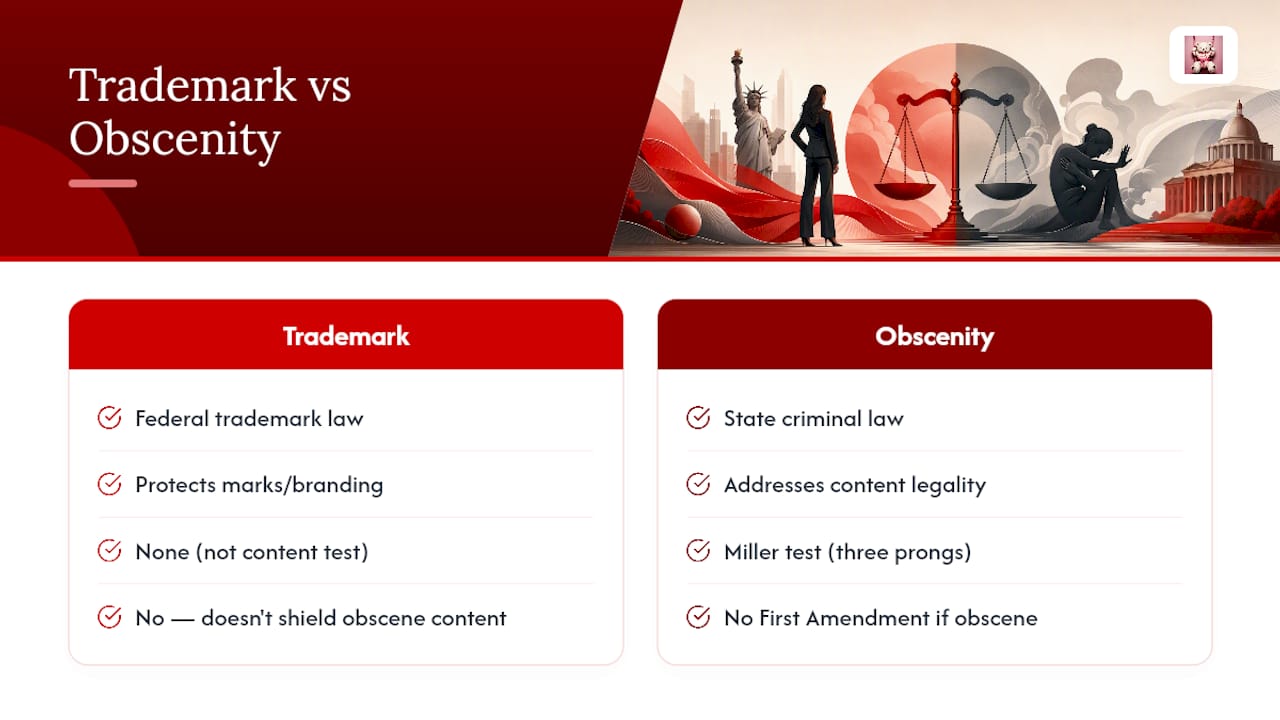
Trademark registration and obscenity law are two separate legal systems, and confusing them causes real problems for adult brand owners. Owning a federal trademark registration says nothing about whether your content is legal to produce, sell, or distribute in a given state.
Obscenity under U.S. law is judged by the Miller test, which asks whether the average person applying community standards would find the work appeals to prurient interest, whether it depicts sexual conduct in a patently offensive way, and whether it lacks serious literary, artistic, political, or scientific value. Content that clears the Miller test enjoys First Amendment protection. Content that doesn't can be prosecuted regardless of how carefully you handled your trademark filing.
This matters directly for brand owners because the same First Amendment reasoning behind Brunetti, protecting even offensive speech from government suppression, doesn't extend automatically to obscenity. The Supreme Court has long held that obscene material sits outside First Amendment protection entirely, unlike merely vulgar or crude expression, which does receive protection.
Practically, this means your trademark counsel and your content-compliance review are two different conversations. Registering "SPICY VELVET STUDIOS" as a trademark protects your brand name. It does nothing to shield the content itself if a jurisdiction's community standards find it obscene under Miller. Owners running multi-state or online operations should treat content compliance as its own legal track, separate from brand protection, because state obscenity enforcement varies widely and a trademark registration offers zero defense against it.
How Trademark Protection Changes Once You Sell Outside The U.S.
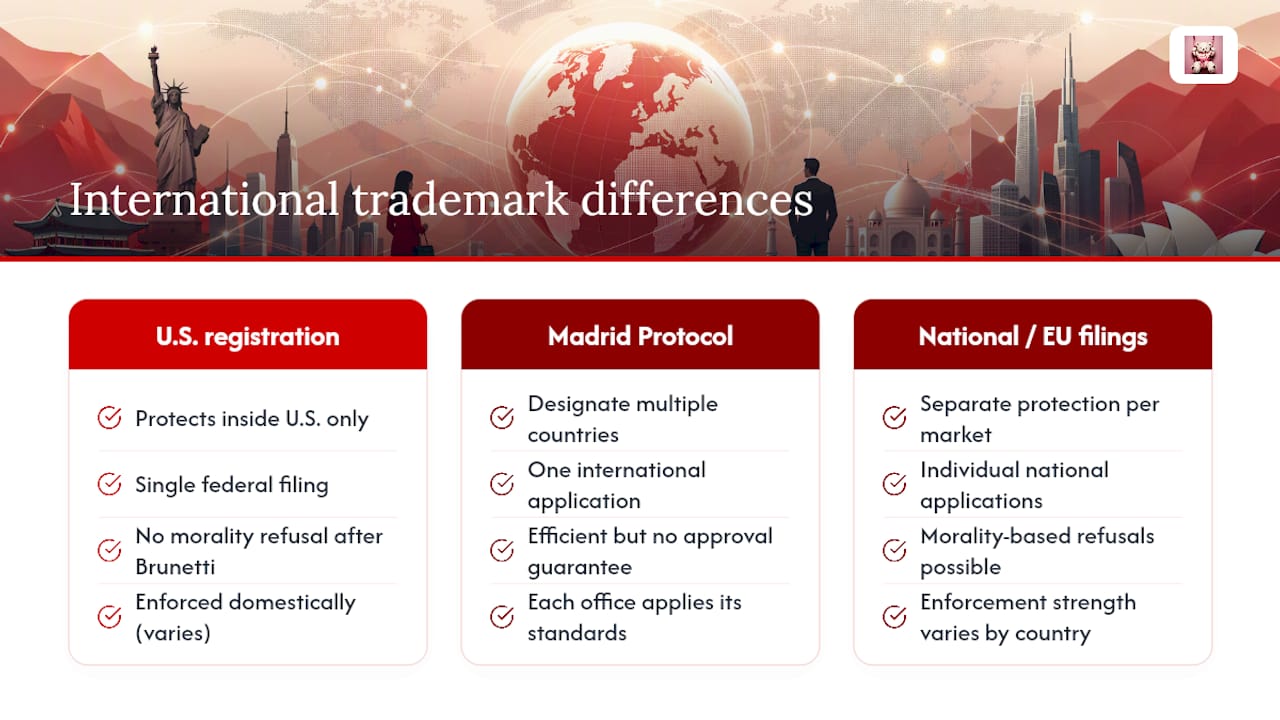
A U.S. federal registration only protects you inside the United States. If you sell content, merchandise, or services internationally, you need separate protection in each market, or a coordinated filing through an international system.
The Madrid Protocol lets you file one international application that designates multiple member countries, using your U.S. registration as the base. It's efficient, but it doesn't guarantee approval anywhere. Each designated country's trademark office still applies its own standards, and that's where adult brands hit real variation.
Some countries maintain morality-based refusal grounds that the U.S. abandoned after Brunetti. An examiner in a jurisdiction with stricter decency standards can refuse an adult-themed mark outright, something that would sail through USPTO examination today. Enforcement varies just as much as registrability. A country with weak IP enforcement infrastructure might grant your registration on paper while offering little practical recourse against local infringers.
The European Union presents its own patchwork. EU trademark law doesn't categorically bar adult-themed marks, but member states differ in how aggressively they police morality-based objections, and enforcement resources vary by country even within the single EU trademark system.
For most adult brand owners, the pragmatic approach is prioritizing international filing in markets where you actually plan to do business, rather than filing broadly and hoping for uniform treatment. A mark that's rock solid in the U.S. can still face a completely different fate the moment you cross a border.
What I've Learned Watching Adult Brand Owners File (And Fumble) Trademarks
The mistake I see most often from sellers building a presence in this space isn't legal ignorance. It's impatience. People pick a name they love, launch under it for a year, then discover during the trademark search that a name will need to change anyway, after the branding, business cards, and social handles are already locked in.
Before you file, gather real evidence of use: dated screenshots, sales pages, service listings. Have a backup name ready in case your first choice collides with something you didn't find in a casual Google search. And build a monitoring habit into your business routine, not just a one-time filing task.
Marketplaces play a real role here too. A platform that helps you present your brand consistently across listings gives you exactly the kind of dated, source-identifying evidence a trademark examiner wants to see.
— Prenston
How Kinkykorner Helps You Build A Brand Worth Protecting
A trademark only protects a name people already recognize, and that recognition starts with visibility, not paperwork. There are paid listing platforms built specifically for the adult industry, so your brand can show up consistently in front of the audience that matters, rather than competing for scraps of attention on mainstream platforms that were never built for adult content in the first place.
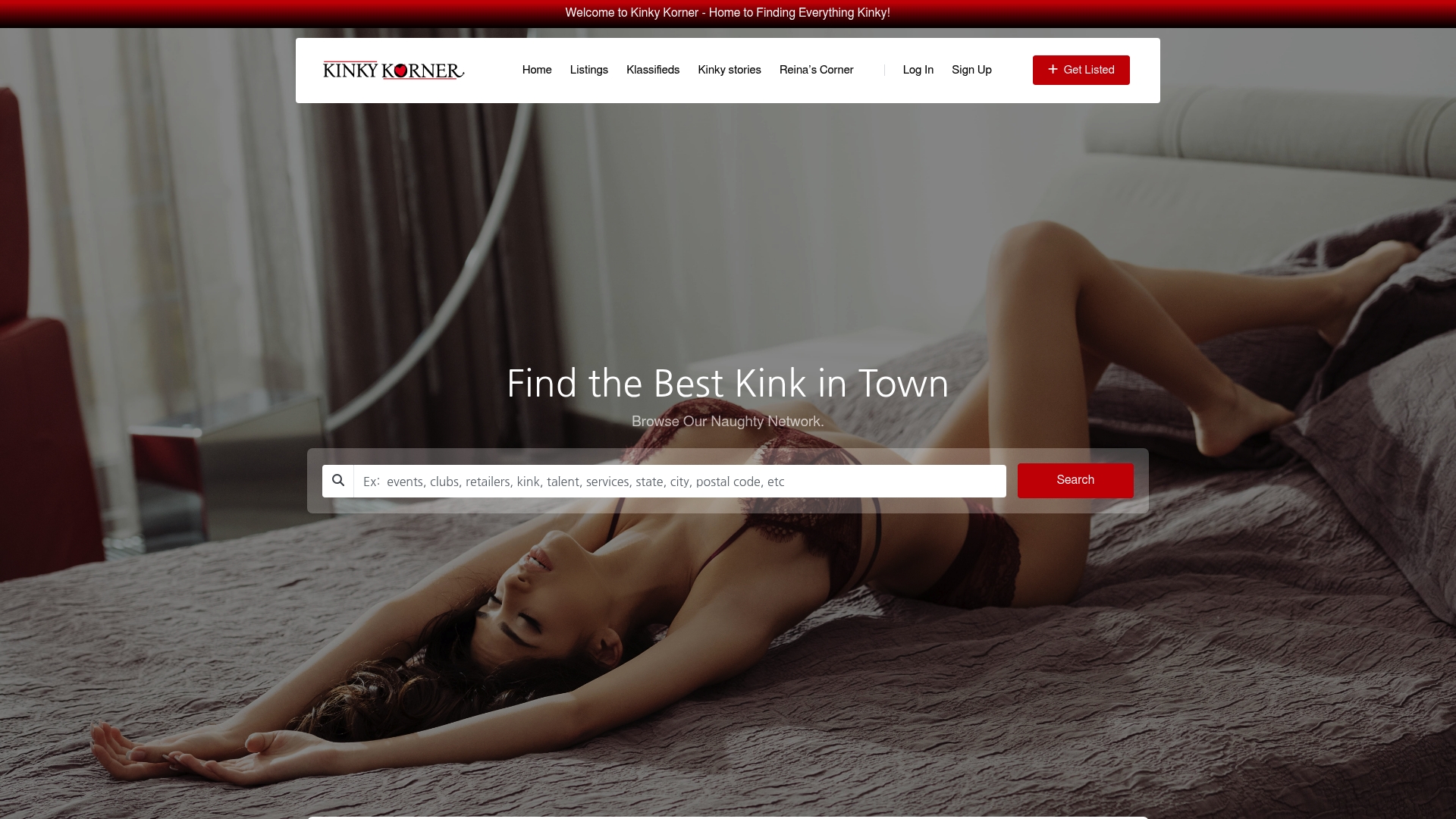
That consistency matters more than most owners realize. Every listing you maintain, every branded page you publish, becomes potential specimen evidence for your USPTO application down the line. Some resources cover naming your services and presenting your brand the right way from day one, so you're not scrambling to document "use in commerce" a year after launch. If you're building a name worth defending, start by making it visible where your customers already look. Visit Kinkykorner to explore listing tiers and get your brand in front of the right audience today.
This article is general information, not a substitute for advice from a qualified lawyer. Consult a qualified legal professional about your own circumstances before acting on anything here.
Sources
- Trademark process | USPTO
- Trademark Center | USPTO
- Dior wins battle to block adult film star Gigi Dior's trademark registration | The Fashion Law
FAQ
How Do I Check If A Name Is Already Trademarked In The U.S.?
Search the USPTO's TESS database for federal registrations, then run a separate common-law search covering business names, domains, and social handles that aren't federally registered but could still block your use.
Did Taylor Swift Trademark Her Name?
Yes, Taylor Swift holds multiple federal trademark registrations covering her name and related merchandise categories, a common strategy for public figures whose identity functions as a commercial brand.
Is It Illegal To Put TM On A Logo?
No, anyone can use the TM symbol on an unregistered mark to signal a claim of trademark rights, but only a federally registered mark can legally use the ® symbol.
Is Chick-fil-A A Registered Trademark?
Yes, Chick-fil-A holds federal trademark registrations, and it's frequently cited alongside other well-known consumer brands as an example of how strong, consistent use builds enforceable trademark rights over time.
Can An Adult Performer Trademark A Stage Name?
Yes, a stage name can be federally registered the same way any brand name can, provided it's distinctive and doesn't infringe on an existing mark, though names echoing celebrities or luxury brands face heightened opposition risk.