

If you list services, sell content, or run a marketplace listing in the adult space, here's the blunt version: implement 2257 recordkeeping, slap a proper disclosure on every page, run an age assurance flow that actually holds up, encrypt and lock down performer records, and have a written plan for the day a subpoena or a flagged report lands in your inbox. Skip any one of these and you're not "probably fine." You're exposed.
Do this before the week is out:
- Add a 2257 disclosure statement or link to every page hosting covered content.
- Pull performer files and confirm every ID, alias, and date of birth is on record.
- Pick an age-assurance approach, whether a vendor, a tiered flow, or geoblocking the hardest states.
- Call your payment processor and read their current adult-content policy, not last year's.
18 U.S.C. §2257 isn't optional guidance, it's a criminal statute. Pair it with DOJ's 2257A certification path and Ofcom's age-assurance framework, and you've got the backbone of a defensible operation.
Pro Tip: Treat compliance like uptime, not paperwork. The moment it breaks, your revenue breaks with it.
Key Takeaways
Compliance succeeds when 2257 recordkeeping, visible labeling, tiered age assurance, secured records, and a documented incident plan operate together, not as isolated checkboxes.
| Point | Details |
|---|---|
| Recordkeeping is non-negotiable | Collect ID, legal name, aliases, and date of birth for every performer under 18 U.S.C. §2257. |
| Labeling must be visible | Affix or link a records-location statement to every page hosting covered content. |
| Age assurance needs a strategy | Use a tiered flow to balance conversion against Ofcom-style "highly effective" standards. |
| Payment access is fragile | Document performer consent and monitor processor policy changes quarterly. |
| Incident response must be pre-written | Have a preservation, notification, and CyberTipline reporting flow ready before you need it. |
Table of Contents
- How Do You Build a Compliance Checklist for an Adult Business?
- What Does §2257 Actually Require You to Collect and Label?
- Which States Require Age Verification, and What Should You Do About It?
- How Do Payment Processors and Advertising Rules Affect Compliance?
- How Should You Store and Secure 2257 Records?
- What Do You Do When You Suspect Underage Content or Get a Subpoena?
- Why Compliance Is a Business Strategy, Not Just a Legal Chore
- Where to Go Next for Authoritative Guidance
- Frequently Asked Questions
- Sources
How Do You Build a Compliance Checklist for an Adult Business?
Break it into three horizons. Trying to fix everything simultaneously is how compliance projects stall.
Week 1: Stop the bleeding.
- Audit performer intake. Confirm every file has a government ID, legal name, aliases, and date of birth on record. Owner: legal/compliance. Outcome: a complete intake folder, no gaps.
- Fix labeling. Add or verify the 2257 records-location statement on every relevant page. Owner: engineering. Outcome: disclosure visible site-wide within days.
- Freeze risky payment flows. Confirm your processor's current adult-content terms before you get frozen instead. Owner: ops.
Month 1: Build the systems. 4. Select an age-assurance method, whether a document-plus-liveness vendor, a tiered estimation flow, or geoblocking. Owner: engineering/legal. Outcome: documented pass-rate targets and a fallback path for edge cases. 5. Reduce PCI scope by routing card data through a processor-hosted field rather than storing it yourself. Owner: engineering. 6. Draft a data-minimization policy: who can see 2257 records, for how long, and why. Owner: legal.
Month 3: Make it durable. 7. Build a content moderation and takedown workflow with logged timestamps. Owner: ops. 8. Train staff on incident response and recordkeeping duties, then document that training happened. Owner: compliance lead. 9. Run an internal mock audit against your own files, as if the Attorney General's office actually asked for them.
Pro Tip: A tiered age-assurance flow (soft check first, full ID only for borderline cases) protects conversion rates without gutting your legal defensibility. Geoblocking the strictest jurisdictions is cheaper upfront but costs you traffic you may never win back.
What Does §2257 Actually Require You to Collect and Label?
The federal recordkeeping rule isn't ambiguous, but a lot of operators treat it like a suggestion. It isn't.
Under Part 75, the implementing regulation for 18 U.S.C. §2257, a primary producer, meaning anyone who films, photographs, or directly arranges the production of sexually explicit content, must:
- Examine a government-issued photo ID for every performer before production.
- Record legal name, all known aliases, date of birth, and the production date.
- Keep a physical or digital copy of the ID on file.
- Maintain a cross-referenced index so records can be located by name or alias.
- Affix or link a records-location statement to every copy, including web pages.
Secondary producers (platforms that reproduce, distribute, or host that content without filming it themselves) inherit real exposure too. If you run a listing site or marketplace where sellers upload sexually explicit material, you need contractual assurance that primary producers hold valid 2257 records, plus your own labeling on distributed copies.
Entities that regularly collect and maintain performer ID records can file a certification under 18 U.S.C. §2257A, which offers a safe-harbor path. The DOJ accepts these filings directly at 2257A.certifications@usdoj.gov.
A basic disclosure reads something like: "All models were 18 years of age or older at the time of production. Records required under 18 U.S.C. §2257 are located at [address/custodian]." Simple, visible, and directly tied to your actual records custodian.
Which States Require Age Verification, and What Should You Do About It?
There's no single national standard, and that's the problem. Some states demand document-and-biometric verification before entry. Others rely on softer estimation methods. The Supreme Court upheld a state's authority to require age verification in 2025, and that ruling accelerated a wave of similar state laws rather than settling the question.
Legal counsel now warns that enforcement can follow accessibility, not corporate address. If residents of a strict state can reach your site, you may face a compliance demand even without a single employee or server there.
Your realistic options:
- Full document plus biometric checks: strongest legal defense, but expect meaningful drop-off at signup.
- Facial age estimation with ID fallback: preserves conversion for most users while catching edge cases.
- Geoblocking strict states: cheap to implement, but you lose that traffic entirely.
- Reusable digital ID credentials: an emerging option worth watching, though adoption is still uneven.
Prioritize the states with active enforcement first. A tiered verification flow usually wins on both cost and defensibility.
How Do Payment Processors and Advertising Rules Affect Compliance?
Card networks and processors aren't neutral bystanders here. Visa and Mastercard's rules push acquirers to demand proof of performer age and consent, plus active content moderation, before they'll keep an adult merchant account open. Miss that, and you can lose payment access overnight, which is a faster death than any regulatory fine.
Before your next processor review:
- Keep documented age/consent records for every performer, ready to produce on request.
- Reduce PCI scope by routing card data through a hosted payment field instead of your own servers.
- Offer discreet billing descriptors to cut chargeback disputes tied to embarrassment, not fraud.
- Keep a backup processor relationship in your pocket, because primary accounts do get terminated.
On the advertising side, the FTC doesn't care that you're in an adult niche, deceptive claims are deceptive claims. Disclose free-trial terms and cancellation steps clearly, and make sure your advertising copy matches what you actually deliver.
Pro Tip: Screenshot your processor's terms of service quarterly. Policies change without much warning, and "we didn't know" won't reopen a frozen account.
How Should You Store and Secure 2257 Records?
Performer ID records are some of the most sensitive data your business holds, more sensitive than most payment data, honestly, because it combines legal name, government ID, and explicit content association in one file.
Minimum technical controls:
- Encrypt records at rest and in transit, no exceptions.
- Restrict access by role, not by convenience.
- Keep immutable audit logs of who accessed what and when.
- Maintain secure offsite backups with a documented retention schedule.
Operationally, limit the number of people who can even see raw ID scans, and keep a chain-of-custody log for any physical records still floating around your office. Growing marketplaces often break down here specifically because manual tracking can't keep pace once you're managing hundreds of sellers instead of a handful.
Pro Tip: Redaction rules under Part 75 allow limited masking of non-essential ID fields. Build your indexed production now, before a subpoena forces you to build it under a deadline.
What Do You Do When You Suspect Underage Content or Get a Subpoena?
Speed and documentation matter more than perfection here.
- Preserve the content and any related metadata immediately. Don't delete first and think later.
- Isolate the flagged material from public view without destroying evidence.
- Notify your internal compliance lead and legal counsel the same day.
- File a report through NCMEC's CyberTipline if the content involves suspected minors.
- Prepare your indexed 2257 records for lawful inspection or subpoena response.
For subpoenas and regulator notices, don't sit on them. Contact counsel immediately, confirm the response deadline, and produce only the records actually requested, protecting unrelated personal data where you can.
Keep a standing list of contacts before you ever need it: internal counsel, outside counsel with adult-industry experience, your technical lead, and the DOJ's 2257A certification contact for certification-related questions.
Why Compliance Is a Business Strategy, Not Just a Legal Chore
Operators who treat compliance as a checkbox exercise miss the actual math: every processor termination, every ISP block, every ad account suspension is lost revenue, not just legal risk. Solid 2257 records and a real age-assurance flow keep your payment rails open and your performers protected, which is what actually keeps a marketplace like KinkyKorner trustworthy to both sides of the transaction.
Where to Go Next for Authoritative Guidance
Share these directly with counsel or your engineering vendor before finalizing any build:
- DOJ's 2257A certification resource for safe-harbor filings.
- Practical intake tooling like Quick2257 and KinkyKorner's adult content legalities guide for ongoing reading.
Frequently Asked Questions
What's the fastest way to comply with adult regulations if I'm just starting out? Start with 2257 intake and page labeling, since both are cheap to implement and carry criminal exposure if skipped. Age assurance and payment readiness follow once your recordkeeping is solid.
Do I need a lawyer to comply with adult regulations, or can I do it myself? You can build the operational pieces yourself, ID collection, labeling, secure storage, but have counsel review your disclosure language and 2257A certification decision before you publish anything.
How often should I audit my adult compliance guidelines and records? Run an internal mock audit quarterly, and immediately after any change to payment processors, hosting, or state law that affects your user base.
Does geoblocking satisfy state age-verification requirements? It can reduce exposure by keeping strict-state residents out entirely, but it's not a substitute for a real age-assurance flow if you intend to serve users nationally.
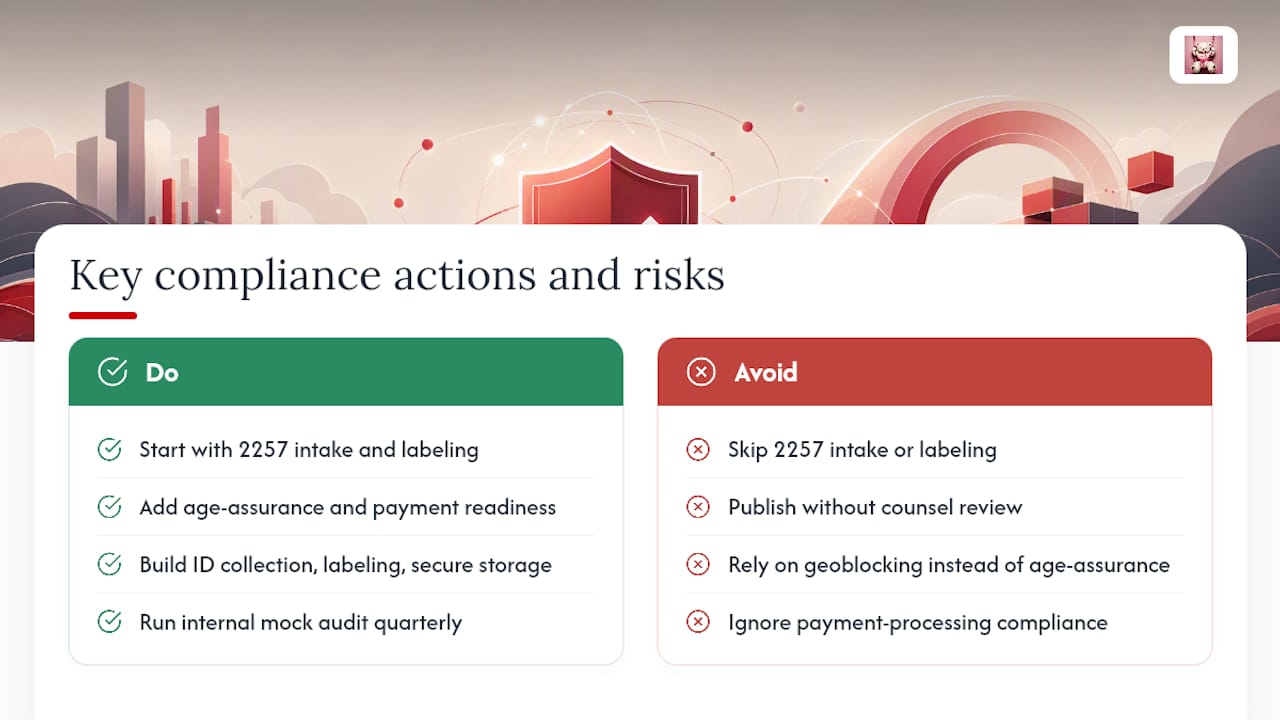
What happens if I ignore adult industry compliance tips around payment processing? You risk sudden account termination from your processor, which cuts off revenue faster than any regulatory fine would.
Sources
- 2257 compliance (DOJ / Part 75 summary)
- 18 U.S.C §§ 2257-2257A certifications (DOJ)
- Worldwide Compliance Adult Websites - Walters Law Group