

A kink event is any adult gathering built around socializing, education, or consensual BDSM play, and the right one depends entirely on your comfort level. This guide breaks down the main event types, decodes the language organizers use, and shows you exactly what a trustworthy listing includes before you hand over a ticket price or your real name.
TL;DR:
- Most events require attendees to undergo screening, orientation, or attend a munch beforehand, especially for play parties.
- Responsible listings explicitly state rules on conduct, photography policies, substances, dress codes, and accessibility to ensure safety.
- Unlisted venue addresses, missing safety protocols, or unclear rules are strong indications of a potentially unsafe or untrustworthy event.
- Community calendars and trusted platforms like Eventbrite are the best sources for locating legitimate kink events.
- Consensual negotiation and aftercare planning are essential parts of safe participation, with clear communication and support structures in place.
Table of Contents
- What Kink Event Types Actually Look Like
- The Rules Every Listing Owes You
- How to Find and Vet a Kink Event
- Consent, Aftercare, and the Practical Safety Stuff
- Who's Behind This Guide, and Where to Read More
- Start Small, Stay Curious
- List Your Event or Find Your Next One on Kinkykorner
- Sources
- FAQ
What Kink Event Types Actually Look Like
Every event type has its own rhythm, and a good listing tells you which one you're walking into before you show up in the wrong outfit.
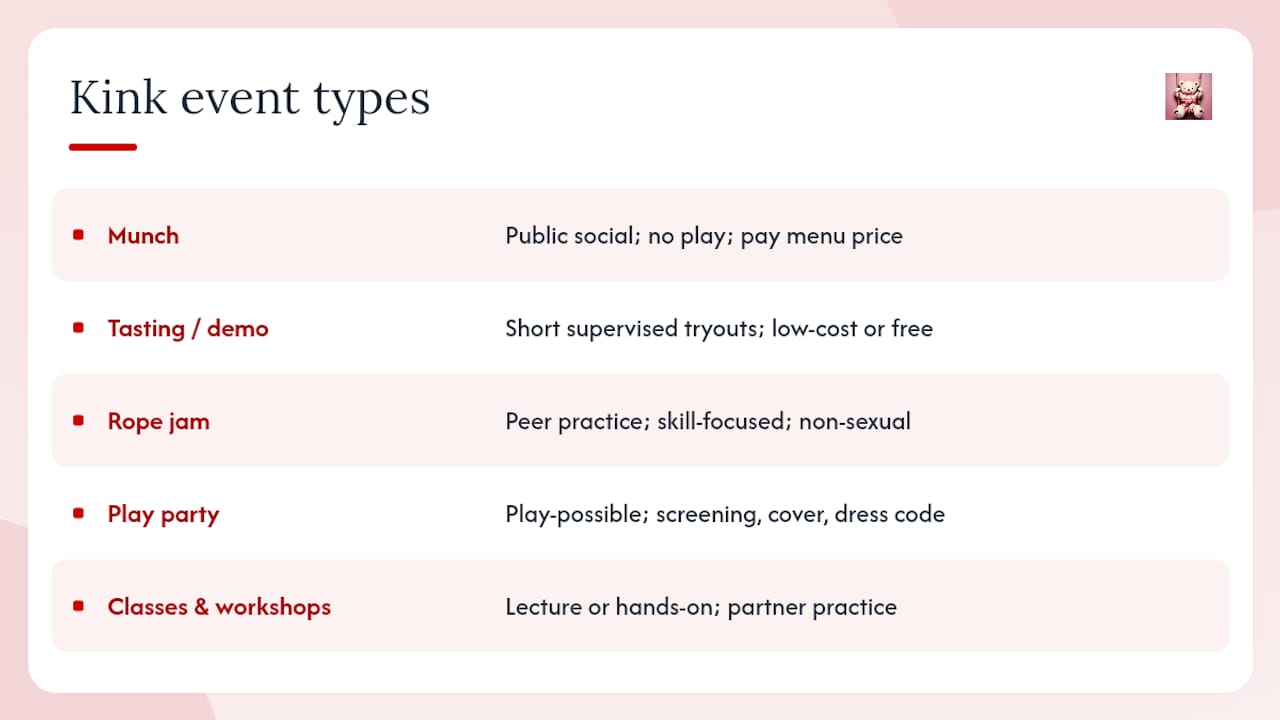
A munch is the front door of the community. It's a social meetup in a public restaurant or bar, dress is whatever you'd wear to brunch, and play is off the table entirely. Cost is whatever you order off the menu. Munches exist so strangers can ask questions without any pressure to perform.
A tasting or demo night lets you try a rope tie, a flogger, or an impact technique for a few minutes under supervision, usually low-cost or free, with zero expectation you'll go further.
A rope jam is a peer-practice space for people who already tie, or want to learn. It's collaborative and skill-focused, and despite the ropes and the occasional moan of concentration, it's typically not sexual.
A play party is where consent and structure matter most. These are "play-possible" events. Organizers explicitly allow adult play in designated areas, enforce dress codes at the door, and often provide suspension points and aftercare corners built into the venue itself. Expect a screening process, a cover charge, and a room that feels very different once the lights dim.
Classes and workshops split into two formats: lecture-style sessions where you sit and absorb technique, and hands-on sessions where you practice on a partner or a designated helper. Descriptions should say which one you're getting.
Conventions and festivals stretch over multiple days and stack all the above into one badge. Expect 50 or more classes, vendor halls, and evening play parties, with scholarship or volunteer slots often available to offset the higher badge price. If you're hunting for programming ideas as an attendee or organizer, examples of event formats worth borrowing can help you picture the range.
The Rules Every Listing Owes You
A responsible event description reads more like a contract than a flyer. Here's what should be spelled out before you buy a ticket.
- Code of conduct. The listing states what behavior gets someone removed and who enforces it.
- Photography and recording policy. Play areas almost always ban phones and cameras outright.
- Substance policy. Most serious play spaces are sober-only or heavily restrict alcohol once play begins.
- Intake or orientation requirement. First-timers are often asked to attend a munch or complete a short orientation before they get play-party access.
- Dress code and gear policy. This covers everything from "fetish attire required" to whether shared equipment gets wiped down between uses.
Pro Tip: If a listing skips the code of conduct entirely, treat that as a bigger red flag than an ugly website. Organizers who take safety seriously write the rules down, every time, without exception.
For a deeper walk-through of unwritten social norms, from greeting etiquette to how to approach someone at a party, Kinkykorner's event etiquette guide covers the ground rules a formal listing won't always spell out.
How to Find and Vet a Kink Event
Legitimate events cluster around a handful of predictable channels: moderated community calendars, Eventbrite, and old-fashioned word-of-mouth from someone you already trust in the scene.
A well-written listing gives you the venue type, a real pricing structure, a published code of conduct, and accessibility notes without making you dig or email five people first.
Watch for these warning signs before you commit:
- A venue address that stays "secret until payment," with no explanation beyond secrecy for its own sake.
- No stated rules, no mention of staff, and no way to ask questions before the event.
- Pricing that's oddly low for a supposedly vetted play party, or oddly high with no explanation of what it covers.
- Zero mention of screening, orientation, or who's actually running the room.
The safest move as a newcomer is attending a munch or an orientation session first. Ask the organizers directly whether they station trained monitors on the floor and what accommodations they can make. Real organizers answer that question without hesitating.
Consent, Aftercare, and the Practical Safety Stuff
The negotiation happens before anyone touches anyone. Scenes get discussed in advance: what's on the table, what's a hard no, and which safeword or hand signal stops everything immediately, no questions asked.
Enthusiastic consent looks like someone actively wanting to be there. Compliance looks like someone who's just going along with it because saying no feels harder than staying quiet. Learning to tell those apart is arguably the single most useful skill you can bring into any kink space, and Kinkykorner's breakdown of consensual kink and safety practices walks through how to spot the difference in real time.
A few things a responsible event description should mention:
- Where the designated aftercare space is, since drop can hit twenty minutes after the scene ends.
- Illness and bloodborne pathogen precautions, especially around shared gear.
- How to request accessibility accommodations, from low-scent policies to physical access.
Community calendars increasingly flag low-scent policies and ADA access directly in the listing, which tells you accessibility isn't an afterthought for organizers who take it seriously.
Pro Tip: Negotiate your aftercare needs with the same seriousness as the scene itself. "I need fifteen quiet minutes and water afterward" is a completely normal thing to say out loud.

Trauma-informed training for facilitators is also becoming standard practice, with programs teaching queer-affirming, consent-centered approaches to sexuality education. That shift is showing up in how the best events get run, not just how they get described.
Who's Behind This Guide, and Where to Read More
Kink is increasingly treated as a legitimate part of sexuality education, not a fringe curiosity. The Kinsey Institute's Human Sexuality Intensive runs a four-day academic course covering kink and consensual power exchange alongside other expressions of sexuality, which says something about how far the clinical world has come on this topic.
Kinkykorner built its marketplace around that same instinct: treat kink seriously, describe it clearly, and connect the people running events with the people looking for them. A few places to go deeper:
- Kink safety tips for practical, scene-by-scene guidance.
- Kink terms explained if the vocabulary in this article was new to you.
- Kink-friendly venues for finding spaces that already have accessibility and safety figured out.
Start Small, Stay Curious
Munches and classes exist for a reason: they let you build trust with a community before you ever set foot in a play space. Showing up more than once, asking questions, and letting people get to know you does more for your safety than any single background check ever could. Stay curious, but hold your limits like they're non-negotiable, because they are.
— Prenston
List Your Event or Find Your Next One on Kinkykorner
Kinkykorner is the alternative to scattered Facebook groups and half-updated calendars for organizers who want their event actually found by the right crowd. Instead of hoping word-of-mouth reaches enough people, organizers list once and get discovered by attendees actively filtering by event type, safety info, and location.
Posting is free with the Free Listing tier, or organizers can upgrade to a monthly plan or a yearly premium plan for more visibility, with details available on the pricing page. A strong listing should include everything this guide walked through: venue type, dress code, photography policy, code of conduct, and accessibility notes, since that's exactly what attendees are trained to look for now. Browsing the event and fetish categories shows how organizers slot their listings for maximum discovery, whether it's a rope jam, a play party, or a full weekend convention. If you're running an event or hunting for one worth attending, start by checking the current listings.
Sources
- A Guide to Kink Events – Magpie Kink Education
- Folsom 2026 Kinksters Paradise Party at The Kink Store | Eventbrite
- How to Find Kink Events Near You: A Practical Guide | East Coast Kink Events
- Human Sexuality Intensive | Kinsey Institute
FAQ
What exactly are kink events?
Kink events are adult gatherings organized around socializing, education, or consensual BDSM play, ranging from low-key munches to structured play parties. The format determines everything from dress code to whether play happens at all, which is why reading the event type carefully matters more than the venue's reputation alone.
How do you describe what a kink is?
A kink is generally described as a non-mainstream sexual interest or preference, ranging from a specific fetish object to broader interests like power exchange or bondage. It's distinct from a paraphilic disorder, which requires distress or harm, whereas a kink is simply a preference someone finds enjoyable and consensual.
What are some common examples of kinks?
Common examples include bondage and discipline, impact play, role play, sensory deprivation, and various forms of power exchange like dominance and submission. Interests vary enormously from person to person, and most people who explore kink only ever engage with a handful of these.
What is considered a kinky act?
A kinky act is any consensual activity that falls outside conventional sexual norms, from light bondage to more intense impact or sensation play. What counts as kinky is subjective and shifts by culture and individual comfort, which is exactly why clear consent and safety practices matter more than any fixed definition.
How much does it cost to list an event on Kinkykorner?
Organizers can post a Free Listing at no cost, or choose the Monthly plan at $4.99 a month or Yearly Premium at $149.95 a year for added visibility. Full details are available on Kinkykorner's pricing page.