

Most people hear "BDSM" and their minds immediately jump to danger, coercion, or something they saw in a poorly researched thriller. That snap judgment couldn't be further from the truth. Consensual kink is, at its core, one of the most communication-heavy, intentionally structured forms of intimacy out there. If you've been curious but cautious, or if you're already in the community and want a solid reference point, this guide walks you through what consensual kink actually means, the frameworks that keep it ethical, how edge cases like consensual non-consent work, and the practical steps to explore all of it safely.
Table of Contents
- Understanding consensual kink: Definition and core principles
- Consent frameworks: SSC vs. RACK
- Navigating edge cases: Consensual non-consent and where the line is drawn
- Practical steps for exploring consensual kink safely
- Prevalence, satisfaction, and community: Facts and myths
- Why informed consent matters more than any label: A fresh perspective
- Explore safe and supportive kink with Kinky Korner
- Frequently asked questions
Key Takeaways
| Point | Details |
|---|---|
| Consent is essential | Consensual kink depends on voluntary, informed agreement and the ability to stop at any time. |
| Safety frameworks matter | Understanding SSC and RACK helps you manage risks and communicate honestly. |
| Boundaries prevent harm | Clear boundaries and safewords are vital for ethical, satisfying experiences. |
| Complex edge cases exist | Practices like CNC require extreme communication and trust, making the difference between consent and assault clear. |
| Community and satisfaction | Many adults find satisfaction and support in kink communities, with prevalence higher than most expect. |
Understanding consensual kink: Definition and core principles
Let's get something clear right off the top. Consensual kink isn't chaos with a safe word tacked on at the last second. It's a deliberate, negotiated form of intimate expression. As Verywell Mind explains, "consensual kink" generally refers to BDSM or kink practices where all participants are adults, agree to the interaction voluntarily, and can withdraw consent; the activity is structured around communication, negotiation, and safeguards rather than coercion.
That word "structured" is doing a lot of heavy lifting there. This isn't winging it. People who practice ethical kink negotiate scenes, set limits, establish stop signals, and check in with each other before and after. WebMD reinforces that BDSM is an umbrella term for consensual relationship dynamics involving bondage, dominance and submission, and sadomasochism, with consent highlighted as the most important element and the distinguishing factor from assault.
The distinction between kink and abuse comes down to one thing: voluntary, ongoing agreement. Full stop.
Here are some core kink terms explained that every newcomer should know:
- Dominant (Dom/Domme): The person who takes the leading or controlling role in a scene
- Submissive (sub): The person who yields control within agreed limits
- Switch: Someone who moves between dominant and submissive roles
- Scene: A specific negotiated play session
- Limits: Personal boundaries, divided into hard limits (absolute no-go) and soft limits (negotiable with care)
- Aftercare: Emotional and physical support given after a scene ends
| Term | What it means | Why it matters |
|---|---|---|
| Negotiation | Pre-scene discussion of wants, limits, health needs | Sets the foundation for consent |
| Safeword | Agreed signal to pause or stop the scene | Preserves ongoing consent |
| Hard limit | An absolute boundary that cannot be crossed | Defines non-negotiable safety zones |
| Soft limit | A boundary that may be explored cautiously | Allows gradual, consensual expansion |
| Aftercare | Post-scene emotional and physical care | Supports mental health and connection |
"The moment you remove the voluntary agreement, you remove the kink. What's left isn't play. It's harm."
That quote reflects what every experienced practitioner knows intuitively: the consent is what makes it kink. Without it, nothing else matters.
Consent frameworks: SSC vs. RACK
Understanding terminology is just the start; safety and ethics are structured through specific frameworks used in the community. Two stand out as industry standards: SSC and RACK.
SSC stands for Safe, Sane, Consensual. It emerged in the 1980s and was designed to give the community a simple ethical baseline. "Safe" means minimizing physical and psychological risk. "Sane" means all parties are mentally present and capable of consent. "Consensual" means everyone has agreed freely.
RACK stands for Risk-Aware Consensual Kink. It came later as a more honest update to SSC, acknowledging that "safe" is genuinely relative. Some kink activities carry inherent risk, no matter how carefully you approach them. According to community educators, safety in kink discussions acknowledges that "safe" is not absolute and that risk cannot be eliminated; the RACK approach is designed to keep consent truly informed rather than pretending risks don't exist.
BDSM ethics frameworks like SSC and RACK are used to discuss how to manage safety and risk while keeping consent central throughout the interaction.
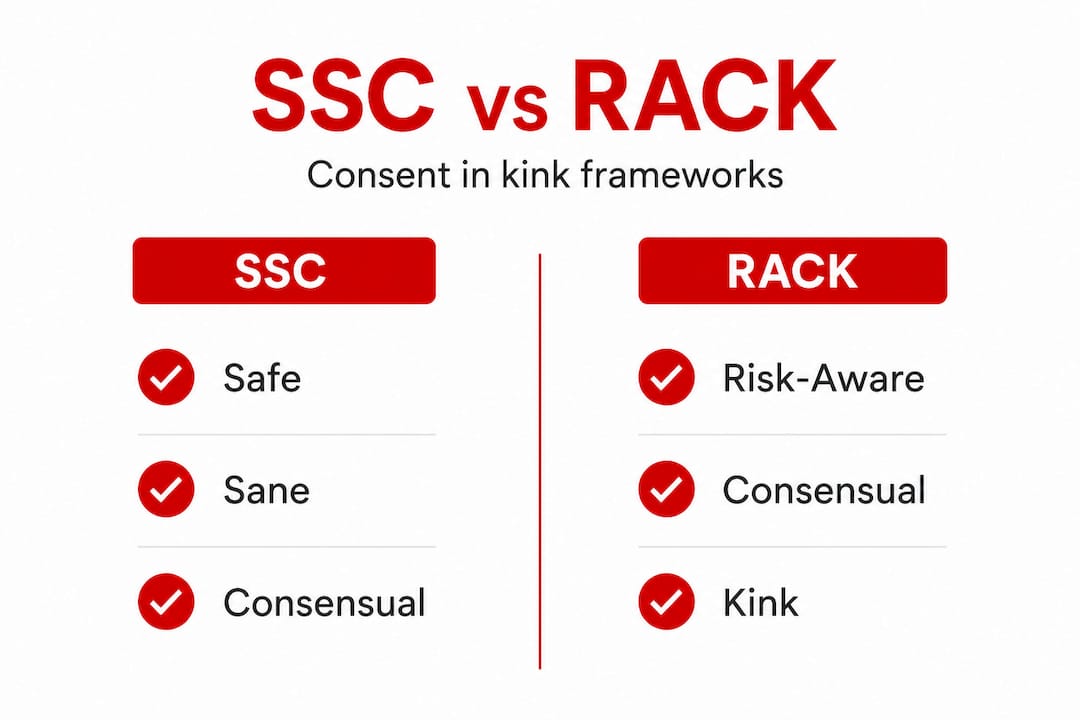
| Framework | Core philosophy | Best for | Limitation |
|---|---|---|---|
| SSC (Safe, Sane, Consensual) | Minimize risk; all parties are grounded | Beginners; lower-risk play | "Safe" can feel misleadingly absolute |
| RACK (Risk-Aware Consensual Kink) | Acknowledge risk; make informed choices | Experienced players; edgier activities | Requires more pre-scene education |
Here's how to apply either framework in practice:
- Identify the activity and its real risks. Don't romanticize. Look up what can actually go wrong with rope bondage, impact play, or whatever you're planning.
- Discuss those risks openly before the scene. Both SSC and RACK demand that no one is blindsided.
- Set your limits explicitly. Hard limits get written down if necessary. Soft limits get discussed.
- Establish a safeword and a non-verbal signal. Not everyone can speak during a scene. A tapped signal or colored word system (red, yellow, green) covers both.
- Check in during the scene. A quick "you okay?" isn't a mood killer. It's a consent checkpoint.
- Debrief afterward. Talk about what worked, what didn't, and how everyone feels.
Pro Tip: If you're new and feeling overwhelmed by SSC vs. RACK debates, just focus on communication in kink as the actual foundation. The frameworks are tools, not religions. What matters is that you and your partner(s) understand each other's risks, limits, and expectations clearly before anything starts.
Navigating edge cases: Consensual non-consent and where the line is drawn
Once basic consent practices are understood, it is important to explore nuanced scenarios where consent is negotiated in more complex ways. The most frequently misunderstood of these is CNC, or consensual non-consent.

CNC is a pre-negotiated form of role play where the scene is enacted as if force or coercion is happening, but it remains entirely consensual underneath. Think of it like an actor agreeing to film a fight scene. They're not actually being attacked. The violence is agreed upon, choreographed, and can stop the moment someone says cut. Research on CNC confirms it is pre-negotiated and enacted as if participants are being forced, but it remains consensual with the ability to withdraw consent and stop; if consent is withdrawn or ignored, it becomes sexual assault.
That last part is critical. Withdrawal ignored equals assault. No amount of pre-negotiation covers you if you keep going after someone has clearly tried to stop things.
Here are the essential safeguards for any CNC scene:
- Extensive pre-scene negotiation. CNC requires more conversation than almost any other type of play, not less.
- A clear, unmistakable stop signal. Some practitioners use a physical object like a ball that can be dropped as the non-verbal stop signal.
- A scene outline or script. Knowing roughly what's planned reduces surprises that could trigger genuine panic.
- No drugs or alcohol. Impaired consent isn't informed consent.
- A post-scene check-in. CNC can bring up unexpected emotions. Aftercare isn't optional here.
- Trust built over time. CNC isn't a first-scene activity. It requires deep familiarity with your partner's signals and limits.
"The line between consensual kink and abuse isn't drawn by what happens in the scene. It's drawn by whether everyone freely agreed, understood what they were agreeing to, and could genuinely stop it."
WebMD's overview makes this explicit: the line between consensual kink and abuse is the presence or absence of voluntary, informed consent and the ability to stop. Some sources contrast consensual BDSM and role play directly with sexual assault and coercion, and that contrast is useful. It strips away ambiguity. You can explore safe adult platforms to find more nuanced resources that don't conflate edgy play with harm.
Practical steps for exploring consensual kink safely
Now that edge cases have been clarified, readers can follow practical steps to explore consensual kink confidently and safely. This isn't a complicated process, but it does require intention and honesty.
The core methodology emphasized across kink education sources is an interaction model: negotiate beforehand, establish hard and soft limits and stop signals, obtain ongoing consent during play, and do aftercare and check-ins afterward.
Here's how to actually do that:
- Have the negotiation conversation before you're in the moment. Don't wait until things are already heated. Sit down, clothes on, and talk through what you both want, what you both don't want, and what you're curious about.
- Create your limit list. Write it down. Hard limits are firm. Soft limits can be approached slowly, with explicit check-ins.
- Agree on a safeword system. The traffic light system (red to stop, yellow to slow down, green to continue) works for most situations. Also agree on a non-verbal version.
- Start smaller than you think you need to. Escalate gradually across scenes, not within a single first scene. This lets trust build organically.
- Check in during the scene. A genuine "color check?" or a squeeze check keeps consent active, not just assumed.
- Do aftercare immediately after. This means physical comfort like blankets, water, and touch if wanted, and emotional space to talk or decompress. Aftercare isn't weakness. It's responsible kink.
- Do a scene debrief 24 to 48 hours later. Sometimes feelings surface later. A follow-up conversation catches what the immediate aftercare might miss.
Pro Tip: Joining the kink community through local munches (casual meet-ups with zero play), online forums, or educational events is one of the fastest ways to learn safe practices from experienced people. You don't have to figure this out alone, and the kinky community online offers a wealth of discussion threads, guides, and mentorship opportunities that can accelerate your learning curve safely.
Prevalence, satisfaction, and community: Facts and myths
To round out the guide, it's important to look at real-world data on prevalence, satisfaction, and community support for those interested in consensual kink. Here's the honest picture.
A major BDSM literature review found that BDSM practitioners report sexual and relationship satisfaction that is not dramatically worse than the general population; however, prevalence estimates vary widely due to definitions and sampling methods.
| Statistic | Finding |
|---|---|
| Range of BDSM interest prevalence | 2% to nearly 70% across studies |
| Active practitioners (rough estimate) | 20 to 30% of those who report interest |
| Reported relationship satisfaction | Comparable to the general population |
| Most common kink interest reported | Bondage and dominance/submission dynamics |
The wide variance in those prevalence numbers reflects how differently studies define "kink" and who they're asking. Some studies measure any fantasy, others measure active practice. Point being: you're not as alone in this curiosity as you might think.
Here's where to find real community and support for well-being through kink services:
- Local BDSM munches: Low-pressure social events, usually at cafes or bars, where no play occurs
- FetLife groups: Community forums and groups organized by interest, region, or relationship style
- Kink-positive therapists: Mental health professionals who understand BDSM without pathologizing it
- Online educational platforms: Detailed, practitioner-led guides on safety, technique, and consent
- Workshops and demonstrations: Hands-on learning events run by experienced community members at dungeon spaces or kink conventions
The community is far more organized and safety-conscious than its reputation suggests. Most experienced practitioners actively mentor newcomers and take consent violations seriously.
Why informed consent matters more than any label: A fresh perspective
Here's what I've come to believe after years of being in and around this community: people get so caught up in whether they're doing SSC or RACK, whether they're a "real" Dom or sub, whether their kink is "valid" enough, that they sometimes skip the thing that actually protects everyone. The ongoing, honest, sometimes awkward conversation.
Consent isn't a checkbox. It isn't "we talked about it once six months ago, so we're good." It's a living thing, and it shifts. What felt exciting last month might feel off today, and that matters. The framework you use matters less than whether you're actually checking in, actually listening, and actually adjusting when something changes.
I've seen well-meaning people hide discomfort because they didn't want to "ruin the scene" or seem inexperienced. That silence is where real harm lives. The label on your consent framework won't protect you if you're not using communication that shapes kink in real time, scene after scene.
The uncomfortable truth is that consent can be violated even between experienced, educated people who "know better." What keeps people safe isn't their vocabulary. It's their willingness to speak up, listen harder than feels comfortable, and be willing to stop when the situation asks for it. That's it. That's the whole game.
Explore safe and supportive kink with Kinky Korner
You've done the reading. You understand the frameworks, the edge cases, the practical steps. Now you need a place to keep exploring without judgment and with genuine community support.

Kinky Korner is built exactly for that. It's a marketplace and community hub where adults can browse kink-positive services and businesses, connect with practitioners, and access literary and artistic content that reflects the full, unfiltered range of consensual adult expression. Whether you're researching your next step, looking for a service provider who gets it, or just craving content that doesn't sanitize your desires into something unrecognizable, Kinky Korner is where you go. Come as you are. Stay curious.
Frequently asked questions
What makes kink consensual?
Kink is consensual when all participants freely agree, set their own boundaries, and retain the right to withdraw consent at any time, with the entire interaction structured around communication and voluntary agreement rather than coercion.
What does a safeword do in BDSM?
A safeword gives any participant the immediate power to pause or stop a scene, functioning as a real-time safety mechanism that preserves ongoing consent even during intense or role-played scenarios.
How is BDSM different from abuse?
BDSM is rooted in voluntary, informed consent and the genuine ability to stop at any time, while abuse lacks consent entirely; consent is the distinguishing factor between ethical kink and assault.
Can someone change their mind during a scene?
Yes, absolutely, anyone can withdraw consent at any point during a scene; ignoring that withdrawal transforms the act from consensual kink into assault, regardless of what was agreed to beforehand.
How common are BDSM or kink interests?
Prevalence estimates vary significantly depending on the study, but reported interest ranges from roughly 2% to nearly 70%, with active practice estimated at around 20 to 30% of those who report any interest.