

Most people treat their kink profile like a dating app bio. Throw in a few interests, maybe a photo, and wait. That approach misses everything that makes a kink profile actually work. A well-built kink profile isn't just an introduction. It's a consent document, a safety signal, and an invitation all rolled into one. Done right, it sets the tone before you ever exchange a single message. This guide walks you through exactly what a kink profile is, why it matters far more than people realize, and how to build one that brings the right people into your world.
Table of Contents
- What is a kink profile and why does it matter?
- Core components of an effective kink profile
- Checklists, consent, and safety: Profiles as negotiation tools
- Navigating common pitfalls and advanced profile strategies
- What most guides miss: The real power of an honest kink profile
- Discover and connect: Take your kink journey further
- Frequently asked questions
Key Takeaways
| Point | Details |
|---|---|
| Kink profiles build safety | Detailed profiles and checklists help set boundaries and promote consent in kink communities. |
| Clear roles and limits matter | Specifying your experience, preferred activities, and boundaries improves connections and reduces misunderstandings. |
| Consent frameworks differ | SSC and RACK approaches shape how you communicate risk, safety, and negotiation in your profile. |
| Avoid profile pitfalls | Steer clear of explicit-only imagery and overlinking; focus on relevant, honest information. |
| Evolve with your journey | Regularly update your profile to reflect your growth, learning, and evolving interests. |
What is a kink profile and why does it matter?
Let me be straight with you. A kink profile is not a Tinder bio with leather in it. It's a structured self-disclosure tool that tells the community who you are, what you're into, what your limits are, and how you operate. When you're discovering the kink community for the first time, the profile is often your first real handshake with potential partners and community members. That handshake either opens doors or quietly closes them.
The difference between a kink profile and a generic dating profile comes down to specificity and safety. A vanilla dating bio says "I like hiking and wine." A kink profile says "I'm a soft dominant exploring rope bondage, my hard limits are X and Y, and I always negotiate before any scene." One of those profiles starts a real conversation. The other wastes everyone's time.
Here's what a strong kink profile typically covers:
- Roles and dynamics: Dominant, submissive, switch, top, bottom, rigger, rope bunny. Be specific and honest, even if you're still figuring it out.
- Interests and kinks: List what genuinely excites you, not what sounds impressive. Curated honesty beats a shopping list of buzzwords.
- Hard and soft limits: Hard limits are non-negotiable. Soft limits are areas you might explore with the right person and the right conversation. Both belong in your profile.
- Safety signals: Preferred safe words, aftercare needs, and any health or accessibility considerations that affect how you play.
- Experience level: Are you a seasoned player or brand new? Stating this upfront filters for compatible connections and protects you.
"A profile that's honest about limits and experience isn't vulnerability. It's power. It tells the community you know yourself, and that makes you safer and more attractive to the right people."
The data backs this up. Profiles with structured information using tools like interactive maps on kink platforms get 40% more messages, and studies on 652 adults found that structured checklists meaningfully improve both consent clarity and safety outcomes. That's not a minor edge. That's the difference between a profile that sits dormant and one that builds your community.
Common misconceptions kill good profiles fast. Leading with explicit-only photos, overloading your bio with external links, or performing an experience level you don't have are all profile killers. Authenticity converts. Posturing repels.
Core components of an effective kink profile
With a clear idea of what a kink profile is, let's break down what makes a profile not just informative but truly effective, inclusive of your needs and safe practices.
Think of your profile like the front page of a negotiation. Before you ever sit down with a potential partner to discuss a scene, your profile has already done some of the heavy lifting. It signals what you want, what you won't accept, and how you like to communicate. Understanding consent and kink terms is essential groundwork before you write a single word of your profile.

Here's a breakdown of what to include versus what to leave out:
| Profile element | Include | Avoid |
|---|---|---|
| Role and dynamic | Clear, specific role(s) and what they mean to you | Vague descriptors like "into everything" |
| Interests | Genuine kinks with some context | Laundry lists with zero explanation |
| Limits | Hard limits stated clearly, soft limits flagged | Leaving this section blank entirely |
| Safe words | Your preferred system, e.g., traffic light | Assuming everyone uses the same defaults |
| Aftercare needs | What you need post-scene, even if it's just space | Treating aftercare as optional or embarrassing |
| Experience | Honest level, even if it's beginner | Inflating experience to seem more appealing |
| Photos | Face or lifestyle photos that reflect your identity | Explicit-only images as your entire gallery |
| External links | One or two relevant, vetted links | Stacking links to every platform you're on |
For newbies, the BDSM Kink Checklist is clear that stating your inexperience is not a weakness. It's smart. New community members who are upfront about being fresh to the scene and express genuine interest in education, mentorship, or attending events attract experienced, ethical players who actually want to help. They also avoid being targeted by people who exploit uncertainty.
Content creators need a special note here. If you're understanding adult platform listings or building a presence across multiple platforms, keep your personal kink profile and your professional offerings separate. Blurring those lines creates confusion and sometimes genuine safety risks. Your personal profile is about you as a person in the community. Your business profile is about what you offer professionally.
Pro Tip: Write your profile as if you're speaking to someone you'd genuinely want to meet. Not to impress a crowd, not to shock strangers, but to connect with the specific kind of person or community you're actually looking for. That focus makes every word count.
Checklists, consent, and safety: Profiles as negotiation tools
Once your profile has all the right pieces, it becomes a powerful tool. Here's how detailed profiles enable safe, satisfying scenes and consent negotiation.
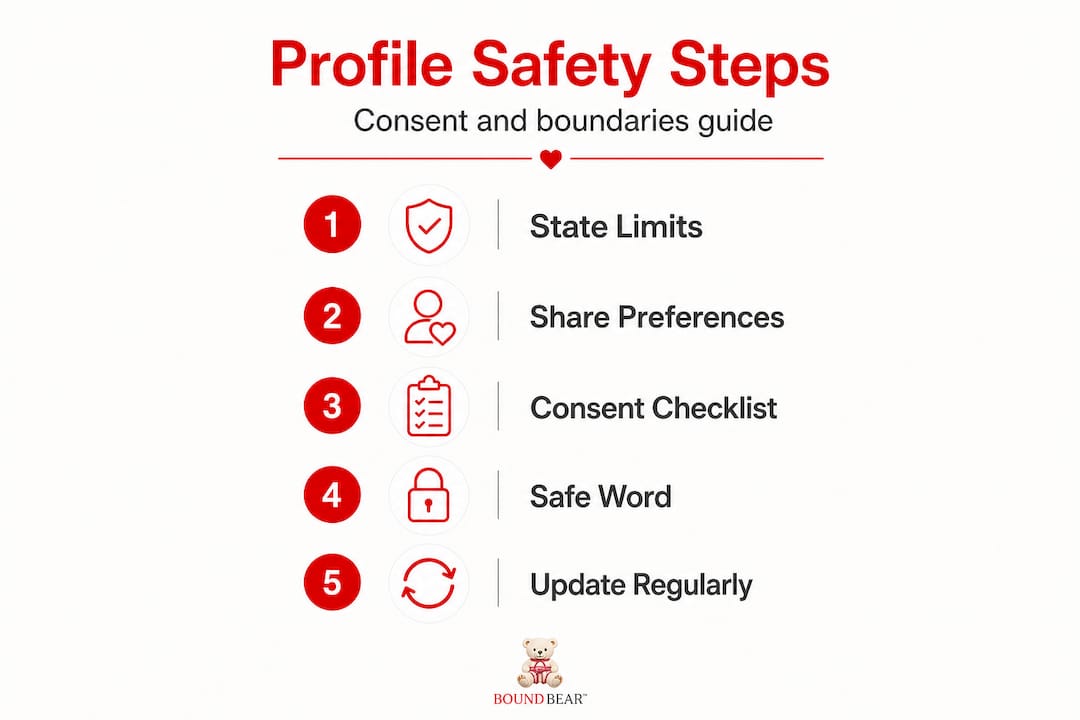
Your profile is a launching point, not the full conversation. Think of it as the opening chapter. The real negotiation happens before any scene, but your profile determines who shows up to that negotiation in the first place. When you list your limits, desires, and non-negotiables upfront, you're pre-filtering for people who can actually work with your boundaries. That saves time, reduces awkward conversations, and honestly makes the whole thing safer.
Communication in kink negotiation is a skill that starts with your profile and extends through every interaction. Here's a practical sequence for how profiles feed into consent and scene negotiation:
- Build your profile with a kink checklist. Use a structured checklist to identify your limits, desires, and non-negotiables. This process is valuable even if you never share the full list publicly.
- Flag your consent framework. Do you operate under SSC (Safe, Sane, and Consensual) or RACK (Risk-Aware Consensual Kink)? These aren't just acronyms. They reflect your philosophy about risk and your expectations going in. Both SSC and RACK frameworks carry different implications for how you discuss consent and should influence the language you use in your profile boundary statements.
- State your aftercare requirements early. Aftercare, meaning the physical and emotional care that happens after a scene, is not optional. It's part of the scene. Listing your aftercare needs in your profile tells potential partners you understand this and take it seriously.
- Use your profile as a conversation starter, not a contract. Kink safety resources confirm that profiles work best as negotiation starters that you then build on through direct conversation, checklists, and ongoing communication.
- Update your profile after significant scenes or shifts in your interests. You change. Your profile should too.
Here's a quick look at how SSC and RACK differ in terms of how they show up in profile language:
| Framework | Core principle | Profile language example |
|---|---|---|
| SSC (Safe, Sane, Consensual) | Activities must be safe, sane, and consensual for all involved | "I operate under SSC. No activity proceeds without full discussion and agreement." |
| RACK (Risk-Aware Consensual Kink) | Acknowledges some activities carry inherent risk; consent is informed and risk-aware | "I use a RACK framework. I expect informed discussion of risks before any edge play." |
Pro Tip: Drop your safe word preference directly in your profile, not buried in messages later. If you use the traffic light system (red, yellow, green), say so. It signals you've done the work and you take safety seriously.
Navigating common pitfalls and advanced profile strategies
Even with a solid profile, navigating common online pitfalls and using advanced strategies can make the difference between frustration and connection.
Here's one misconception that trips people up constantly. FetLife, one of the most well-known kink platforms, is not a dating site. It's built around groups and events. Treating it like a swipe-based app leads to disappointment and missed opportunities. The real power of platforms like FetLife lives in community groups, local munches (low-key social meetups for kink-minded people), and events where connections form organically.
Common pitfalls to dodge:
- Assuming silence means consent. No response to a message isn't an invitation to try again or escalate. Move on.
- Leaving your inexperience unstated. If you're new, say so. Hiding it creates mismatches and sometimes dangerous situations.
- Oversharing in the first version of your profile. You don't need to list every trauma, every fantasy, or every past relationship dynamic right away. A solid profile is focused, not exhaustive.
- Ignoring blocking and reporting tools. If someone is making you uncomfortable, use the tools. That's what they're there for. Protecting your profile experience is part of taking the community seriously.
"The best profiles I've seen aren't the most detailed ones. They're the ones that feel like a real person wrote them. Specific, grounded, and a little bit vulnerable."
Advanced strategies for community builders and content creators look a bit different. If you're working on tips for adult content creators or actively building a kinky community, your profile carries extra weight. Here's how to level up:
- Use group memberships and event attendance to signal active community participation, not just interest.
- Keep your privacy settings sharp. Decide what's public, what's for friends, and what's private. This isn't paranoia. It's smart profile management.
- If you run events or offer education, mention that in your profile. It positions you as a contributor, not just a consumer.
- Refresh your profile every few months. Stale profiles suggest disengagement.
What most guides miss: The real power of an honest kink profile
Here's the thing most profile guides won't tell you. Formulaic profiles don't build trust. They just check boxes. And in a community that runs on trust, a checked-box profile is almost as useless as no profile at all.
I've seen people with elaborate, beautifully formatted profiles who couldn't hold a real scene negotiation to save their lives. And I've seen simple, plainly written profiles that somehow communicated everything: who this person is, what they need, and exactly what kind of energy they bring into a dynamic. The second kind almost always leads to better connections. Every time.
The real power of an honest kink profile is that it forces you to know yourself before you ask someone else to trust you. That self-reflection isn't a warm-up exercise. It's the whole point. When you sit down and actually think about your limits, your desires, your aftercare needs, and your communication style, you become a safer and more connected partner. That process benefits you regardless of whether anyone else ever reads your profile.
Shortcuts and posturing do the opposite. Faking experience you don't have, listing kinks you've only read about, or performing a dominant or submissive energy that isn't yours yet. These things erode safety and trust. And in kink, when trust erodes, people get hurt.
Even experienced players get lazy about this. If you've been in the community for years, your profile might be outdated, reflecting a version of yourself from three relationships and a dozen scenes ago. Updating it regularly is part of the practice. If you're thinking about starting a kink business or building a professional presence in the kink space, an honest and current personal profile also builds the kind of credibility that a business profile simply can't create on its own.
Openness about your limits, your learning edges, and your current interests doesn't make you look inexperienced or vulnerable. It makes you look like someone worth knowing.
Discover and connect: Take your kink journey further
Ready to put your knowledge to work? Here's how you can leverage this guide and find your community.
Building a strong kink profile is only the beginning. The real magic happens when you step into a community that respects what you've put out there and reflects it back with curiosity, enthusiasm, and care. Whether you're a newcomer finding your footing or an experienced player looking to grow your network, having the right platform makes all the difference.
At Kinky Korner, you can list your services, build your presence, and connect with a community that takes consent, creativity, and genuine connection seriously. If you're also creating adult content and want to grow your audience, explore how to promote adult content in ways that are strategic and authentic. Your profile is your foundation. Now it's time to build on it.
Frequently asked questions
What details should newbies share in their kink profile?
State your inexperience openly, name the areas you're curious about, and express genuine interest in attending events or finding mentorship. Per the BDSM Kink Checklist, newcomers who are upfront about being new attract ethical, experienced community members who want to help.
How can a kink profile improve safety and consent?
Structured profiles and checklists clarify limits and consent before any interaction escalates. Studies on 652 adults found that using structured checklists in kink settings meaningfully improves both consent clarity and safety outcomes.
Is FetLife a dating site or for groups and events?
FetLife is built around community groups and events, not traditional dating or matching. Treating it like a hookup app means you're missing the platform's actual strengths.
Should I use explicit images or share multiple external links in my profile?
Skip the genitals-only photo gallery and the wall of external links. The BDSM Kink Checklist is clear that over-listing links and leading with explicit-only images reduces your credibility and engagement with the people you actually want to meet.
What is the difference between SSC and RACK in kink profiles?
SSC (Safe, Sane, and Consensual) emphasizes that activities must be safe and sane for everyone involved. RACK (Risk-Aware Consensual Kink) acknowledges that some activities carry real risk and focuses on informed, aware consent. Per the BDSM Kink Checklist, your framework preference shapes how you word your boundary statements in your profile.