

Finding genuine kinky connection online feels like navigating a minefield some days. You want authenticity, safety, and a real sense of belonging, but the internet is cluttered with unmoderated hellholes, creepy DMs, and spaces that make you feel more exposed than empowered. I've been there, scrolling through profiles that feel about as warm as a parking garage at 2 a.m. The truth is, building a kinky community online that actually works requires more than a Discord server and good intentions. It takes strategy, trust, and a whole lot of care for the people who walk through your digital door.
Table of Contents
- Get ready: What you need to build a kinky community online
- Step-by-step: Setting up your kinky online community
- Moderation, safety, and privacy: Protecting members and trust
- Troubleshooting: Common mistakes and how to fix them
- Our perspective: What truly makes a kinky online community thrive
- Discover your next kinky community online
- Frequently asked questions
Key Takeaways
| Point | Details |
|---|---|
| Trust is the foundation | Verified profiles and kink-literate moderation are the cornerstone of safe, thriving communities. |
| Micro-communities excel | Focused, smaller groups maintain higher engagement, retention, and satisfaction among members. |
| Safety needs continuous attention | Privacy tools and consent education must evolve to counter new online risks. |
| Onboarding shapes community culture | Welcoming beginners and educators is key to sustainable growth and inclusion. |
Get ready: What you need to build a kinky community online
With these challenges in mind, let's inventory what you'll need to build a welcoming and secure kinky community online.
Before you set up anything, be brutally honest with yourself about what you're creating and for whom. Are you building a space for rope enthusiasts, a broad BDSM education hub, or a local munch coordination group? Clarity of purpose shapes every decision you'll make after this point, from platform choice to moderation tone.
On the technical side, the core mechanics for building an online kinky community include dedicated platforms with verified profiles, forums for knowledge sharing, event calendars for munches and play parties, and privacy-focused features like end-to-end encryption and kink-literate moderation. That's your baseline. Without at least most of those pieces, you're building on sand.
Here's a quick checklist of what you need before you launch anything:
- A defined niche or purpose (education, social, event planning, or all three)
- A platform that supports privacy controls, group creation, and event tools
- Community guidelines written clearly, covering consent, harassment, and disclosure
- Verification methods rooted in SSC (Safe, Sane, and Consensual) or RACK (Risk-Aware Consensual Kink) frameworks
- At least two moderators who are kink-literate and available consistently
- Onboarding materials for newcomers who may feel nervous or overwhelmed
The onboarding piece is one people constantly underestimate. Someone new to joining kink communities is often nervous, possibly closeted, and acutely aware of the risks of exposure. Your onboarding process is the handshake that sets the tone for everything. Make it warm, thorough, and non-judgmental.
Pro Tip: Write your community guidelines before you invite anyone. Retroactively adding rules after a conflict feels chaotic and unfair. Having them in place from day one signals seriousness and builds immediate trust.
| Resource | Why it matters | Where to find it |
|---|---|---|
| End-to-end encryption (E2EE) | Protects private conversations | Signal, Session, or custom platforms |
| SSC/RACK frameworks | Establishes consent standards | Community documentation, FetLife groups |
| Kink-literate moderators | Handles conflicts with context | Experienced community members |
| Event calendar tools | Coordinates munches and parties | Platforms like FetLife or custom builds |
| Privacy settings | Controls member visibility | Platform-specific features |
Knowing what safe play venues look like in the physical world also informs how you should design your digital one. The principles translate directly: clear rules, trained staff, and a zero-tolerance policy for violations.
Step-by-step: Setting up your kinky online community
Once you've gathered your essentials, it's time to launch your community. Here's how, step by step.

Step 1: Choose your platform wisely. Established platforms like FetLife, which has over 10 million users, emphasize community forums, groups organized by fetish, event listings, and written content over dating, making them genuinely useful for discussions, education, and local connections. FetLife is the obvious starting point for most people because the infrastructure is already there. But it has real privacy limitations, rating around 3 out of 5 on privacy benchmarks. KNKI is a newer contender that scores higher on privacy and is worth considering if your community handles sensitive topics or members with high exposure risk.
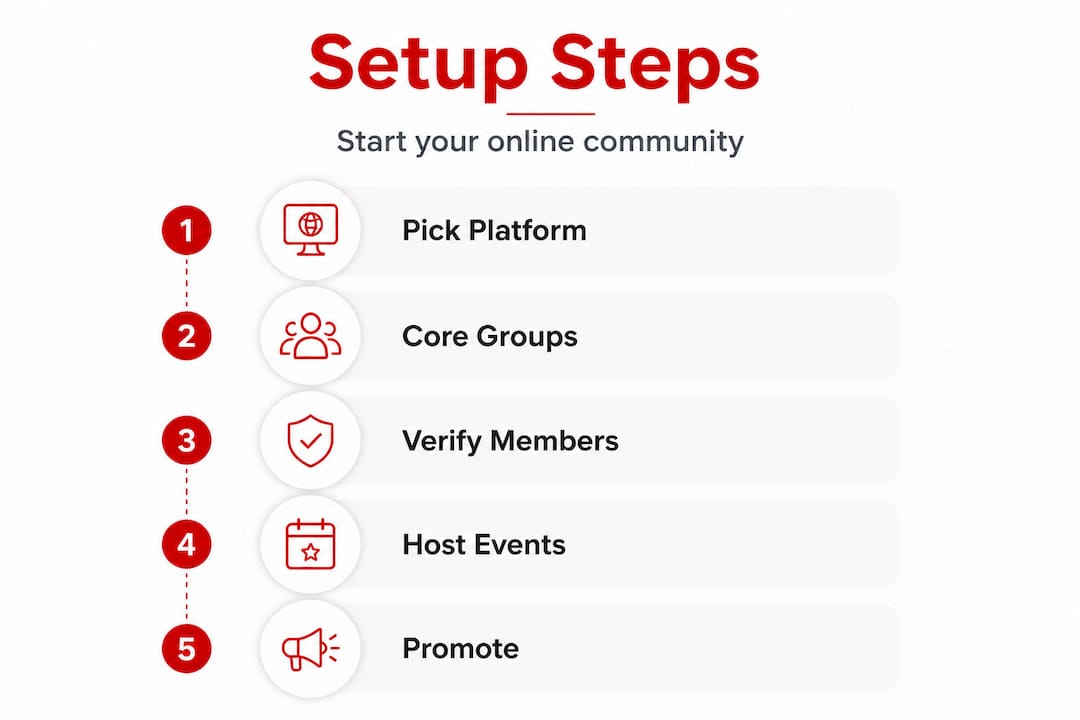
Step 2: Create your core group structure. Don't try to cover everything at once. Start with two or three focused forums or groups: one for introductions, one for your niche topic, and one for announcements and events. Keeping it focused early prevents the fragmented, ghost-town feeling that kills new communities before they gain momentum.
Step 3: Enable verification before you open the doors wide. Verified profiles don't need to mean real names. They mean members have agreed to your terms, confirmed their age, and completed your onboarding process. This single step filters out a surprising amount of bad actors.
Step 4: Schedule your first events. These can be virtual: an introductory Q&A, a consent education session, or a casual chat night. Check out event ideas for kink to spark your planning. Events create rhythm, and rhythm keeps people coming back.
Step 5: Promote thoughtfully. Share in existing kink spaces with transparency about what you're building. Word of mouth inside trusted circles beats blanket advertising every time.
The global kink market reached $2.5 billion in 2023, with 10 percent of the US population having tried BDSM and 65 percent of practitioners reporting better relationships because of their kink practice. That tells you the audience is real, large, and hungry for quality spaces. You're not building for a niche fringe. You're building for a significant, underserved community that deserves something better than what they've been handed.
| Platform | Privacy score | Community tools | Event features | Best for |
|---|---|---|---|---|
| FetLife | 3/5 | Excellent (forums, groups) | Yes (munches, parties) | Broad community building |
| KNKI | 5/5 | Growing | Limited | Privacy-first users |
| Custom site | 5/5 (if built right) | Fully customizable | Fully customizable | Established communities |
| Discord | 3/5 | Good (channels, roles) | Limited | Tight-knit groups |
Pro Tip: Micro-communities consistently outperform broad networks for retention and engagement. A 200-person group built around a specific interest will feel more alive and connected than a 10,000-person group built around "kink" in general. Start small and focused. You can always expand later. Browse community platform options for more context on what's out there.
Moderation, safety, and privacy: Protecting members and trust
With your community online, strong moderation and privacy practices are essential to earn members' trust.
Let me be real with you: bad moderation will kill your community faster than anything else. One ignored harassment report, one leaked member list, one moderator who doesn't understand consent dynamics, and people vanish. The trust you build over months can evaporate overnight. Safety and moderation best practices prioritize clear boundaries, ongoing consent education, trained kink-literate moderators, zero tolerance for harassment, robust privacy compliance with standards like GDPR and CCPA, age verification, and human-first moderation over AI alone.
That last point matters. AI moderation is a support tool, not a replacement for humans who understand kink context. A conversation about consensual impact play looks very different from actual abuse, and an algorithm often can't tell the difference. Your moderators need to know the difference intuitively.
Here's what a solid moderation framework looks like in practice:
- Clear rules posted visibly, with consequences spelled out for first and repeat violations
- A confidential reporting system so members can flag issues without fear of public retaliation
- Regular moderator check-ins to review reports, discuss edge cases, and avoid burnout
- Consent education resources pinned and accessible to all members, especially newcomers
- Fast response windows, ideally under 24 hours for harassment reports
Understanding consent and safety at a foundational level is not optional for anyone on your mod team. It's the table stakes.
On the privacy side, edge cases include privacy breaches, predatory behavior in unmoderated spaces, doxxing risks, and the complex balance between anonymity and verification. The recommended tools here are burner devices for sensitive communications, metadata stripping from photos before posting, and basic OpSec (operational security) threat modeling, which means asking "what's the worst that could happen if this information got out, and how do I prevent that?"
"Privacy in kink spaces isn't paranoia. It's survival. People lose jobs, custody of children, and family relationships when their kink lives are exposed without consent. Building privacy infrastructure into your community from the start is an act of genuine care for your members."
The risks are documented and real. Learning about online safety risks specific to adult spaces and building safe communication habits across your community will protect people in ways that genuinely matter.
Troubleshooting: Common mistakes and how to fix them
Even the best communities encounter obstacles. Here's how to recognize and fix them.
The number one mistake I see is chasing features over trust. Someone decides they need a points system, custom badges, a dedicated app, live streaming, and a virtual dungeon all in year one. The result? A bloated, confusing platform that nobody actually uses because nobody feels safe or connected in it. Experts recommend focusing on beginners' needs like accessible onboarding and non-mocking spaces, and educators who need solid event tools, rather than feature stacking. FetLife succeeds not because it's technically impressive but because its persistent forums create ongoing, searchable conversations that outlast individual users.
Other common mistakes:
- Poor onboarding: Dropping new members into an active forum with no introduction ritual is disorienting. Create a dedicated "introductions" space and actively welcome newcomers.
- Lack of inclusion: Communities that default to a narrow demographic (typically white, cisgender, heterosexual kinksters) quietly signal that others aren't welcome. Intentional inclusion of LGBTQ+ members, people of color, disabled practitioners, and those from diverse cultural backgrounds isn't just ethical. It makes your community stronger.
- No feedback loops: You can't improve what you don't measure. Build in regular surveys, open suggestion threads, or informal check-ins to understand what members need.
- Ignoring burnout in moderators: Moderation is emotionally heavy work. Rotate responsibility, acknowledge the labor, and compensate moderators where possible.
Methodologies evolve, and starting with groups on existing platforms like FetLife before scaling to custom sites is smart. Continuous education, active feedback loops, and genuine inclusion for diverse backgrounds aren't nice-to-haves. They're the engine of long-term retention.
Explore kink culture insights to keep your community grounded in real, nuanced understanding rather than surface-level assumptions about what kinksters want and need.
Pro Tip: Run a "soft launch" with 20 to 30 trusted members before opening publicly. Use their feedback to fix the obvious problems before a larger audience shows up and forms first impressions you can't undo.
Our perspective: What truly makes a kinky online community thrive
After troubleshooting, it's worth considering what really sets successful kinky spaces apart from the crowd.
Here's the uncomfortable truth that nobody wants to say out loud: most kinky online communities fail not because of bad technology but because of bad human dynamics. The Discord servers and FetLife groups that die are almost always the ones where the founder treated trust as an afterthought. They built beautiful spaces with terrible foundations.
What I've seen work, over and over again, is this: small, intentional, high-context communities where people feel genuinely known. Not platforms with 50 features. Not groups with 50,000 members. Small groups where the moderators know your name, where you're greeted when you show up, and where asking a "dumb" question won't get you mocked.
Micro-communities win because intimacy scales downward, not up. The bigger a community gets, the harder it becomes to maintain the personal texture that makes people feel safe enough to be fully themselves. That's the paradox of growth in this space. Chasing numbers often kills the very thing that made your community worth joining.
And here's another hard one: openness without vigilance is dangerous. The kink community talks a lot about "community policing" as a virtue, but self-policing only works when there's a shared culture of accountability. That culture has to be actively built and constantly reinforced. It doesn't emerge naturally. It's a choice, every single day, by every moderator and engaged member.
How communication shapes safe and satisfying kink is not just about negotiation before a scene. It's about the ongoing dialogue that makes a community a community rather than just a gathering of people in the same digital room.
Technology is a tool. Trust is the product. Build trust first, and the technology will serve you well.
Discover your next kinky community online
Ready to take the next step? Here's where you can find your tribe and build lasting connections.
Building a kinky community from scratch is deeply rewarding, but sometimes you need a head start. A space that already has the infrastructure, the culture, and the people.

Kinky Korner is a marketplace where adults in the kink community can list adult-themed services and businesses, connect with others, and explore erotic literary and artistic content. Whether you're looking to grow your own corner of the kink world, find vetted service providers, or simply connect with people who genuinely get it, Kinky Korner brings it together in one place. Browse listings, read community content, and find events that match your interests. Your people are already there.
Frequently asked questions
What are the safest platforms for building a kinky community online?
KNKI scores 5/5 on privacy and is rated highly for protecting member data, while FetLife's 10M+ users make it the strongest choice for community engagement, forums, and event organization.
How do I verify community members without exposing their identity?
Use SSC or RACK consent frameworks, confidential onboarding flows, and privacy tools like E2EE and burner devices so you can confirm member intent without requiring real identity disclosure. Operational security practices like metadata stripping add another layer of protection.
How can I prevent harassment in my online kinky community?
Zero tolerance policies, kink-literate moderators, and consent education woven into onboarding are your three strongest tools against harassment. Fast response to reports matters just as much as the rules themselves.
What is the best way to onboard new members?
Create a dedicated introduction space, welcome newcomers personally, and introduce consent education early and without condescension, as experts emphasize non-mocking spaces as essential for retaining beginners and building long-term community health.