

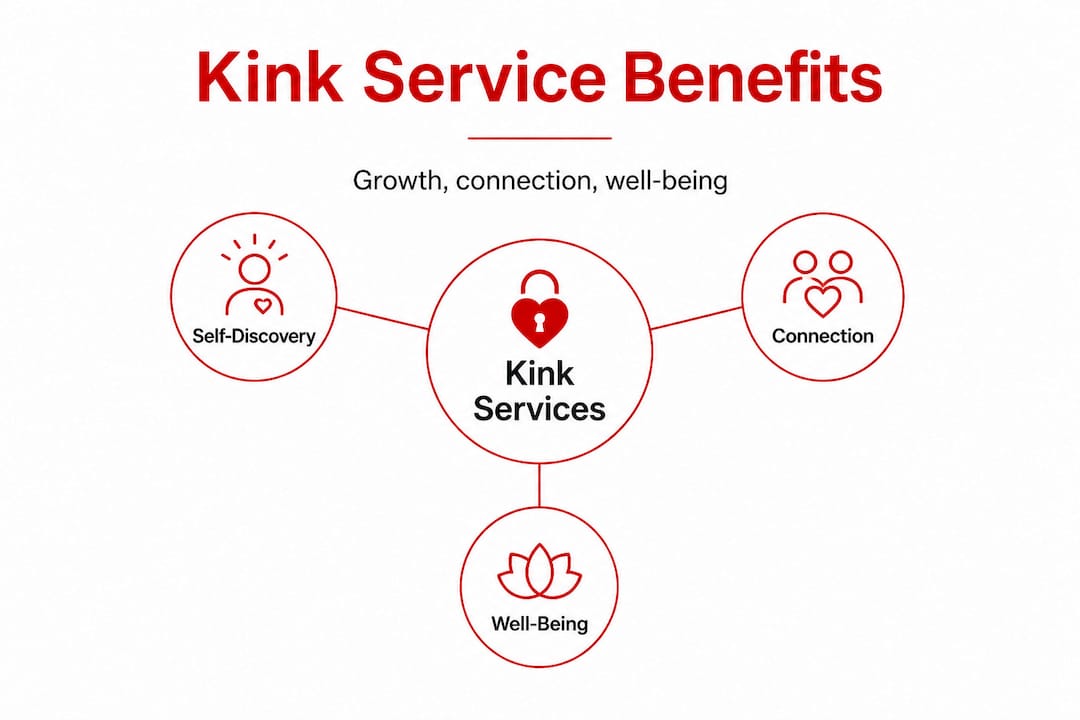
Let's be real. Most people assume kink services are about one thing: sexual novelty. A little spice, maybe a fantasy fulfilled, and then back to regular life. But that framing misses almost everything that actually matters. Research confirms that many adults explore BDSM as a form of self-knowledge and personal meaning-making, not as a cheap thrill. The adults who find kink services genuinely transformative are rarely chasing shock value. They are chasing something real: identity, intimacy, community, and a version of themselves they couldn't find anywhere else.
Table of Contents
- Beyond sexual novelty: Identity, fulfillment, and self-expression
- Well-being and relationship benefits: Emotion, intimacy, and community
- Physical and mental health: Kink services in chronic pain contexts
- Consent, safety, and limitations: Navigating edge cases
- Our perspective: Why meaningful kink is more than pleasure or taboo
- Take the next step: Find your community and unlock your inner potential
- Frequently asked questions
Key Takeaways
| Point | Details |
|---|---|
| More than sexual novelty | Kink services support self-discovery, fulfillment, and connection as primary motivations. |
| Holistic well-being gains | Many participants gain emotion regulation, improved intimacy, and community engagement. |
| Physical and mental support | Some people with chronic pain report short-term relief and psychological benefits from kink activities. |
| Consent and safety matter | Complex practices require dynamic, ongoing consent and transparent communication for participant safety. |
| Community enhances experiences | Engagement in kink often leads to resource-sharing, mentorship, and deeper social fulfillment. |
Beyond sexual novelty: Identity, fulfillment, and self-expression
Having established that motivations go far beyond basic novelty, let's unpack what truly drives people to explore kink services.
The first thing you need to understand is that for a lot of people, kink isn't a hobby. It is closer to a lens through which they see themselves more clearly. A submissive who spends their whole professional life making decisions for others might find genuine release in relinquishing control for a few hours. A dominant who navigates chaotic family dynamics might discover a deep sense of calm and competence in structured power exchange. These aren't performances. They are honest expressions of something that already existed inside.
The qualitative research on BDSM participants makes this point clearly: self-knowledge is a primary driver. Not just "I want to try something different." More like, "I want to understand who I actually am and what I actually need." That is a fundamentally different kind of engagement, and it changes everything about how you approach a kink service or a kink community.
Here's what makes this nuanced though. Identity and practice don't always line up neatly. Some people identify deeply with BDSM as a lifestyle and engage in it daily as part of their relationship structure. Others dip in occasionally, using specific services to explore a facet of themselves without committing to a full-time dynamic. Both are valid. Both serve a real purpose. The mistake is assuming everyone has the same motivation.
What actually draws people in, beyond the obvious stuff:
- Self-expression: Kink gives you permission to embody parts of yourself that polite society doesn't leave room for. Aggression, vulnerability, control, surrender. All of it can live here.
- Fulfillment: There is something deeply satisfying about a scene done well. Like finishing a hard workout or nailing a presentation. It is earned.
- Community values: Kink communities tend to prioritize consent, communication, and honesty at a level that many people find refreshing compared to vanilla social circles.
- Identity exploration: For some, figuring out how to join the kink community is the first step in a much longer process of understanding their gender, sexuality, or relational needs.
"Kink is not a detour from self-discovery. For many people, it is the fastest road there." That's not a therapist talking. That's what you'll hear over and over from people who've been doing this long enough to have perspective.
Pro Tip: If you're new to this space, read up on kink culture insights before jumping into services. Understanding the culture first gives you a framework to recognize what resonates with you and what doesn't.
Well-being and relationship benefits: Emotion, intimacy, and community
Now that we've explored self-expression and identity, how do these services translate to broader well-being and relationship benefits?

This is where things get genuinely interesting, and also where the research starts to feel less like a surprise and more like a confirmation of what practitioners already knew intuitively. Well-being benefits extend beyond sexual pleasure for many BDSM practitioners, including emotion regulation, intimacy-related communication, and community engagement. That's a meaningful set of outcomes.
Think about emotion regulation for a second. If you've ever been in a scene where intensity built and then released, you know that physical and emotional release can be profound. Some people describe it as a reset button. The nervous system gets activated, worked, and then settled. It's not magic. It's physiology interacting with psychology in a very intentional way.
Intimacy is another big one. When you negotiate a scene with a partner, you are having one of the most honest conversations two people can have. You are saying: here is what I want, here is what I fear, here is where my line is. That kind of communication in kink forces a level of attunement that most couples in vanilla relationships never achieve. You can't fake it. Either you're both present and communicating, or the whole thing falls apart.
Here's a breakdown of the core well-being dimensions that practitioners report:
| Dimension | What it looks like in practice | Why it matters |
|---|---|---|
| Emotion regulation | Post-scene calm, stress reduction, emotional release | Helps process daily life stress in a structured way |
| Intimacy and attunement | Deep negotiation, active listening, physical presence | Builds trust and closeness faster than most activities |
| Communication skills | Clear boundary-setting, check-ins, aftercare conversations | Transfers to healthier communication outside kink too |
| Community engagement | Attending events, mentorship, peer support | Reduces isolation and builds lasting social bonds |
| Personal growth | Challenging comfort zones, confronting shame | Creates measurable shifts in self-confidence and resilience |
The community angle deserves more attention than it usually gets. The benefits of attending kink events go way beyond the scenes themselves. Munches, workshops, and play parties create spaces where people who've often felt isolated or misunderstood in vanilla life find genuine belonging. That sense of being seen is not trivial. It has real psychological weight.
"I spent years feeling like something was wrong with me," one longtime community member said. "Walking into a munch and realizing that dozens of people understood exactly what I meant when I described how I think — that changed something in me permanently."
Here's how to actually start experiencing these benefits:
- Prioritize aftercare: Whether you're with a professional or a personal partner, build in time for grounding after any intense experience.
- Seek education first: Attend a workshop or read community guides before your first hands-on experience.
- Build relationships gradually: Community benefits come from sustained engagement, not one-off encounters.
- Talk openly about what you felt: Processing emotions after a scene is where the growth actually happens.
- Give back to the community: Teaching, mentoring, or simply showing up for others deepens your own sense of belonging and purpose.
Physical and mental health: Kink services in chronic pain contexts
Beyond emotional and relational aspects, some participants also report unexpected physical and mental health effects. Let's analyze these contexts.
This one surprises people. Including me, the first time I encountered it. The data from an exploratory survey of BDSM practitioners found that for some people, kink participation is associated with physical and mental benefits specifically in the context of chronic pain. That deserves some careful unpacking, because the mechanism isn't as strange as it sounds.
When the body experiences controlled intensity, like impact play or sensation play, it can trigger the release of endorphins and adrenaline in ways that temporarily alter pain perception. For someone living with chronic pain, that window of relief can feel enormous. It is not a cure. It is not a medical treatment. But it is a real experience that some people report consistently.
The mental health dimension matters here too. Chronic pain is exhausting and demoralizing. It narrows your world. Kink, for some practitioners in this situation, offers agency: the ability to choose and control the type of intensity your body experiences. That reclamation of agency has psychological significance that goes beyond the physical moment.
| Context | Potential benefit | Important limitation |
|---|---|---|
| Chronic pain and sensation play | Temporary endorphin release, pain relief | Not a substitute for medical care |
| High-intensity scenes | Adrenaline response, altered mental state | Requires significant risk awareness |
| Submission and surrender | Reduced cognitive load, mental rest | Needs strong trust and safety protocols |
| Community support | Peer validation for health struggles | Community is not a clinical resource |
Be honest with yourself about what you're using kink for. If it's a genuine adjunct to a healthy life, great. If it's becoming an avoidance mechanism for something you actually need clinical support for, that's a different conversation to have.
Pro Tip: If you're exploring kink in the context of health or pain, always read up on erotic marketplace safety before engaging with service providers. Understanding who is offering what, and under what conditions, protects you physically and emotionally.
Consent, safety, and limitations: Navigating edge cases
Finally, understanding benefits means knowing limitations and risks, especially as kink services often involve nuanced consent and edge dynamics.
Consent in kink is not a checkbox. It is an ongoing conversation. And the more intense the practice, the more that conversation matters. What you agreed to at 7pm might not be what you want at 9pm. A good partner, a good service provider, or a good community will know that and check in. A careless one won't. That distinction is everything.
Edge practices deserve special attention. Consensual non-consent (CNC) is one of the most misunderstood areas in kink. It involves scenes where one person has agreed in advance to a scenario that mimics non-consent. The research is clear that CNC frameworks are complex and empirically limited, meaning we don't have a robust body of evidence on outcomes yet. That doesn't mean it's inherently wrong. It means it requires extra caution, thorough negotiation, and a deeply established trust dynamic before anyone goes near it.
What safe, responsible engagement looks like:
- Negotiate everything before the scene starts: What is allowed, what is off-limits, what the safe word is and how it will be honored.
- Use traffic light systems or custom safe words: Something that works even when verbal communication is difficult.
- Build in aftercare from the start: Both partners need grounding. Don't treat it as optional.
- Revisit agreements regularly: Consent and safety in kink evolve as people do. What felt right six months ago might not fit now.
- Know your safe spaces for kink: Where you engage matters enormously. Environments that prioritize safety culture produce very different outcomes than ones that don't.
Consent is not a moment. It is the entire architecture of the experience. If the structure isn't solid, nothing else you build on top of it will hold.
The methodological limits in current research are worth being honest about too. Most studies rely on self-reported data from volunteer participants, which skews toward people with positive experiences. People who've had genuinely harmful experiences are less likely to show up in academic studies. That doesn't negate the positive findings, but it does mean we shouldn't oversell kink as universally beneficial. Context, consent, and community culture shape outcomes more than the practice itself.
Pro Tip: Before engaging with any kink service provider, ask explicitly about their consent framework, their aftercare approach, and their experience with the specific practice you're interested in. How they answer tells you almost everything you need to know.
Our perspective: Why meaningful kink is more than pleasure or taboo
Here is the truth that doesn't show up in most articles about kink services: the individual experience almost always matters less than the relational context surrounding it. You can have an incredibly intense scene that leaves you feeling hollow if the human connection around it is thin or dishonest. And you can have a relatively mild experience that reshapes you, if the trust, communication, and community holding it are solid.
The people who thrive in kink communities long-term are not the ones who chased the most extreme experiences. They are the ones who built real relationships, learned to communicate honestly about desire and limits, and found communities that reflected their values. That's not an accident. It's a pattern.
We've seen it consistently: people who treat kink as a community practice rather than a solo consumption activity tend to report higher satisfaction, better safety outcomes, and more meaningful personal growth. Attending kink events regularly, connecting with mentors, showing up for others, these aren't side features. They are the actual substance of a fulfilling kink life.
The other thing worth saying plainly: safety is not the opposite of intensity. The most experienced practitioners tend to be the most rigorous about consent, risk awareness, and emotional aftercare. Recklessness is not a sign of commitment to the lifestyle. It is a sign of ego getting in the way. The real edge is knowing yourself well enough to ask for exactly what you need, and caring enough about your partner to hold space for what they need too.
Take the next step: Find your community and unlock your inner potential
If any of this resonated, you don't have to figure it out alone. The journey toward self-discovery through kink is real, it's meaningful, and it's a lot easier when you've got the right community around you.

Kinky Korner is a marketplace built for adults who want more than just a transaction. Whether you're looking to explore your kinky network, find vetted service providers, connect with like-minded people, or just read some genuinely good erotic content while you figure things out, this is the place. Real listings. Real community. And a culture that takes consent, safety, and authenticity seriously. Come in curious. Leave knowing yourself better.
Frequently asked questions
What are the main motivations for using kink services?
Most people seek kink services for self-knowledge, emotional fulfillment, and meaningful connection, with research showing that adults explore BDSM for personal meaning-making far more than for sexual novelty alone.
Can participation in kink services improve well-being?
Yes, and research backs it up: participants frequently report benefits beyond sexual pleasure, including better emotion regulation, deeper intimacy, and a stronger sense of community belonging.
Is kink participation helpful for people with chronic pain?
Some individuals do report physical and mental relief, with BDSM associated with benefits in chronic pain contexts, but it is not a clinical therapy and should never replace medical care.
How is consent handled in kink services?
Consent is treated as an ongoing, dynamic process rather than a one-time agreement, and CNC and complex dynamics require especially thorough negotiation, established trust, and regular check-ins throughout any experience.
Where can I find reputable kink communities?
Look for platforms and venues that explicitly prioritize safety culture, consent education, and community accountability. Online marketplaces with verified listings, in-person munches, and kink-positive event spaces are solid starting points for finding communities worth your time.