
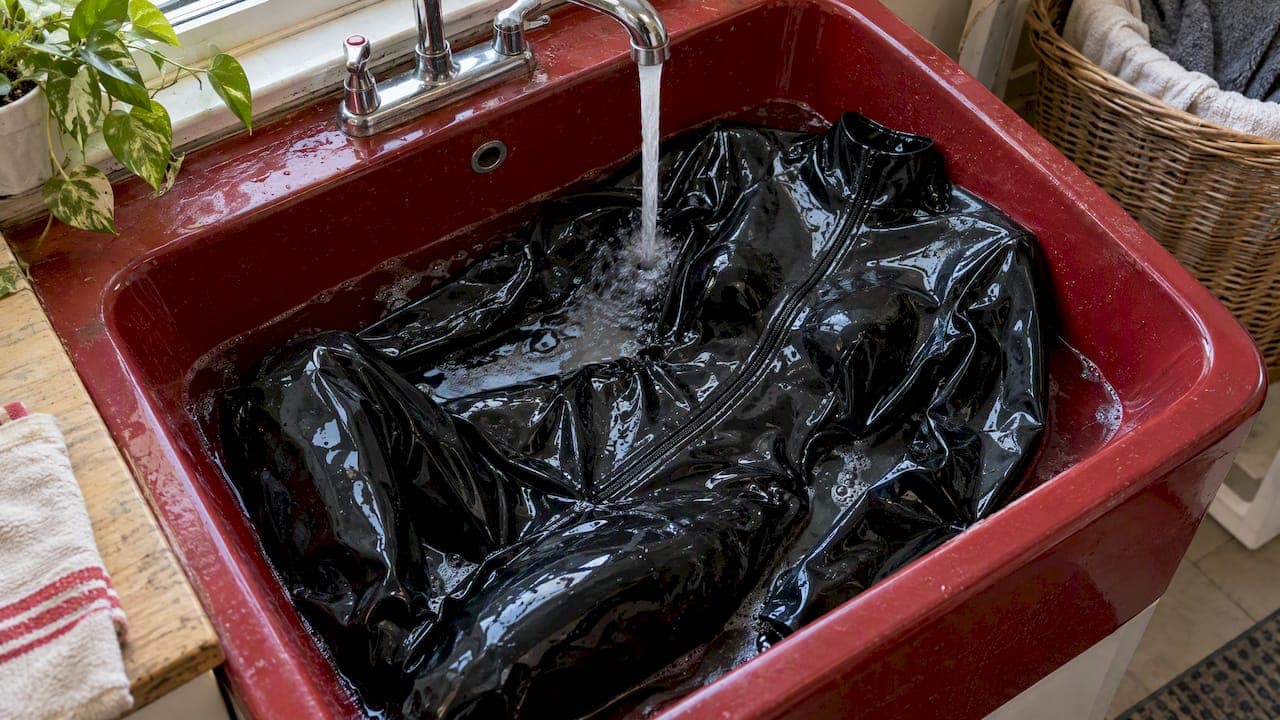
Latex clothing is tough in the way a good argument is tough: it holds up until you hit the one weak spot. Care comes down to a short routine. Wash it by hand in lukewarm water after every wear, dry it away from sun and heat, shine it with a silicone product, and store it clean, dark and away from metal and electronics. Skip any step and the damage is slow, quiet and permanent.
Below is the full routine, the mistakes that wreck garments, and how to pick someone to repair or tailor your pieces.
TL;DR
- Hand wash after every wear in lukewarm water with a few drops of mild, fragrance-free dish soap. Never use a washing machine or dryer.
- No oils, lotions or baby oil on latex or on the skin it touches. Use water-based or silicone-based dressing aids made for latex.
- Dry it in the shade, inside out first. Heat, UV and ozone from electronics all break latex down.
- Store it clean and dry, in the dark, away from copper, brass and nickel, in a breathable bag rather than an airtight tub.
- Patch-test before you wear a full piece if you have any history of latex sensitivity.
Table of Contents
- Why latex needs its own rules
- Before the first wear
- Getting dressed without hurting it
- How to wash latex
- Drying without wrecking the shine
- Talc or silicone: choosing your finish
- Storing latex so it lasts
- The things that kill latex fastest
- How long does latex clothing last?
- Latex allergy: the one safety point you can't skip
- Repairs, patches and choosing a latex tailor
- Our perspective: care is part of the kink
- If you make or sell latex
- FAQ
- Sources
Why latex needs its own rules
Latex is not like cotton. Makers who work with it describe natural latex as a material that oxidizes and breaks down at a molecular level, and the decay runs through the whole thickness of the sheet, not just the surface. That is why prevention matters more than restoration. You can't buff a ruined catsuit back to life.
The three things that speed that decay up are UV light, heat and ozone. Everything in this guide is a way of keeping those three, plus skin oils and metal, away from the rubber.

If you're newer to the scene and still working out what you like, our fetish checklist is a good place to sort out what's worth spending money on before you buy your first garment.
Before the first wear
A new latex garment usually arrives matte, with a thin powdery coating. That coating, typically talc, keeps the material from sticking to itself in transit. It also means the piece needs a wash before you put it on.
Do this before day one:
- Check for allergy risk. More on this below, but if you have ever reacted to medical gloves or balloons, stop here and talk to a doctor.
- Inspect it. Hold it up to the light and look for thin spots, pinholes or seams that look uneven. Better to find them on your living room floor than mid-scene.
- Wash it. Follow the washing steps below to get rid of the powder.
- Decide on your finish. Matte, or high gloss. That choice also decides whether you reach for talc or silicone.
Getting dressed without hurting it
Most latex injuries happen in the first two minutes of dressing, and they are usually nails and jewelry.
- Take off rings, bracelets and anything sharp, and trim long nails. Cotton gloves help with delicate pieces, as one maker suggests.
- Keep your skin free of oils and creams. Moisturizer, sunscreen and body oil all break latex down over time. Shower, dry off, and go in clean and dry.
- Use a dressing aid. A water-based lubricant or a silicone-based latex lube makes it slide. Coat the inside, then gather arms and legs and ease them on rather than yanking.
- Go slow at the seams and the hips. Pulling from the edge of a seam is how you get a split.
If you're wondering about baby oil: no. Petroleum-based and mineral oils are about the worst thing you can put near latex. Healthline notes that baby oil is water-insoluble and hard to wash off, and the research we reviewed indicates condom-grade latex can start breaking down within about a minute of contact with mineral oils. Swelling, loss of stretch and splitting follow. Lotions and petroleum jelly belong in the same banned pile.
How to wash latex
The good news: it's quick. The bad news: it's every time.
Most care guides agree on a wash after each wear, because skin oils slowly degrade latex if they're left sitting on it. Here's the routine.
- Rinse first. As soon as you take it off, rinse the inside with cool or lukewarm water. Sweat and lube are easier to remove while they're still wet.
- Fill a clean sink, tub or plastic bowl with lukewarm water. Not hot.
- Add a few drops of mild, fragrance-free dish soap. Gentle dish soap is fine. Avoid heavy-duty, highly perfumed or dye-heavy products, which can streak or tint light-colored latex. Yes, the Dawn question comes up a lot: a small amount of plain dish soap is the standard answer, but go easy on the amount and rinse thoroughly.
- Turn it inside out and swish. Let it soak for a few minutes. If something stubborn is stuck on, use a soft cloth or sponge, never a scrub brush.
- Rinse until the water runs clear and no soap film is left.
What stays out of the process: bleach, washing machines, tumble dryers and dry cleaning. Heat and agitation destroy the material, and chemicals do too. Chlorine is a special case. If you ever plan to repair a garment, don't chlorinate it, because chlorination changes the latex so standard latex glue can no longer bond to it.
Drying without wrecking the shine
Pat it with a soft towel or a lint-free cloth to remove most of the water. Then hang it to dry somewhere shaded and out of direct sun. Hang it by a strong, wide point such as the waist or shoulders on a padded hanger, not by a thin edge that will stretch.

Don't use a hairdryer, radiator or sunny windowsill. Heat and UV are two of the main drivers of decay, and a garment left drying on a hot radiator can warp.
Water spots? Drying too slowly can leave marks. A quick wipe with a soft towel before hanging helps, and a shine product will cover most of what's left.
Talc or silicone: choosing your finish
This is the part newcomers argue about, so here's the plain version.
| Silicone shiner | Talcum powder | |
|---|---|---|
| Look | High gloss, wet-look | Matte, soft |
| Best for | Wearing, photos, play | Storage between wears |
| Dressing | Slippery, easy | Reduces sticking to itself |
| Upkeep | Reapply before each wear | Dust on after washing and drying |
Silicone-based products give the glossy finish and are the common recommendation for frequent wearers, while talc is often preferred for long-term storage or to stop surfaces from clinging.
One warning that catches people out: don't mix them carelessly. Manufacturers say the two create a gummy residue when they meet. If you're switching from talc to a silicone polish routine, wash every trace of powder off first.
A practical way to run it: wash, dry, then dust with talc if the piece is going into storage. When you want to wear it, rinse off the talc, dry it, and polish it with silicone.
Storing latex so it lasts
Storage is where most garments quietly die. People search "how to store latex" because the damage doesn't show until months later.
Dark, cool and away from electronics
Light and heat come first. Keep pieces in a dark closet or drawer, not on a hook near a window. Less obvious is ozone: keeping latex near televisions, computers or halogen lights can start cracking within one to two years, even in the dark, according to one maker's preservation guide. So skip the shelf behind the TV.
Keep metal away
Copper, brass and nickel can stain latex, and the staining is often permanent. Even clean zippers or studs should be wrapped in tissue paper in storage, especially if any polish or body oil is left. Clean and dry all metal fastenings before you put a piece away.
Hang it or fold it
Hanging works for most garments, as long as they are washed and dry first. Use a wide, padded hanger. Heavy or complex pieces do better in an opaque garment bag that isn't sealed, so the rubber can breathe a little. Airtight plastic tubs can trap moisture and speed up damage.
Folding is fine for small pieces like gloves, stockings and hoods. Lay them flat, dust with talc, and don't let two coloured pieces press together for months, because dyes can transfer.
Keep pieces apart
Latex sticks to itself. Separate garments with tissue paper or cotton, especially when stored warm.
If you store other kit nearby, like rope, our guide to bondage rope materials covers what each fiber needs. It's worth keeping oiled leather and treated rope away from your latex shelf.
The things that kill latex fastest
Quick reference, sorted by how often we hear about them:
- Oils and creams. Baby oil, body lotion, massage oil, sunscreen, petroleum jelly.
- Sunlight. Even a few hours on a windowsill adds up.
- Heat. Radiators, hot cars, dryers, hot water.
- Metal contact. Copper, brass and nickel stain; jewelry scratches.
- Sharp edges. Nails, rings, zippers, velcro.
- Folded and unwashed storage. Sweat sits in the folds and eats at the seams.
- Ozone sources. Electronics and halogen lamps near the storage spot.
How long does latex clothing last?
With average use and decent care, one source puts it at about eight years before real degradation sets in, though frequent wear, poor care and exposure shorten that, and meticulous care can stretch it. Treat that as a ballpark, not a promise. A thick, well-made catsuit you wash after every wear and store in the dark will outlive a thin piece left in a hot closet.
Latex allergy: the one safety point you can't skip
Natural rubber latex allergy ranges from itchy skin and hives to anaphylaxis, which can cause throat swelling and serious trouble breathing, according to Mayo Clinic. If you've ever reacted to medical gloves or balloons, see an allergist before wearing latex clothing, and don't treat it as a trial and error thing.
If you have no known issues, the common advice is to patch-test a small piece on your skin for 24 to 48 hours before committing to a full garment. If you get redness, swelling, hives, itching or any trouble breathing, take it off, and get medical help for breathing symptoms right away. For more on looking after your body around play, see our kinky self-care tips.
Repairs, patches and choosing a latex tailor
A small tear isn't always the end. Latex can be patched with latex glue and a scrap of the same material, and a good maker can re-seam, resize or add panels. That is why the chlorine warning earlier matters: bleached or chlorinated rubber won't bond.
When you're picking a tailor or repair maker, look for these:
- They work in latex every day. A seamstress who does fabric is not the same as a latex maker. Ask what thickness they cut and how they join seams.
- Photos of repairs, not only finished pieces. Look for clean, flat seams and invisible patch edges.
- Clear measurements process. Good makers explain how to measure, or offer a fitting. Fit matters more than almost anything for longevity, because garments that are too tight stress at the seams.
- Honest about what can't be fixed. If a maker tells you a sun-cracked piece is beyond saving, believe them. Degradation runs through the whole thickness of the sheet.
- Transparent turnaround and pricing, in writing. Custom work takes time. Get a quote and a timeline before you send anything.
- Reviews from other fetish clients. Word of mouth in the community counts for a lot.
If you can't find a local tailor, check the makers, studios and retailers listed on our categories page, where you can browse adult-themed businesses in one place. Always talk to the maker directly about your own piece.
Our perspective: care is part of the kink
We see a pattern in the community. People spend serious money on a catsuit, then throw it in a drawer with the lube bottle leaking onto it. Six months later it's sticky, discolored and brittle, and they blame the brand.
We think of aftercare for gear as the same muscle as aftercare for people. It's the unsexy ten minutes after the scene that make the next one possible. Wash it, dry it, put it away right. The ritual can even be part of it: some people love the slow polishing before a night out.
There's a business side too. The makers, tailors and studios who do this work well are the ones who deserve to be found. Kinky Korner exists so providers in this world can be discovered by the people looking for them, and so readers can find them in one place. Good care advice from honest makers is as valuable to our community as the garments themselves.
— Prenston
If you make or sell latex
If you're a latex maker, repair specialist, studio or retailer, list yourself where kinky shoppers are already browsing. Kinky Korner has a free basic listing, a Monthly plan at 4.99 USD per month and a Yearly Premium plan at 149.95 USD per year. See the details on our pricing page. Before you post classifieds, read the U.S. fetish classified rules on 18+ verification, consent and reporting.
FAQ
Can I use baby oil on latex clothing?
No. Baby oil and other mineral or petroleum-based products break latex down, causing swelling, loss of stretch and splitting. Use a water-based lube or a silicone-based latex dressing aid instead.
Can you use Dawn dish soap on latex?
A few drops of a mild, fragrance-free dish soap in lukewarm water is the usual advice. Avoid heavily perfumed or dye-heavy detergents, which can streak or tint light latex. Rinse thoroughly, because leftover soap leaves a film.
How often should I wash latex?
After every wear. Skin oils and sweat degrade latex if left on it, and a quick hand wash prevents that. Never machine wash or tumble dry it.
Should I store latex hanging or folded?
Hang most garments on wide, padded hangers in a dark, cool closet, inside an opaque bag that isn't airtight. Fold small pieces flat with talc. Either way, wash and dry fully first, and wrap metal fasteners in tissue paper.
How long does latex clothing last?
One maker-side source estimates about eight years with average use, and it varies with how often you wear it and how well you care for it. Heat, light, ozone and oils shorten that. Careful washing and dark storage are the biggest levers you control.
Sources
- Latex allergy, symptoms and causes (Mayo Clinic)
- Baby Oil as Lube: Is It Safe? (Healthline)
- Latex Garment Preservation guide (Vex)
- The Complete Latex Clothing FAQ (Vex)
- Caring for Your Latex (Vex)
- Pflege von Latex (ODDIA)
- Latex clothing care instructions (Milkshaken)
- Latex Care Guide (Slick Products)
- How to Store Latex & Protect It (Dead Lotus Couture)
- Rubber/latex clothing wearing (Kink Checklist)