

X (formerly Twitter) allows consensual adult nudity and sexual content, as long as it's labeled and not placed in prominent, unavoidable spots like your profile photo. What's banned outright: non-consensual imagery, CSAM, and anything sexualizing minors. If you're posting anything explicit, your first move is simple: mark the post as sensitive and check your account media settings before you hit publish.
TL;DR:
- Label every explicit post individually and activate the account-wide sensitive media setting to prevent reach suppression and policy violations.
- Explicit content is prohibited in profile pictures, banners, live streams, and community covers, with risk increasing if labeled content appears in prominent profile areas.
- Self-reported age verification is weak, and minors often bypass restrictions, making stronger age checks likely in the future.
- Sharing non-consensual, exploitative, or minor-related sexual content is forbidden and results in immediate bans or law enforcement referrals; reporting helps enforce these rules.
- A dedicated adult content platform like Kinkykorner offers more consistent visibility for legally compliant creators, bypassing platform restrictions.
Table of Contents
- What Twitter's Adult Content Policy Actually Allows and Forbids
- How to Label Your Content and Set Up Media Settings
- Who Can Actually See Labeled Adult Content
- Where You Can't Post Explicit Content, Period
- How Reporting and Enforcement Actually Work
- A Compliance Checklist for Creators and Moderators
- What These Policy Shifts Mean Going Forward
- Kinkykorner: A Marketplace Built for Creators Who Play by the Rules
- Sources
- FAQ
What Twitter's Adult Content Policy Actually Allows and Forbids
Here's the plain version: X's own adult content guidelines state that users "may share consensually produced and distributed adult nudity or sexual behavior, provided it's properly labeled and not prominently displayed." That covers nude photography, erotic art, fetish content, and yes, AI-generated sexual images and videos, since TechCrunch's reporting on the 2024 policy update confirmed AI media falls under the same rules as anything else. If your bot-generated fantasy scene is explicit, it needs the same sensitive label a photo would.
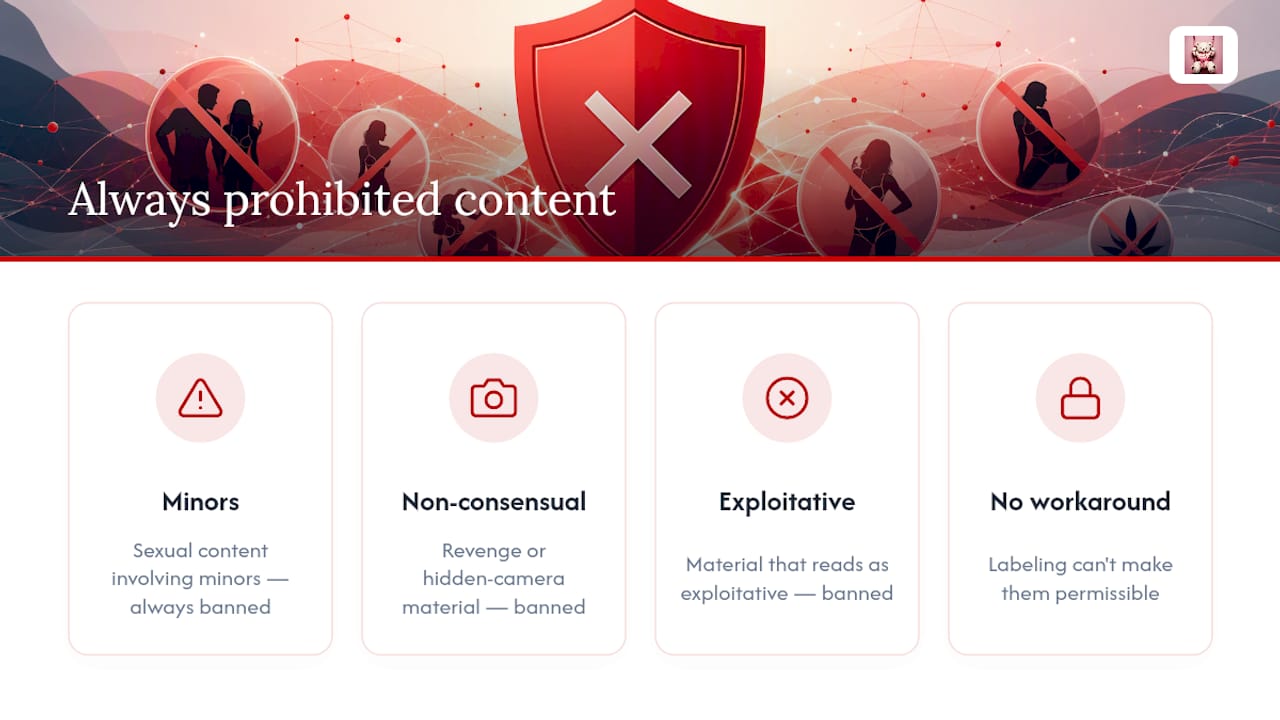
What doesn't get a pass, ever: content depicting minors in any sexual context, non-consensual nudity (think revenge content or hidden-camera material), and anything that reads as exploitative rather than consensual. There's no labeling workaround for those categories. AP News described the 2024 rewrite as less of a new door opening and more of a formal confirmation of practices X had already tolerated for years under Twitter's old adult content guidelines.
One nuance creators miss: "consensual" isn't just about the people in the frame. It also covers how the content was distributed. Sharing someone else's explicit content without their permission violates the policy even if the original creation was consensual.
How to Label Your Content and Set Up Media Settings
Labeling isn't optional, and it isn't automatic. X puts the responsibility on the poster.
- When composing a post with explicit or graphic media, look for the media settings option before you tweet. It lets you flag that specific post as containing sensitive content.
- Go to your account's privacy and safety settings to enable the toggle showing you regularly post sensitive media. This applies the label account-wide, so you're not manually tagging every single post.
- Confirm the label displays as a warning screen to other users before the media loads.
On the viewing side, the official media settings page walks through where to find "Display media that may contain sensitive content" under your settings menu. Turn it on to see labeled posts without the warning screen, or leave it off to keep your feed cleaner. There's a parallel setting for search results if you want sensitive content filtered out of what you search for, too.
Skip the labeling step and you're gambling with:
- Reduced reach, since X's systems can suppress unlabeled sensitive posts algorithmically
- A higher chance of manual review flagging your account
- Possible content removal or a strike against your account for policy violations
Who Can Actually See Labeled Adult Content
Age gating on X depends on a self-reported birthdate entered by users, which restricts viewing of labeled adult content for those flagged as underage. However, this birthdate verification is not strongly enforced and can be bypassed.
The obvious problem: this is self-reported. Nobody's checking ID.
- Birthdate entry is a one-time gate, not ongoing verification
- TechCrunch's coverage of X's age-gating rollout notes research showing a meaningful share of minors misreport their age online to get around exactly this kind of gate
- Regulatory bodies like Ofcom in the UK, plus various state-level proposals in the US, have been pushing platforms toward stronger age verification precisely because birthdate fields are trivial to fake
That regulatory pressure is why you'll likely see more friction added to age checks in the coming years, not less.
Where You Can't Post Explicit Content, Period
Some spots on X are permanently off-limits for adult content, regardless of labeling. The logic is exposure: these placements show up to everyone who visits your profile, with no warning screen and no opt-in.
- Profile pictures and header/banner images can't contain adult nudity or sexual content
- Live video streams can't feature adult content
- Community cover pages follow the same restriction
The distinction that trips people up is "prominently displayed" versus posted in-stream. A labeled explicit post in your timeline, behind a sensitive-content warning, is fine. That same image as your banner, visible to anyone who lands on your profile with zero warning, is not. If you're ever unsure whether something counts as "prominent," keep it out of your permanent profile assets. The downside of guessing wrong outweighs the upside of a slightly edgier banner.
How Reporting and Enforcement Actually Work
Anyone can report a post that contains unlabeled adult content or content they believe violates the rules, using the report option on the post itself. For CSAM specifically, X escalates directly to the National Center for Missing & Exploited Children, and accounts sharing that material get banned immediately, no warning, no grace period.
Enforcement generally scales with severity:
- Unlabeled but otherwise compliant content usually gets a warning or forced label, sometimes reduced visibility
- Repeated violations or non-consensual content can trigger account suspension
- CSAM and severe policy violations result in permanent bans and, in many cases, referral to law enforcement
If your account gets actioned and you think it was a mistake, X provides an appeals path through its enforcement pages, where you can contest suspensions or content removals. Keep in mind that appeals take time, and reversal isn't guaranteed just because you disagree with the call.
A Compliance Checklist for Creators and Moderators
Staying compliant isn't complicated, but it does require consistency. Here's what actually reduces your risk:
- Label every explicit post individually, and enable the account-level sensitive media setting so nothing slips through unmarked.
- Keep your profile picture, banner, and any live streams strictly non-explicit.
- Write clear captions or content warnings, especially for kink or fetish material that a casual viewer might not expect.
- Maintain a separate feed or clearly marked account for safe-for-work content if you post both types regularly, since mixing them muddies your labeling consistency.
- Screenshot or save records of your posts and settings if content ever gets challenged, so you have your own documentation during an appeal.
Automated spam is a separate headache entirely. Explicit posts tend to attract bot replies linking off-platform, and Lifehacker's guidance on managing this recommends blocking aggressively, using keyword filters, and pinning a legitimate reply to bury spam replies further down the thread.
Pro Tip: Keep a dated folder of screenshots showing your labels and settings at the time you posted. If you're ever reported in error, having your own timestamped proof speeds up an appeal considerably. For deeper compliance detail, Kinkykorner's adult content legalities guide breaks down platform rules alongside broader legal considerations.
What These Policy Shifts Mean Going Forward
Formalizing the rules gave creators clearer language, but it didn't fix discoverability or monetization, and creators told NBC News as much. Expect regulators and platforms to keep tightening age verification and CSAM detection long before they loosen anything else. Track policy updates directly, and label consistently. That habit protects your account more than any workaround.
— Prenston
Kinkykorner: A Marketplace Built for Creators Who Play by the Rules
Compliant labeling gets your content seen on X, but it doesn't get your services discovered by the people actually looking for them. That's a separate problem, and it's the one Kinkykorner solves: a platform where adult creators and service providers can offer their services to audiences interested in kink and fetish content, instead of hoping the algorithm cooperates.

Where X places explicit posts behind sensitivity toggles and inconsistent reach, listings on this platform remain visible to those browsing for such content. If you're building a presence around adult content and want a channel that doesn't depend on platform mood swings, start by reading Kinkykorner's adult content posting process guide and then set up your listing on Kinkykorner to get discovered on your own terms.
Sources
- Adult Content (X Help)
- X tweaks rules to formally allow adult content | TechCrunch
- Musk's X is allowing users to post consensual adult content, formalizing a prior Twitter policy | AP News
- X’s 'new' adult content policy isn't new, sex workers say, and it hasn't cleared up moderation concerns | NBC News
FAQ
Why can't I see NSFW content on Twitter anymore?
You likely have the "Display media that may contain sensitive content" setting turned off, or your account's birthdate flags you as underage. Check your privacy and safety settings to toggle it back on.
What is X's adult content policy?
X allows consensually produced adult nudity and sexual content, including AI-generated explicit media, as long as it's labeled as sensitive and not placed in permanent spots like your profile picture or banner.
How do I turn on 18+ mode on Twitter?
There's no separate "18+ mode." You enable sensitive content viewing through your settings menu by turning on "Display media that may contain sensitive content," which requires your account to show an adult age.
Does Twitter monitor NSFW content?
Yes, X reviews reported content and uses automated detection for serious violations, escalating CSAM cases directly to the National Center for Missing & Exploited Children with immediate account bans.
What happens if I post explicit content without labeling it?
Your reach can drop, your content may get flagged or removed, and repeated unlabeled posting risks account suspension under X's enforcement process.