

A working explicit-content policy names what's allowed, spells out what's banned, and locks down four things before anything gets published: consent evidence, identity and age verification, labeling and age-gating, and a moderation trail that ends in a clear enforcement ladder. That's the whole job. If your policy is missing any of those pieces, you don't have a policy, you have a liability with a nice font.
Kinkykorner builds its listing rules around this structure, and we lean on recognized signals like 18 U.S.C. § 2257 recordkeeping standards and PhotoDNA style CSAM detection as the floor, not the ceiling, for what "verified" means.
Your next move, starting today: build a pre-publish checklist that physically blocks a listing from going live until consent documentation and identity checks both clear.
- Allowed content definitions, written in plain language
- Explicit prohibitions, with sample banned phrases
- Consent evidence requirements tied to the actual asset
- ID and age verification before anything touches "published"
- Labeling and age-gate rules for every listing type
- A moderation workflow with a real enforcement ladder
Key Takeaways
A compliant explicit-content policy requires named allowed and prohibited content, asset-specific consent records, verified identity, consistent labeling, and an enforcement ladder that operators actually follow.
| Point | Details |
|---|---|
| Define content clearly | Ban euphemisms and code words; state allowed and prohibited categories in plain language. |
| Tie consent to the asset | Require signed, dated consent that references the specific published scene or image. |
| Verify identity before payout | Collect ID, selfie, and DOB at onboarding, and gate payout-ready status on verification. |
| Build a real enforcement ladder | Use warning, suspension, ban, and termination, each triggered by defined severity. |
| Kinkykorner builds compliance in | Onboarding states, consent uploads, and age-gate tagging are part of the listing flow itself. |
Table of Contents
- Explaining Explicit Content Rules: A One-Page Checklist
- What Counts as Allowed Versus Prohibited Content?
- What Consent Documentation Should Creators Submit?
- How Should Identity and Age Records Be Collected and Stored?
- How Do You Label and Age-Gate Explicit Listings?
- How Does Moderation Actually Catch Violations?
- What Happens When a Creator Violates the Policy?
- How Should Creators Submit a Compliant Listing?
- What Does Rolling Out This Policy Cost in Time and Staff?
- Why a Policy Blueprint Beats a Legal Memo
- Get Your Listing Compliant Without the Guesswork
- Where to Learn More About Building This Policy
- Frequently Asked Questions
- Sources
Explaining Explicit Content Rules: A One-Page Checklist
Paste this into your internal docs. It's built so a reviewer can hit publish or reject in under sixty seconds.
Operator responsibilities:
- Confirm consent file matches the exact asset submitted
- Verify government ID and age before account reaches "payout-ready"
- Apply required tags before the listing goes live
- Log every moderation decision with reviewer name and rule cited
Creator deliverables:
- Upload signed consent record for each scene or shoot
- Submit matching ID and selfie at onboarding
- Tag content honestly, including explicitness level
- Avoid euphemisms, price-for-act language, or coded terms
Pass criteria: consent matches asset, ID is current, tags are accurate. Fail any one, and the listing stays in review.
What Counts as Allowed Versus Prohibited Content?
Vague policy language is how good creators get flagged and bad actors slip through. Say exactly what's welcome: erotic writing, consensual adult performance, fetish photography and art, and classifieds for legal adult services. Say it the way you'd explain it to a new creator over coffee, not the way a lawyer would explain it to a jury.
Prohibitions need the same clarity. Ban sexual solicitation phrased as a transaction ("donation for meetup," "gift for companionship"), price-for-act wording, and code words that imply anything beyond legal content or services, echoing the FOSTA/SESTA compliance guidance that treats solicitation language as a top mitigation target.
Safe examples: "Fetish photography set, 20 images, tagged bondage/rope." "Erotic novella, dominant/submissive dynamic, 8,000 words." "Companionship event listing, ticketed, venue named."
Flagged examples: "Donation-based private session, ask for rates." "Special service, discreet, cash only." "GFE available, text for details."
Pro Tip: Euphemisms trigger both automated filters and human reviewers because ambiguity reads as concealment. Say what the content actually is, and your listing clears review faster.
What Consent Documentation Should Creators Submit?
Require consent evidence tied directly to the asset being published, not a generic release signed months earlier. That distinction matters more than most creators realize.

Required artifacts include a signed scene rider naming participants and acts depicted, a dated written statement, on-camera consent checks recorded at the start of a scene, and participant initials embedded in the file metadata. Acceptable formats: a photo or scan of a signed PDF, a short timestamped video clip, or structured form fields completed at upload, similar to what we recommend in our consensual kink guide.
Verification runs on three tracks: automated timestamp checks that flag mismatched dates, manual spot-checks on a rolling sample, and scheduled re-verification for creators who post recurring content with the same participants.
Pro Tip: Require consent language that names the specific published asset, not just the shoot date. A generic "I consent to being filmed" from March doesn't cover a scene uploaded in June with different edits.
How Should Identity and Age Records Be Collected and Stored?
Collect full legal name, date of birth, government ID type, a clear ID image, a selfie for biometric matching, and the document's expiration date at onboarding. None of this is optional if you want a functioning payout system.
Retention policy should map directly to your approval states: draft, pending, verified, and payout-ready, an approach recommended in launch guidance for adult creator platforms. Keep identity records as long as the creator remains active plus whatever window your payment processor requires, and keep audit logs (who reviewed what, when) on a separate retention schedule from the consent files themselves.
Storage needs access controls, logged access attempts, and a short list of staff who can view sensitive records. Missing this recordkeeping is a documented cause of payment processor disruptions, since processors expect operators to prove age and consent on demand, not promise it exists.
How Do You Label and Age-Gate Explicit Listings?
Every listing needs metadata that does real work: content type, explicitness level, participant count, location constraints, and the creator's verification state.
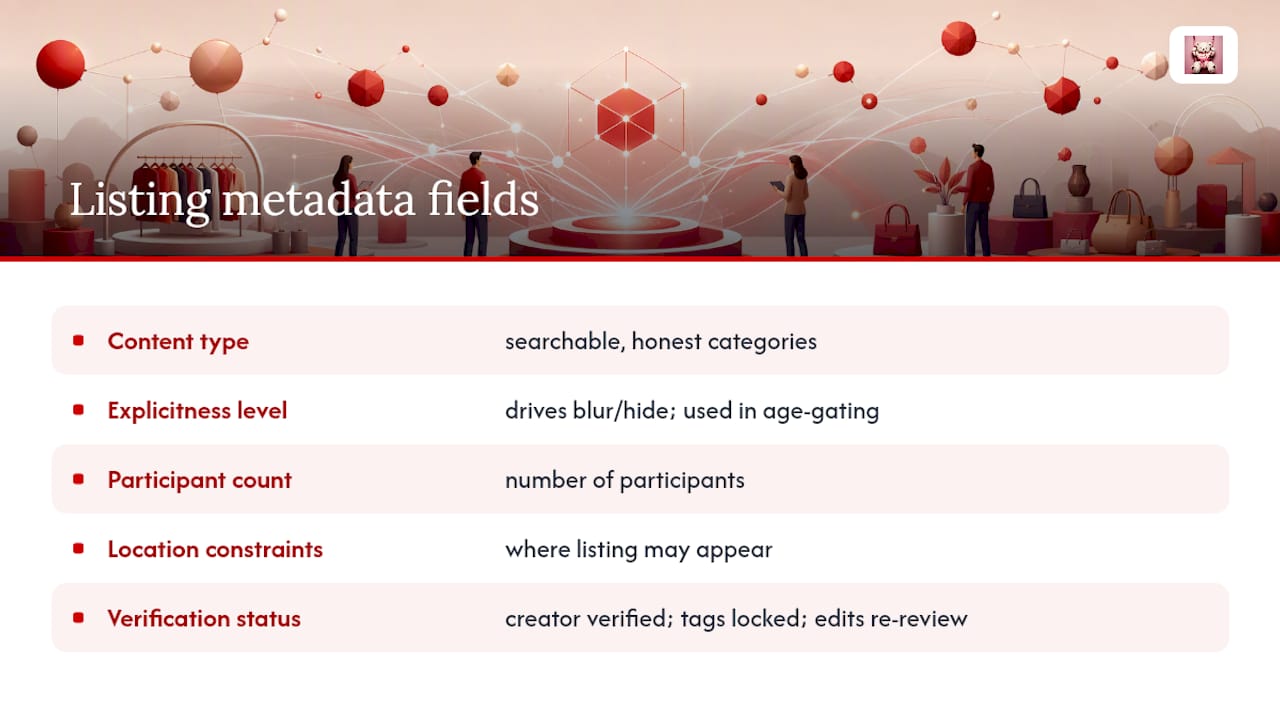
Build your tag taxonomy around searchable, honest categories rather than marketing language, drawing on the structure in our NSFW content guide. Display rules should blur or hide thumbnails for high-explicitness content until a user clears an age gate, and that gate needs to appear before preview, not after.
Lock tagging at submission. If a creator edits a listing to lower its stated explicitness level, route it back through verification automatically. Letting edits bypass re-review is how policies quietly fall apart.
How Does Moderation Actually Catch Violations?
The workflow runs in three stages: automated triage flags content on upload, a severity score routes it, and anything high-severity lands in a human review queue. This mirrors the trust-and-safety operator model built around separate rulesets for prohibited content, coercion signals, and impersonation.
Signals worth collecting across your platform: onboarding flags, upload metadata that doesn't match the listing description, repeated IP or device patterns across suspended accounts, keyword matches on banned phrases, and payout anomalies.
Circumvention tends to follow patterns: code words swapped for banned terms, pricing embedded as text inside an image instead of the listing description, and euphemisms rotated every few weeks. Detection needs both text scanning and image OCR to catch the second two.
Every decision needs an audit log entry: what was flagged, who reviewed it, and which specific rule applied.
What Happens When a Creator Violates the Policy?
A workable enforcement ladder has four rungs: warning, temporary suspension, publishing ban, and account termination, each triggered by a defined severity threshold rather than reviewer discretion.
Your reporting form needs to capture content URL, uploader ID, alleged violation type, reporter contact, and evidence attachments, following the reporting structure recommended in FOSTA/SESTA compliance checklists for platforms hosting adult listings.
Appeals need a stated response window, a list of acceptable evidence, and clear criteria for reinstatement versus escalation. Put payouts on hold the moment an account hits suspension, and require a named compliance approver before releasing them.
How Should Creators Submit a Compliant Listing?
- Choose the correct category. Don't force a listing into the wrong bucket to dodge stricter review.
- Write a title and description that match the actual content, no euphemisms.
- Attach photos that match the description exactly.
- Upload signed consent documentation for the specific asset.
- Confirm ID verification is current before submitting.
- Submit and expect standard review, or expedited review if your account already carries verified performer status.
Read the policy before you write anything. Most removals trace back to mismatched photos, code words, or pricing language slipped into a description, all avoidable with a five-minute read first.
What Does Rolling Out This Policy Cost in Time and Staff?
Introducing or tightening a policy runs in three phases: a pilot on new listings, staff training on the enforcement ladder, then full enforcement across existing content.
Staffing typically needs a moderation reviewer scaled to creator volume, one compliance owner accountable for the policy itself, and a support liaison who handles creator questions during rollout.
Budget for age-verification integration, secure document storage, moderation tooling, and payment processor re-certification, a sequence launch guidance recommends handling before scaling new features. Automation handles volume triage well; human review still has to own anything high-severity or ambiguous.
Why a Policy Blueprint Beats a Legal Memo
Most explicit-content policies fail for a boring reason: they're written like legal documents instead of operating manuals. A creator doesn't need case law. They need to know that "donation-based session" gets flagged and "fetish photography set" doesn't.
The industry's real gap isn't legal risk tolerance, it's operational clarity. Platforms that struggle with content moderation usually have technically accurate policies that nobody can actually follow at 11pm when they're trying to publish a listing before a shoot. Kinkykorner built this blueprint the other direction: start with what a creator does at their keyboard, then work backward into what the policy needs to say.
Prenston has spent years watching marketplaces get this backward, front-loading legal language and leaving creators to guess at enforcement until they get banned.
Get Your Listing Compliant Without the Guesswork
Kinkykorner is built differently from a generic classifieds board because compliance is wired into the listing flow itself, not bolted on afterward. That means onboarding states that track verification progress, consent attachment fields built into the upload form, a moderation queue that reviewers can actually work through, and age-gate tooling that applies automatically based on your content tags.

If you're a performer, business, or creator ready to list adult-themed services or erotic creative work, our support team walks you through identity verification and consent documentation so nothing sits in limbo. You won't be left decoding a policy PDF alone. Start your listing and complete verification today at Kinkykorner, and check our posting process guide for the exact steps before you upload your first piece.
Where to Learn More About Building This Policy
These resources cover implementation, not legal advice. Consult a qualified professional for jurisdiction-specific questions.
- Adult Content Legalities Guide: documentation practices for age and identity checks
- Adult Marketplace Successful Listing Guide: why matching photos and descriptions cuts takedowns
- The Role of Trust in the Adult Industry: how policy connects to moderation and payments
- Adult Platform Trust and Safety: 2026 Operator Guide: signal collection and escalation matrix design
Frequently Asked Questions
What is considered explicit content on a marketplace like Kinkykorner? Explicit content includes erotic writing, consensual adult performance, fetish photography and art, and classifieds for legal adult services or events, each clearly labeled and age-gated at publication.
How do content moderation standards handle borderline listings? Borderline listings route to human review when automated triage flags ambiguous language, mismatched photos, or coded phrasing, since a reviewer needs context an algorithm can't reliably judge.
What identity documents does age verification require? Standard fields include a government-issued ID, a selfie for biometric matching, date of birth, and the document's expiration date, collected before an account reaches payout-ready status.
How long should consent and identity records be kept? Retention should track active account status plus your payment processor's required window, with audit logs kept on a separate schedule from the consent files themselves.
What triggers an account suspension under explicit content policies? Repeated policy violations, mismatched consent documentation, or use of banned solicitation language typically move an account from warning to temporary suspension on the enforcement ladder.
Sources
- Trust-and-safety operator perspective on platform compliance and payment risk
- 18 U.S.C. § 2257 / recordkeeping guidance
- Adult Platform Trust and Safety: 2026 Operator Guide
- Adult Creator Platform Launch Guide 2026