

Supporting sex workers is defined as recognizing their full humanity, labor rights, and dignity as the foundation of any serious commitment to social justice. The question of why support sex workers matters is not abstract. It cuts straight to how we treat the most marginalized people in our communities. Research shows that criminalization increases violence, isolation, and health risks for sex workers, while decriminalization and peer-led programs produce measurable improvements in safety and well-being. This article lays out the human rights case, the evidence from real programs, and the practical steps you can take to advocate effectively.
Why support sex workers as a human rights issue?
Sex workers are workers. That sentence sounds simple, but the legal and social systems in most countries refuse to treat it as true. Criminalization legally and socially marginalizes sex workers, increasing safety risks and blocking access to legal protection. When the law treats your work as a crime, you cannot report violence without risking arrest. You cannot organize with colleagues without exposing yourself. You cannot access healthcare without fear of judgment or disclosure.
The harms of criminalization are not theoretical. Research involving independent sex workers found that 9 of 13 participants hid their work out of fear of police and social judgment. That secrecy is not a personal choice. It is a survival strategy forced on people by laws that treat them as criminals rather than citizens. The major barrier to safety for sex workers is not the work itself. It is the surrounding legal framework that enforces secrecy and isolates workers, heightening vulnerability.

Labor rights are the other missing piece. Sex workers are excluded from the protections most workers take for granted: workplace safety standards, anti-discrimination laws, the right to organize. That exclusion is not neutral. It is a policy choice that leaves an entire workforce exposed to exploitation with no legal recourse.
Here is what the human rights case for supporting sex workers actually demands:
- Legal protection from violence, regardless of occupation or immigration status
- Access to healthcare without mandatory disclosure of sex work
- Labor rights including the right to organize, refuse clients, and report abuse
- Freedom from arbitrary arrest and police harassment
- Inclusion in social safety nets like unemployment insurance and housing support
Pro Tip: When you talk about sex worker rights with others, lead with labor rights language. Most people already believe workers deserve safety and legal protection. That framing cuts through stigma faster than any other approach.
How do supportive policies improve safety and well-being?
The evidence on what actually works is clear. A review of 57 publications on sex work legal approaches from 2000 to 2025 found that decriminalization models consistently produce better health outcomes and greater access to legal protection compared to repressive legal models. That is not a marginal difference. It represents fewer STIs, less violence, and more people able to seek help when they need it.
Peer support programs are one of the most effective tools available. Strong peer networks reduce social isolation, PTSD, and violence risks by enabling collective safety strategies and mutual emotional support. Peer support functions as informal mental health infrastructure in criminalized contexts where formal services are inaccessible or unsafe to use. That is a significant public health finding. It means investing in peer networks is not charity. It is evidence-based health policy.
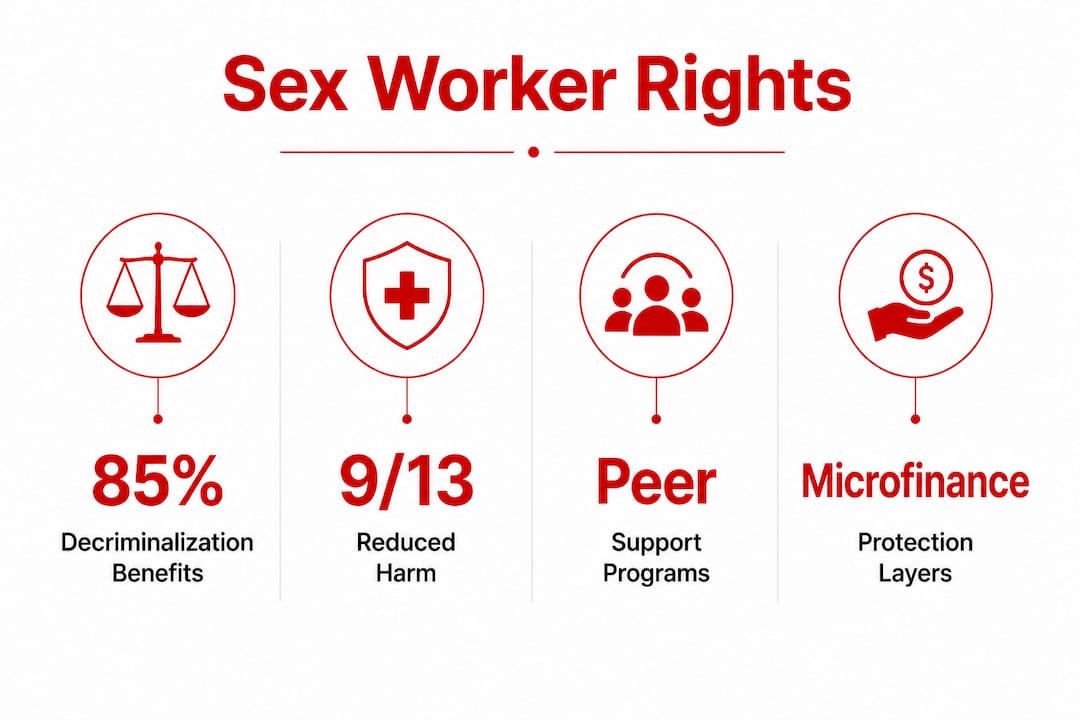
Microfinance programs add another layer of protection. A study with 120 female sex workers over 3 years in Tijuana showed that combining microfinance with peer support improved both financial stability and safer sex negotiation. Financial security gives people options. Options reduce coercion. That chain of cause and effect is exactly why economic support belongs in any serious discussion of sex worker safety.
Co-designed health strategies led by sex workers themselves are more sustainable than programs designed for them by outside organizations. Programs that shift from biomedical to rights-based frameworks achieve better mental health outcomes and stronger violence prevention results. The reason is straightforward. Sex workers understand their own risks and needs better than any outside researcher or policymaker.
| Approach | Key outcome |
|---|---|
| Decriminalization models | Better health access and legal protection across 57 studies |
| Peer support networks | Reduced PTSD, violence risk, and social isolation |
| Microfinance plus peer programs | Improved financial stability and safer sex negotiation |
| Rights-based health frameworks | Better mental health and violence prevention outcomes |
| Sex worker-led co-design | More sustainable and acceptable interventions |
Pro Tip: If you want to support a program that actually works, look for ones where sex workers hold leadership roles, not just advisory seats. Leadership means decision-making power, not just consultation.
What are the social justice dimensions beyond legal reform?
Legal reform is necessary but not sufficient. Full justice for sex workers requires progress on three fronts at once: economic redistribution, cultural recognition, and political representation. Research on multidimensional justice for sex workers confirms that holistic strategies integrating labor rights, stigma reduction, and political inclusion are the only path to full citizenship. Addressing just one dimension while ignoring the others produces fragmented, unsustainable results.
Cultural recognition means dismantling the stigma that marks sex workers as less deserving of dignity, safety, or voice. Stigma is not just a social discomfort. It is a mechanism of exclusion that prevents sex workers from accessing housing, healthcare, custody of their children, and protection from violence. Recognizing sex workers' dignity is not a soft, feel-good goal. It is a concrete prerequisite for every other form of support to function.
Political representation means sex workers having a real seat at the table when policies that affect them are made. Tokenism, where one sex worker is invited to a panel while the actual policy is written by people who have never done the work, is not representation. Genuine participation means sex workers shaping the laws, health programs, and social services that govern their lives.
The social justice case for supporting sex workers includes:
- Stigma reduction through public education and media representation that reflects real lives
- Political inclusion in policymaking bodies at local, national, and international levels
- Economic redistribution through access to banking, housing, and social services without discrimination
- Recognition of intersectionality, since many sex workers also face racism, transphobia, and immigration-related discrimination
- Accountability for violence, including police violence, with real legal consequences
These dimensions reinforce each other. Economic stability makes political participation possible. Cultural recognition makes healthcare access real. You cannot pull one thread without affecting the whole fabric.
What can you do to support sex workers' rights?
Advocacy for sex worker rights does not require a law degree or a nonprofit budget. It requires consistency, honesty, and a willingness to follow the lead of sex workers themselves.
-
Amplify sex worker voices. Share content created by sex workers and their organizations. Do not speak over them in conversations about their own lives. The most credible advocates for sex worker rights are sex workers.
-
Support decriminalization campaigns. Decriminalization is not legalization. It removes criminal penalties from sex workers without necessarily regulating the industry like a licensed business. Organizations like SWOP (Sex Workers Outreach Project) run active campaigns in multiple U.S. cities.
-
Donate to peer-led mutual aid programs. Sex workers often avoid traditional charity programs because of disclosure requirements and stigma. Peer-to-peer mutual aid programs offer immediate, anonymous support without income thresholds or mandatory disclosure. Your money goes further in those structures.
-
Educate people in your network. Most opposition to sex worker rights is based on misinformation, not values. When you correct a myth about sex work, you reduce the social permission for discrimination and violence. That is real advocacy.
-
Push back on conflation. Sex work and sex trafficking are not the same thing. Conflating them harms both sex workers and trafficking survivors by muddying the policy conversation and directing resources away from where they are needed. Knowing the difference and saying so clearly is one of the most useful things an advocate can do.
You can also read about supporting adult artists as a related form of advocacy that shares many of the same principles around dignity, labor rights, and creative autonomy.
Key Takeaways
Supporting sex workers requires simultaneous progress on legal reform, economic inclusion, cultural recognition, and political representation, because progress on any single dimension without the others produces incomplete and unsustainable results.
| Point | Details |
|---|---|
| Criminalization causes direct harm | Laws that criminalize sex work force secrecy, block healthcare access, and increase violence risk. |
| Decriminalization improves outcomes | A review of 57 studies shows better health and legal protection under decriminalization models. |
| Peer support is evidence-based | Peer networks reduce PTSD, violence, and isolation and function as informal mental health infrastructure. |
| Multidimensional justice is required | Economic, cultural, and political inclusion must advance together for lasting change. |
| Sex worker leadership matters | Programs co-designed by sex workers produce more sustainable and effective outcomes than top-down interventions. |
Why this cause deserves more than lip service
I have spent enough time around advocacy spaces to know the difference between people who say they support marginalized communities and people who actually do the uncomfortable work. Sex worker rights sit in an awkward place for a lot of advocates. People who are comfortable marching for racial justice or LGBTQ+ rights sometimes go quiet when sex work comes up. That silence is not neutral. It is a choice, and it has consequences.
What I keep coming back to is this: the research is not ambiguous. Participation of sex workers in designing their own health and safety programs produces better outcomes every time. That is not a political opinion. It is a documented pattern across multiple countries and contexts. When we ignore that evidence because the topic makes us uncomfortable, we are choosing our comfort over other people's safety.
The peer network finding hits me hardest. Peer networks mitigate PTSD and violence through shared safety protocols and emotional support. Think about what that means. In the absence of legal protection, in the absence of formal mental health services, sex workers built their own systems. They did not wait for institutions to show up. They took care of each other. The least the rest of us can do is stop making that harder.
The safe spaces in the adult industry conversation is part of this too. Safety is not just physical. It is economic, legal, and social. Any advocacy that ignores one of those dimensions is leaving people exposed.
— Prenston
Kinkykorner and the case for ethical adult spaces
Kinkykorner is a marketplace where people and businesses can list adult-themed services and connect with an audience that respects their work. That kind of platform matters in a world where sex workers and adult creators are routinely deplatformed, demonetized, and excluded from the tools everyone else takes for granted.

Supporting sex worker rights and engaging with ethical adult content are not separate conversations. They are the same conversation about dignity, autonomy, and who gets to participate in the economy. Kinkykorner exists as a space where that participation is possible, where adult creators and service providers can operate with respect and visibility. If you want to put your values into practice, explore Kinkykorner as a platform built around those principles.
FAQ
Why is supporting sex workers a social justice issue?
Sex workers face criminalization, stigma, and exclusion from labor protections that affect their safety, health, and economic stability. Supporting their rights is a direct application of human rights and labor rights principles.
Does decriminalization actually make sex workers safer?
A review of 57 publications found that decriminalization models consistently produce better health outcomes and greater access to legal protection compared to criminalized frameworks.
What is the difference between sex work and sex trafficking?
Sex work is consensual adult labor. Sex trafficking involves force, fraud, or coercion. Conflating the two harms both sex workers and trafficking survivors by distorting policy and misallocating resources.
How do peer support programs help sex workers?
Peer networks reduce PTSD, social isolation, and violence risk by enabling collective safety strategies and providing trauma-informed emotional support in contexts where formal services are inaccessible.
What is the most effective way to advocate for sex worker rights?
Follow the lead of sex workers and their organizations, support decriminalization campaigns, donate to peer-led mutual aid programs, and correct misinformation in your own networks.