

This erotica genres list breaks down the major subgenres of erotic fiction, from contemporary and historical settings to BDSM, fetish, and taboo categories, with the tropes and explicitness levels each one typically delivers. It also draws a line between erotica and erotic romance, since that distinction changes what you'll find on the page. Use it to search smarter, tag your own writing accurately, or just figure out what you're actually in the mood for.
TL;DR:
- Most erotica subgenres differ significantly in explicitness, with mild stories often fading to black, while extreme content explores taboo or graphic themes.
- BISAC codes classify erotica into broad categories, but micro-niches like shifter breeding or tentacle erotica rely mostly on reader tags and retailer filters.
- Combining specific genres with targeted tropes and reading samples before purchasing helps ensure the story's tone and heat level match expectations.
- Readers should prioritize explicitness tiers first, then genre tropes, and rely on author notes and sample chapters rather than marketing blurbs.
- Strict platform restrictions often limit taboo and niche erotica, making platform-specific policies a key factor in content availability.
Table of Contents
- Erotica Genres List: The Major Subgenres and What Defines Them
- How Explicitness Levels and Content Warnings Shape What You're Reading
- What BISAC Codes Tell You About Erotica Categories
- How to Find Erotica That Matches Your Taste
- Why Micro-Niches Keep Multiplying
- The Real Problem With Most Genre Lists
- Sources
- FAQ
Erotica Genres List: The Major Subgenres and What Defines Them
Erotica isn't one thing. It's a sprawling family of subgenres, each with its own rulebook for pacing, tone, and how much the story leaves to the imagination. Understanding the difference between "erotica" and "erotic romance" matters here: erotica centers the sexual experience itself as the point of the story, while erotic romance still needs a relationship arc and, usually, an emotionally satisfying ending. A lot of readers conflate the two, then get frustrated when a "romance" doesn't deliver the happily ever after they expected.
Here's how the core categories break down, with the tropes and reading experience each one typically brings.
- Contemporary erotica. Set in the present day, usually grounded in ordinary settings like workplaces, apartments, or vacations. Expect direct, present-tense-feeling narration and explicit scenes with minimal world-building overhead. Common tropes include office affairs, hookup apps, and neighbor scenarios.
- Historical erotica. Same explicit content, different backdrop, think Regency ballrooms, Victorian households, or wartime settings. The Wikipedia overview of erotic fiction traces this back centuries, noting how period-set erotic writing has existed alongside "respectable" historical fiction for a long time. Tropes lean on forbidden courtship, class tension, and repressed desire finally breaking loose.
- Erotic romance. A relationship-first hybrid where explicit content serves character development and the plot builds toward emotional resolution. If you want steam without abandoning a love story, this is the category, and it's distinct enough from pure erotica that retailers tag it separately.
- BDSM and kink erotica. Centers power exchange, dominance and submission dynamics, and often includes explicit negotiation or aftercare scenes. If you're new to the terminology around roles and dynamics, a primer on common BDSM roles helps decode what a listing means before you dive in.
- Fetish-focused erotica. Built around a specific object, body type, or scenario obsession, like feet, uniforms, or a particular physical trait. These stories tend to be shorter and hyper-specific, written for readers who know exactly what they want.
- Dark romance and dubious consent. Explores morally gray dynamics, captor/captive setups, or consent that's blurred or negotiated mid-scene. This subgenre draws real scrutiny from platforms, and it's worth reading author notes closely since tone varies wildly between authors treating the material seriously versus using it as shock value.
- Paranormal and monster erotica. Vampires, shifters, demons, and increasingly, non-humanoid creatures. Explicitness runs high, and the appeal is often the fantasy of an inhuman partner with inhuman stamina or possessiveness.
- Ménage and group scenarios. Multiple partners, often a central character navigating two or more romantic or sexual interests at once. Expect negotiated dynamics and, in the romance-adjacent versions, an eventual resolution about who ends up with whom.
- LGBTQ+ subcategories. Gay, lesbian, bisexual, transgender, and nonbinary erotica each carry distinct reader communities and conventions. These aren't a single catchall tag; a gay romance reader and a sapphic-fiction reader are often looking for very different pacing and tropes, and treating them as interchangeable is a common tagging mistake.
- Taboo subgenres. Age-gap and stepfamily fantasy scenarios exist in a fictional, fantasy-only framework and sit at the edge of what most retailers and platforms will host. Many storefronts restrict or delist this content outright, so availability varies a lot by platform.
Beyond these core categories, you'll find an explosion of micro-niches: billionaire shifter breeding romance, cyberpunk tentacle erotica, that kind of thing. Publishers Weekly's reporting on erotica trends confirms this isn't random. Authors deliberately stack high-demand tropes, billionaires plus paranormal plus breeding themes, for example, because combined-trope stories perform better than single-trope ones. That's why the tag list on any erotica platform looks endless. It's not clutter. It's the market responding to exactly what readers keep clicking.
How Explicitness Levels and Content Warnings Shape What You're Reading
Every subgenre carries an implied explicitness level, and knowing the three rough tiers saves you from mismatched expectations. Mild erotica fades to black or keeps sexual content brief and suggestive. Explicit erotica describes acts in full detail, with anatomical language and extended scenes. Extreme content pushes into taboo territory, graphic violence paired with sex, or intensity that most mainstream retailers won't carry.
Conventions shift by genre too:
- Erotic romance almost always ends happily or at least hopefully; pure erotica often ends on ambiguity or doesn't resolve a relationship at all.
- BDSM and kink writing tends to slow down for negotiation and consent framing, even in fantasy-driven scenarios.
- Dark romance and dubious consent stories frequently include upfront content warnings, precisely because the power dynamics are the point, not a surprise twist.
- Fetish-focused stories are usually shorter and skip elaborate plot in favor of getting to the specific scenario fast.
Pro Tip: Read the blurb, then the sample chapter, then a couple of reviews before you commit. The blurb tells you the trope, the sample tells you the actual prose voice and heat level, and reviews (especially ones that mention pacing or content warnings) will flag anything the blurb glossed over.
What BISAC Codes Tell You About Erotica Categories
Retailers and libraries don't rely on vibes to shelve erotica, they use the Book Industry Study Group's BISAC taxonomy. FIC005000 covers general erotica, with subcodes branching into specifics: FIC005010 for BDSM, FIC005060 for historical, and a cluster around FIC005070 through FIC005110 for LGBTQ+ breakdowns by orientation and identity. Science fiction and fantasy erotica gets its own code as well.
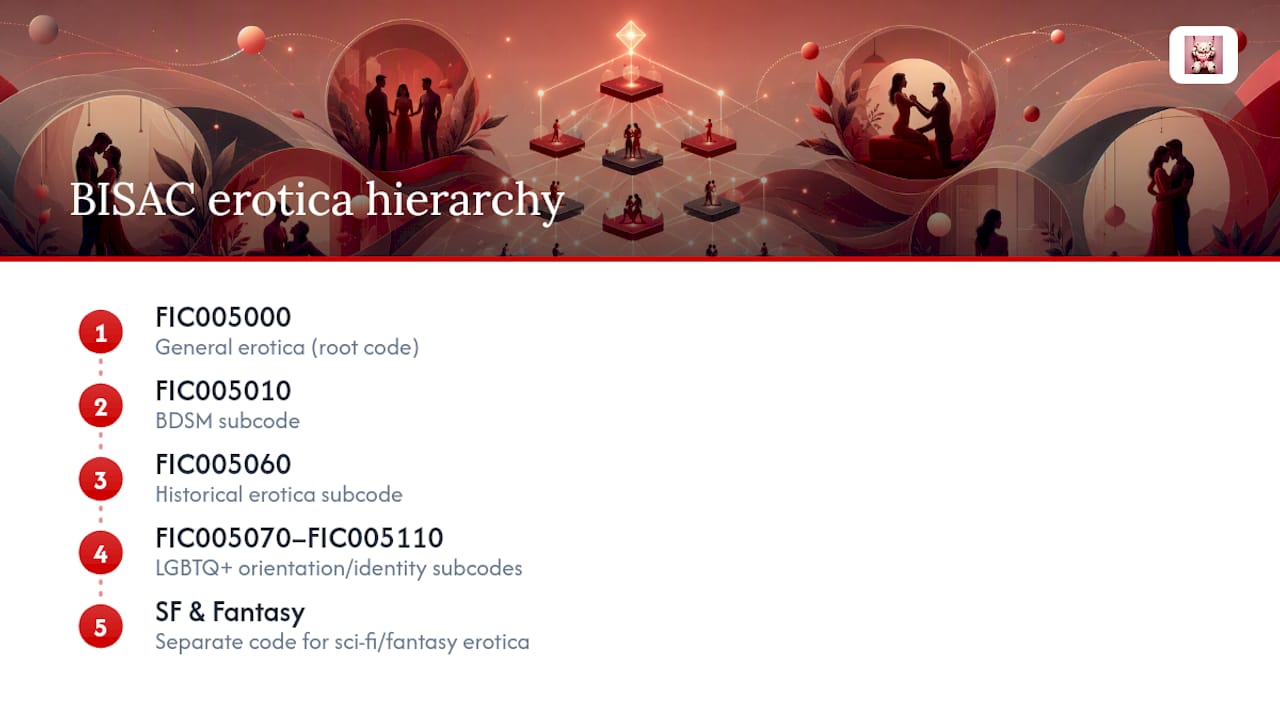
This system exists so a bookstore's inventory software and a library's catalog can both point a reader toward the right shelf without a human manually sorting each title. It's useful, but it's not exhaustive. Micro-niches like "shifter breeding romance" or "cyberpunk tentacle erotica" will never get their own BISAC code. Those live entirely in retailer-specific and reader-generated tags, which is a different system running in parallel.
How to Find Erotica That Matches Your Taste
Finding the right subgenre is mostly a search-strategy problem, and a few habits make it much faster:
- Combine a subgenre with a specific trope in your search terms, "dark romance mafia" pulls very different results than "dark romance" alone.
- Use platform tags and filters directly. Goodreads' erotica category runs on granular, reader-generated tags that are often more specific than any official taxonomy.
- Read a sample chapter before buying to confirm the heat level and prose style actually match what the blurb promises.
- Check author notes and content warnings, especially for dark romance or dubious consent stories, where tone varies enormously between writers.
- If you're browsing listings across a broader adult marketplace rather than a single retailer, a guide to navigating adult platforms safely covers how to vet a listing before you commit.
Why Micro-Niches Keep Multiplying
Genre mashups aren't a passing fad. Publishers Weekly has tracked this shift for years, and it hasn't slowed. Meanwhile, some categories just don't move, MILF-focused fiction, for instance, remains one of the steadiest sellers in the space regardless of what's trending. That stability sits right next to constant experimentation elsewhere in the market.

If you're trying to judge a listing's actual tone, skip the marketing copy and read the author's own notes and the sample pages. That's where heat level and seriousness of treatment show up honestly. Kinkykorner's guide to what custom erotica actually is breaks down how these niche requests get built from scratch.
The Real Problem With Most Genre Lists
Most erotica genre lists treat every category as equally weighted, as if "fetish-focused erotica" and "erotic romance" are the same kind of decision. They're not. One is a heat-level and structure choice; the other is a taste-in-object choice. Conflating them is why so many readers end up disappointed by a "recommended for you" algorithm that matched the wrong axis.
The bigger gap, though, is between official taxonomy and lived reader behavior. BISAC codes tell you what shelf a book sits on. They don't tell you whether the dark romance you're about to read treats its subject matter with any weight, or whether it's shock value dressed up in a trope. That judgment call still comes down to reading a sample chapter and taking author notes seriously, no code fixes that. If there's one thing worth prioritizing, it's this: pick your explicitness tier first, your trope second, and trust the sample chapter over the blurb every time.
— Prenston
Sources
- The indie author's guide to trends in erotica and erotic romance | Publishers Weekly
- Erotic fiction — Wikipedia
- Erotica books — Goodreads
FAQ
What is the most explicit type of erotica?
Extreme-tier erotica, often dark romance, dubious consent, or certain fetish-focused stories, pushes furthest into graphic detail and taboo territory, and it's the tier most likely to face platform restrictions.
What are sexualized books called?
They're generally called erotica or erotic fiction; when a strong relationship arc and emotional resolution are central, the more accurate term is erotic romance.
What's the difference between erotica and erotic romance?
Erotica centers the sexual content itself as the story's focus, while erotic romance requires a relationship arc that typically resolves with an emotionally satisfying, often happy, ending.
How do I find erotica in a specific subgenre?
Combine a subgenre with a trope in your search terms, use tag filters on sites like Goodreads, and read a sample chapter to confirm the heat level before buying.
Are all erotica subgenres available on every platform?
No. Taboo subgenres in particular face frequent restriction or removal, since retailer and platform policies vary widely on what fantasy-only content they'll host.