

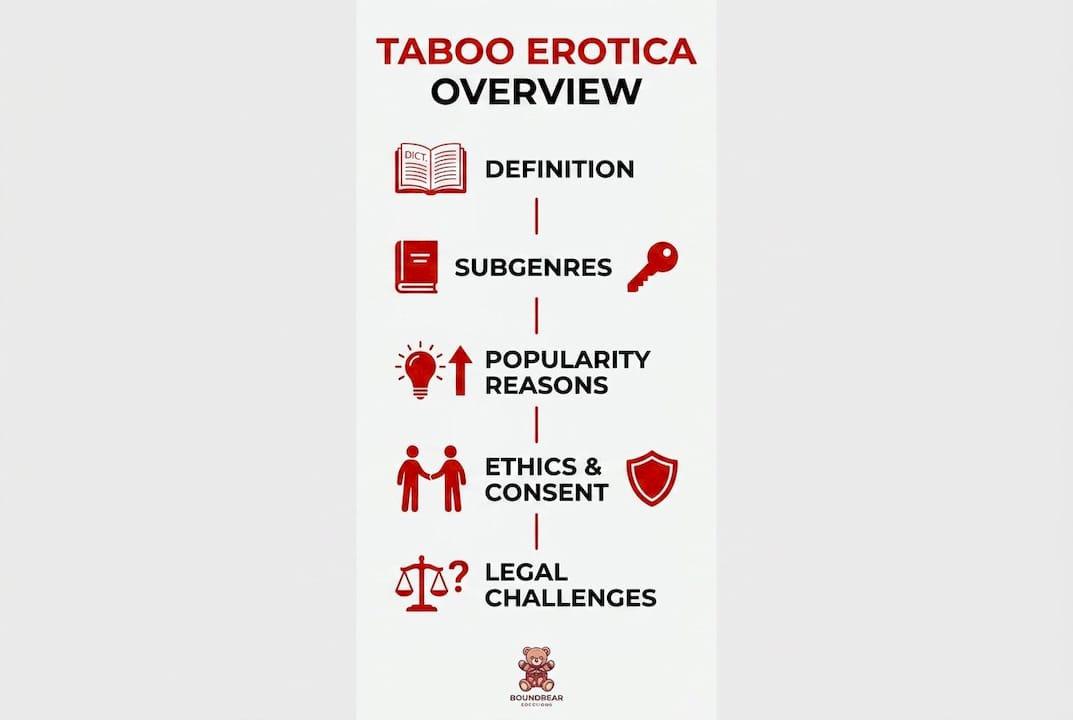
Taboo erotica is defined as adult fiction that portrays sexual scenarios considered forbidden or transgressive within specific cultural or social contexts. The genre covers a wide spectrum, from mildly provocative power dynamics to intensely boundary-pushing narratives, and its definition shifts with geography, time, and community norms. What counts as taboo in one culture is mainstream in another. Interracial romance, once labeled as taboo across major adult fiction platforms, now sits comfortably in the mainstream. That fluidity is the whole point. Taboo erotica is not a fixed category. It is a moving line drawn by society, and the genre exists precisely to cross it.
What is taboo erotica, and what are its major subgenres?
Taboo erotica explores sexual desires and dynamics that are off-limits for open discussion within specific cultural contexts. The genre is socially constructed, meaning its boundaries evolve as norms shift. That evolution is what keeps it alive and endlessly debated.
The major categories break down like this:
- Power imbalance narratives. Age-gap stories and authority-figure scenarios sit at the core of this category. The tension comes from unequal social standing, not just physical attraction.
- Forbidden relationship dynamics. Step-sibling, teacher-student, and boss-employee scenarios dominate this space. The "forbidden" framing is the engine of the fantasy, not the relationship itself.
- Dubious consent (dubcon). These stories involve ambiguous consent, where a character's willingness is unclear or contested within the narrative. The ambiguity is intentional and is part of the erotic charge.
- Non-consent (noncon). Explicit absence of consent defines this category. It is the most controversial subgenre and carries the heaviest content warnings.
- Breeding and impregnation. These scenarios center on the act or fantasy of conception, often layered with dominance and submission dynamics.
- Objectification. Characters are framed as objects of desire rather than autonomous agents. The fantasy is about control and possession.
Each category spans a spectrum from mildly provocative to intensely boundary-pushing. A step-sibling romance with slow-burn tension sits at a very different intensity level than an extreme noncon narrative. Both fall under the taboo umbrella, but they serve different readers with different thresholds.
Pro Tip: If you are new to taboo erotic fiction, start with power-imbalance or age-gap stories. They carry the transgressive charge of the genre without the intensity of dubcon or noncon content.

Industry editorial guidelines as of 2026 formally recognize these subgenres and require platforms to categorize content responsibly. That structure helps readers find what they want and avoid what they do not.
Why is taboo erotica so popular?
The appeal of taboo erotica is rooted in neuroscience, not moral failure. Societal shame attached to taboos activates the brain's reward centers, intensifying arousal. The dopaminergic system responds to transgression the same way it responds to any high-stakes risk. Forbidden feels electric because the brain is wired to make it feel that way.
"Shame and prohibition reroute desire in the brain, making taboo fantasies an intense form of erotic energy that is distinct from dysfunction. Taboo erotica functions by crossing categorical boundaries set by society, creating a stimulating tension between forbidden and familiar elements."
That tension is the core product. Taboos serve as societal boundaries that maintain social order, and taboo erotica violates those boundaries deliberately to create excitement and emotional tension. The mix of forbidden and familiar stimulates intellectual and emotional engagement that mainstream erotica rarely achieves.
There are several psychological drivers worth naming:
- The paradox of prohibition. Telling someone they cannot have something makes them want it more. Taboo erotica weaponizes that instinct.
- Safe exploration. Fantasies are a nervous system playground. Readers explore desires they would never act on in real life, and that exploration carries no real-world consequence.
- Escape from social norms. The genre offers a temporary exit from the rules readers live by every day. That exit is the relief.
- Power and control. Dominance and submission are deeply embedded in human sexuality. Taboo erotica gives those dynamics a narrative frame.
Pro Tip: Reading taboo erotic fiction does not mean you want to live out the scenario. Experienced readers treat these stories as cognitive escapism, not personal manifestos.
Taboo erotica fulfills the human desire for escapism by allowing readers to explore forbidden themes safely. That safety is what makes the genre sustainable across decades of censorship and cultural pressure.
How do readers and creators navigate consent and ethics in taboo erotica?
The consent vocabulary in taboo erotica is specific, and getting it wrong causes real harm to readers. Tagging clarity is the single most important tool for ethical consumption and creation. Labels are navigation tools, not moral judgments.
Here is how the key distinctions work:
- Dubcon (dubious consent). The character's willingness is ambiguous. The reader is left uncertain whether the character truly wants what is happening. The tension lives in that uncertainty.
- Noncon (non-consent). The absence of consent is explicit. The character does not want what is happening. This is the darkest end of the spectrum and requires clear content warnings.
- CNC (consensual non-consent). This is pre-negotiated roleplay. Both parties in the fiction have agreed to the scenario in advance. The "non-consent" is performed, not real. CNC is distinct from noncon because the consent framework exists outside the scene itself.
- Clear tagging. Creators have an ethical responsibility to label their work accurately. A reader who wants dubcon and receives noncon without warning has been failed by the creator, not by the genre.
- Platform self-regulation. Adult content platforms set their own content policies, and most require explicit tagging for consent-related subgenres. Those policies exist to protect readers, not to censor creators.
Differentiating taboo erotica from taboo OCD is also worth naming directly. Taboo OCD is a clinical condition involving intrusive, distressing thoughts that a person does not choose and does not want. Taboo erotica is chosen fantasy exploration. Confusing the two causes unnecessary shame for readers and misrepresents a legitimate mental health condition.
Pro Tip: Before reading a new taboo title, check the tags. If a platform does not tag content clearly, that is a red flag about the platform, not the genre.
Ethical consumption means knowing what you are choosing. Ethical creation means making that choice possible for your readers. Both sides of that equation matter.
What cultural and legal challenges does taboo erotica face in 2026?
Taboo erotica has survived censorship for as long as it has existed. The challenges in 2026 are more technical and legislative than moral, but they are no less real.
| Challenge | Current Impact |
|---|---|
| Age verification laws | Restrict platform access in multiple U.S. states and several countries |
| Payment processor restrictions | Limit revenue models for independent creators |
| Platform content policies | Result in content removal or demonetization without appeal |
| Search engine filtering | Reduces organic discoverability for adult content sites |
Censorship and age verification laws pose ongoing risks to the availability of taboo content. Creators respond by building alternative distribution models, including subscription platforms, direct-to-reader sales, and decentralized hosting.
The genre's persistence is not accidental. Several factors keep it alive:
- Underground and alternative markets absorb content removed from mainstream platforms.
- Reader demand remains consistent regardless of legal pressure.
- Digital distribution lowers the barrier to entry for new creators.
- Community-driven platforms prioritize creator autonomy over advertiser comfort.
The role of art in adult content is increasingly recognized as a legitimate cultural conversation, even as legislators push back. That recognition gives the genre a foothold in mainstream discourse that it did not have a decade ago. Taboo erotica is not going away. It is adapting, as it always has.
Key Takeaways
Taboo erotica is a socially constructed genre defined by transgression, and understanding its subgenres, psychological appeal, and consent vocabulary is the foundation for engaging with it thoughtfully and safely.
| Point | Details |
|---|---|
| Definition is fluid | Taboo erotica reflects shifting cultural norms, not a fixed list of forbidden acts. |
| Subgenres require clear tagging | Dubcon, noncon, and CNC are distinct categories that readers deserve to navigate by choice. |
| Neuroscience explains the appeal | The dopaminergic system responds to transgression, making forbidden content feel more intense. |
| Fantasy is not intent | Taboo erotica is cognitive escapism, not a reflection of real-world desires or identity. |
| Legal pressure drives adaptation | Creators respond to censorship and platform restrictions with alternative distribution models. |
Why I think the shame around taboo erotica is the actual problem
Here is my honest take: the genre is not the issue. The shame is.
People read taboo erotic fiction for the same reason they watch crime dramas or horror films. They want to feel something they cannot safely feel in real life. The brain does not distinguish between a fantasy and a real threat when it comes to arousal or fear. Both activate the same reward pathways. Taboo erotica is just a very efficient delivery system for that activation.
What I have found, after years of engaging with this genre and the communities around it, is that the readers who struggle most are not the ones reading dark content. They are the ones who cannot separate what they read from who they are. That confusion is the real harm, and it comes from a culture that refuses to talk about fantasy honestly.
The consent vocabulary matters more than people realize. Knowing the difference between dubcon and CNC is not pedantic. It is the difference between a reader finding exactly what they need and stumbling into content that genuinely distresses them. Creators who tag carefully are doing real ethical work. Platforms that enforce tagging standards are protecting real people.
Taboo erotica, approached with informed adult curiosity, is one of the most psychologically honest genres in fiction. It does not pretend desire is clean or simple. That honesty is worth something.
— Prenston
Kinkykorner: where taboo erotica finds its home
Kinkykorner is a marketplace built for adults who want to engage with taboo and adult content on their own terms, without judgment and without the sanitized experience that mainstream platforms deliver.

Whether you are looking for curated erotic fiction across every subgenre, or you want to connect with creators who specialize in the kind of content that gets scrubbed from everywhere else, Kinkykorner has the space for it. The platform lists adult-themed services, literary content, and artistic work from independent creators who take tagging and consent seriously. If you are ready to read, explore, or create taboo erotic fiction with full context and zero apology, Kinkykorner is where that happens.
FAQ
What is the definition of taboo erotica?
Taboo erotica is adult fiction that portrays sexual scenarios considered forbidden or transgressive within specific cultural or social contexts. The definition is socially constructed and shifts with time, geography, and community norms.
Is taboo erotica safe to read?
Taboo erotica is safe for adults who engage with it as chosen fantasy exploration. The key is using content tags to navigate subgenres and distinguishing fantasy from real-world intent or identity.
What is the difference between dubcon and noncon?
Dubcon involves ambiguous consent within the narrative, while noncon involves explicit absence of consent. CNC (consensual non-consent) is pre-negotiated roleplay where both parties have agreed to the scenario in advance.
Why is taboo erotica so popular?
The dopaminergic system responds to transgression, making forbidden content feel more intense than mainstream erotica. Taboo erotica also offers safe escapism, allowing readers to explore desires they would never act on in real life.
Does reading taboo erotica mean I want to act it out?
No. Experienced readers treat taboo erotic fiction as cognitive escapism, not a reflection of personal intent. Fantasies are a nervous system playground, and the content of a fantasy does not define a person's real-world desires or character.