
"Types of sensual art" covers the different media and styles artists use to explore desire, intimacy, and the body, from a 12,000-year-old carving to a phone screen. The category spans a lot of ground, and here's the quick map:
- Fine-art nudes and academic painting
- Erotic photography and boudoir
- Shunga and other print traditions
- Performance art and burlesque
- Digital and AI-generated erotica
Kinkykorner exists because that range needs a home. The Venus of Willendorf proves the impulse is ancient. Shunga proves it was never confined to one culture.
Key Takeaways
Sensual art spans painting, sculpture, print, photography, performance, and digital media, and the same image can shift categories entirely based on intent, audience, and where it's displayed.
| Point | Details |
|---|---|
| Context defines category | The same nude reads as art, erotica, or pornography depending on intent and display setting. |
| History runs deep | Sensual imagery dates back to the Venus of Willendorf and spans cultures from ancient Rome to Edo-period Japan. |
| Medium shapes technique | Painting idealizes, photography frames, print circulates, performance embodies. |
| Consent is foundational | Documentation and age verification separate legitimate practice from exploitation. |
| Genre follows intent | Fetish, boudoir, and aesthetic erotica differ mainly in purpose and audience, not subject matter. |
Table of Contents
- What Counts as Types of Sensual Art vs. Erotic, Nude, or Pornographic?
- How Did Sensual Art Develop Across History?
- What Are the Main Types of Sensual Art by Medium?
- What Are the Common Styles and Genres of Sensual Art?
- What Legal and Ethical Rules Apply to Sensual Art?
- Which Artists and Works Define Sensual Art?
- Where Can You View or Research Sensual Art?
- How Should You Interpret Sensual Art Critically?
- Where Can You Learn More About Erotic Art History?
- An Editorial Take on Classifying Sensual Art
- Frequently Asked Questions
- Sources
What Counts as Types of Sensual Art vs. Erotic, Nude, or Pornographic?
Sensual art suggests. Erotic art depicts desire more directly, often with nudity or sexual activity, but always with an interpretive layer beyond the body itself. Pornography aims for arousal and stops there. Nude art is the oldest and most neutral term of the four, focused on the human form as a subject, with sensuality as an optional byproduct rather than the point.
The line between these categories rests on intent, audience, and context, not on how much skin is showing. Erotic art is generally understood as work that evokes arousal while carrying additional artistic or cultural purpose, which is exactly why the same image can sit in a museum catalog and a private collection with two different labels attached. The Stanford Encyclopedia of Philosophy draws a sharper practitioner-level distinction still: erotic art is made for contemplation, erotica is made for stimulation, and the two goals produce different objects even when the subject matter overlaps.
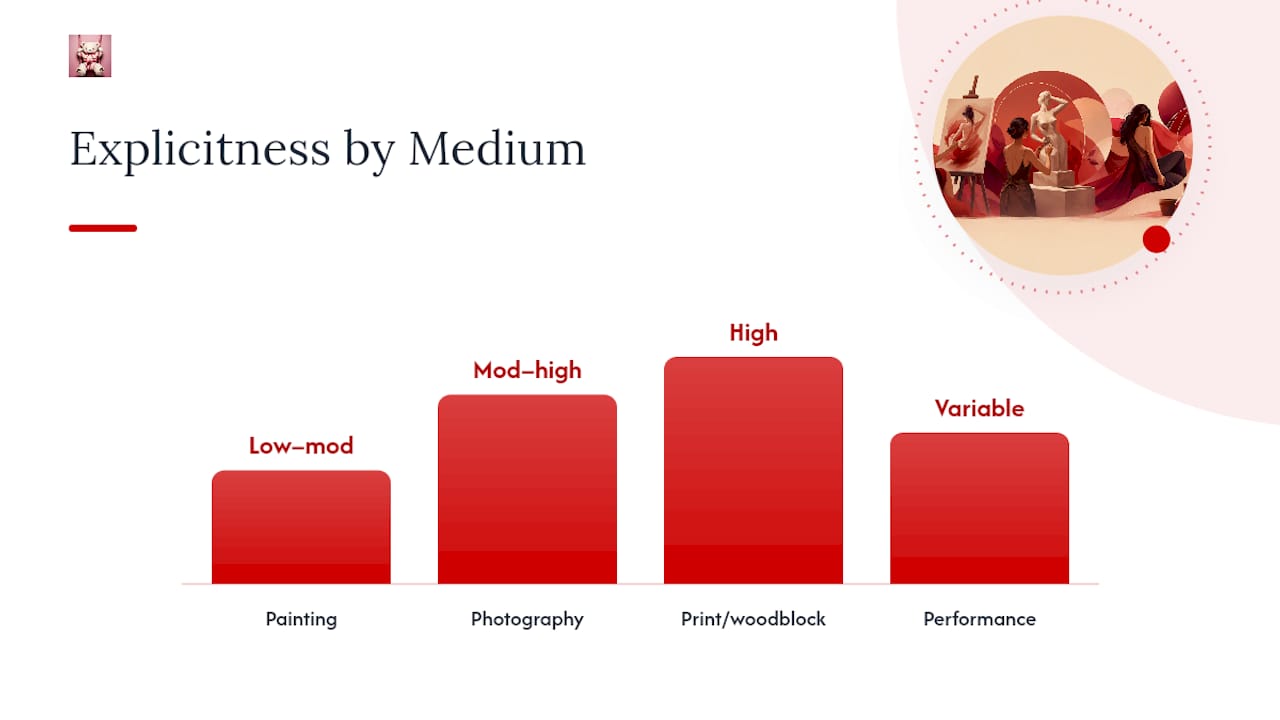
| Medium | Historical period | Cultural purpose | Explicitness | Display setting |
|---|---|---|---|---|
| Painting | Renaissance to present | Academic, decorative | Low to moderate | Museum, private collection |
| Photography | 19th century to present | Commercial, fine art | Moderate to high | Gallery, online |
| Print/woodblock | Edo-period Japan | Ritual, educational | High | Private circulation, archive |
| Performance | 20th century to present | Critique, empowerment | Variable | Theater, gallery |
Consider three borderline cases. A Titian nude hangs in the Prado as an academic masterwork, but strip away the mythological framing and it's a naked woman on a bed, which is precisely the debate art historians have had for centuries. A boudoir photograph shot for a private client and a near-identical image published as stock erotica differ only in distribution and audience, not composition. A Shibari rope sequence performed live reads as sculpture to one audience and as fetish content to another, depending entirely on where it's staged.
How Did Sensual Art Develop Across History?
Sensual imagery is one of the oldest recorded human impulses, older than writing, older than agriculture in some regions.
- Paleolithic era: The Venus of Willendorf, a prehistoric figurine emphasizing fertility and form over realism.
- Classical antiquity: Greek vase painting and Roman frescoes at Pompeii depicted sex acts openly, often in domestic and bathhouse settings rather than as scandal.
- Asia: Japanese shunga woodblock prints circulated for centuries as both erotic entertainment and sexual education, occasionally suppressed by authorities but never fully eliminated.
- Pre-Columbian Americas: Moche ceramics from ancient Peru show explicit sexual scenes integrated into everyday pottery, suggesting these images carried ritual or social meaning rather than shame.
- 19th and 20th centuries: The camera changed everything. Postcards, then magazines, then mass-market publications turned erotic imagery into a commercial product for the first time at real scale.
Rock art at England's Creswell Crags dates back to the Paleolithic era, and while not all of it depicts sexuality, the site is a reminder that image-making and the human body have been intertwined since ancient times.
What a given culture called ritual, another called education, and a third called decoration. Roman erotic frescoes decorated bathhouses without controversy, while the exact same imagery would have drawn censure in Victorian England centuries later. The 20th century added its own turning point when artists began using performance and photography to interrogate the nude rather than simply render it, turning the body into a political and conceptual subject instead of a passive one. That shift didn't erase the older traditions. It just added new tools next to the woodblock and the paintbrush.
What Are the Main Types of Sensual Art by Medium?
Every medium handles sensuality with its own toolkit. Knowing the toolkit tells you what to look for.
Painting
Oil and canvas built the Western nude tradition, from Renaissance mythological scenes to modern figurative work. Explicitness stays low to moderate because the medium favors idealization over documentation. Museums and private collectors are the primary display settings, and Titian remains the reference point for how classical painting used allegory to make nudity respectable to its patrons.
Sculpture
Sculpture turns the body into physical mass, using stone, bronze, or clay to render form in three dimensions. The Venus of Willendorf sits at one end of this tradition; classical Greek and Roman statuary sits at the other, often using mythological subjects as cover for frank sexuality.
Print and Woodblock
Shunga is the essential example here, produced across the Edo period using carved wooden blocks and multiple ink layers. The prints were explicit, mass-producible, and socially embedded rather than underground, sold alongside other popular art of the era.
Photography
Photography splits into fine-art nudes, erotic photography, and pornographic photography, and the boundaries between them depend almost entirely on framing, lighting, and where the image gets published. Erotic photography tends to occupy the middle ground, using aesthetic choices to suggest desire without full explicitness. Learn more about how this plays out with real examples of erotic photography that illustrate the range.
Film and Video
Moving image adds pacing and narrative to the equation. Explicitness ranges from suggestive art films to hardcore production, with display settings running from festival screenings to private streaming.
Literature and Poetry
Words work through implication and rhythm rather than image. This is where suggestion does the heaviest lifting, and it's a category growing fast online as readers seek narrative-driven erotic content over static images.
Performance
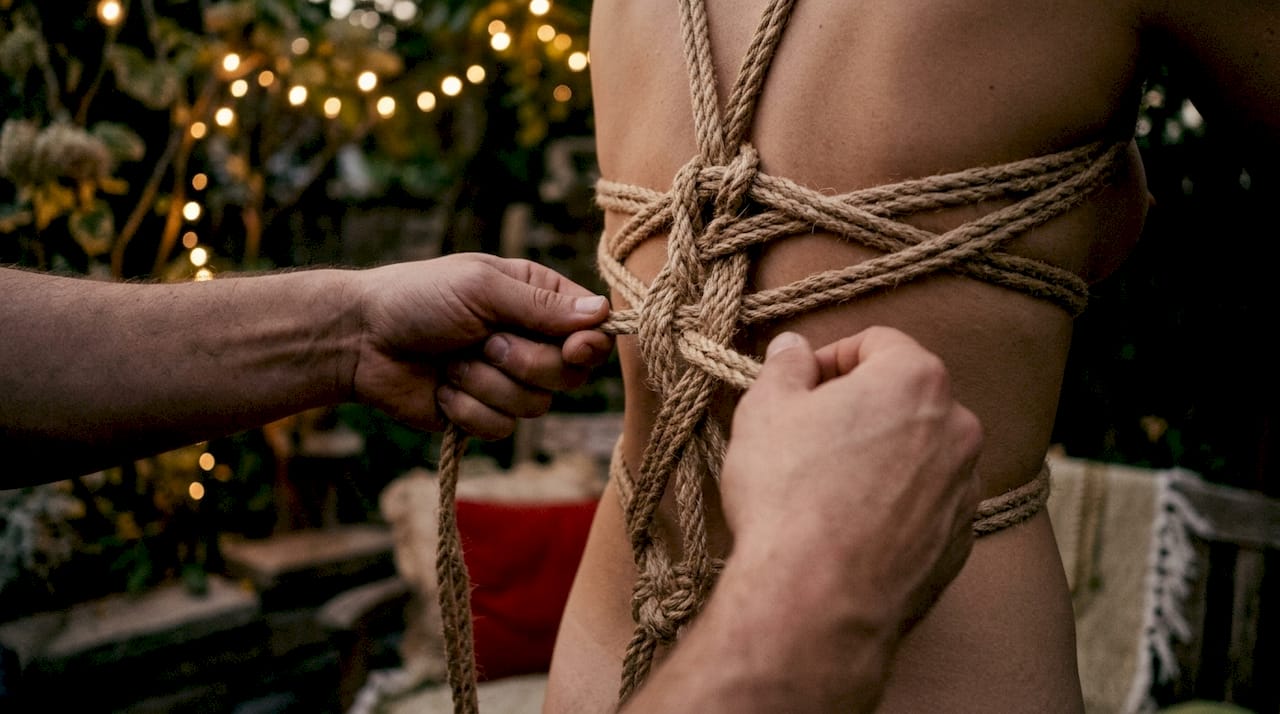
Burlesque, performance art, and Shibari/Kinbaku rope work all use the live body as the medium. Shibari in particular treats rope as sculptural line, turning restraint into visual composition rather than pure fetish display.
Comics and Illustration
Hentai, adult graphic novels, and erotic illustration allow for stylization that photography can't match, letting artists push anatomy and scenario past what live subjects could realistically pose for.
Digital and Interactive
VR, AR, and AI-generated imagery are the newest entries, raising fresh questions about consent and authorship since no live model may exist at all.
Textiles and Fashion
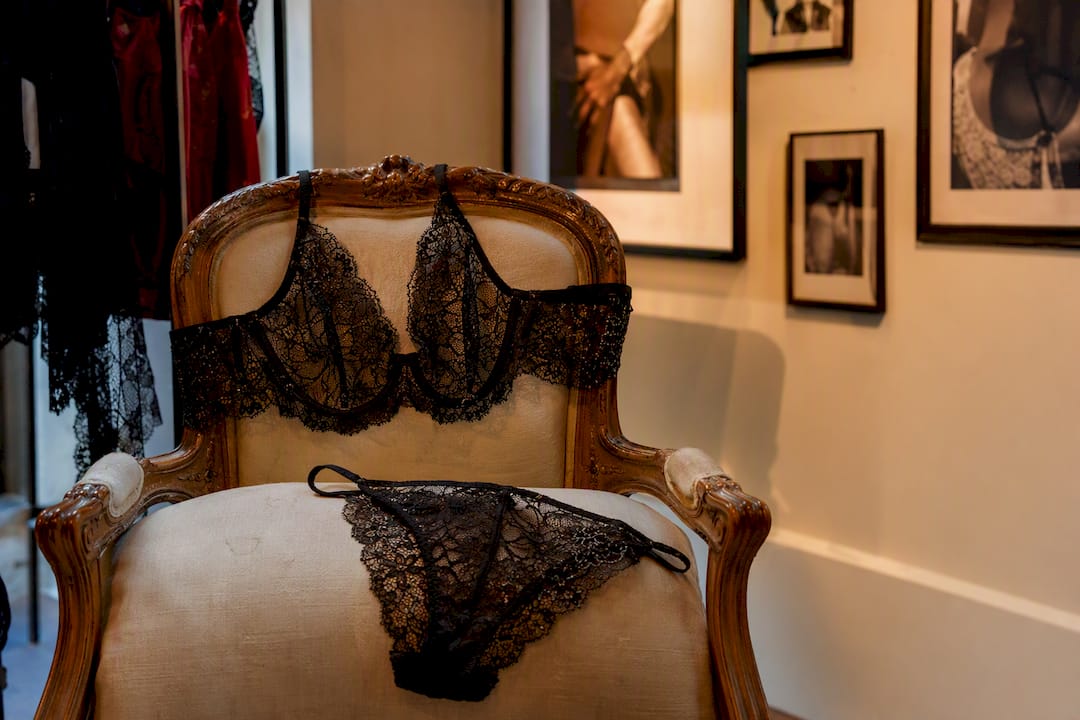
Lingerie design and body-adornment textiles use fabric, texture, and partial concealment to construct sensuality through what's covered rather than what's shown.
Pro Tip: When you're trying to classify a piece, ask where it's displayed before you ask what it shows. A gallery wall and a subscription feed change the reading of an identical image.
What Are the Common Styles and Genres of Sensual Art?
Medium tells you the tool. Genre tells you the intent behind using it.
- Fetish art focuses on specific objects, materials, or acts (latex, leather, feet) as the central subject rather than the body as a whole.
- Queer eroticism centers LGBTQ+ desire and bodies, often as a deliberate corrective to a historically heterosexual canon.
- Romantic/sensual portraiture leans on softness, mood, and implied intimacy over anatomical directness.
- Aesthetic erotica prioritizes narrative and atmosphere over explicitness, working as a bridge between classical fine art and modern sensual imagery.
- Boudoir is intimate portrait photography, frequently framed around the subject's own body positivity and self-empowerment rather than an outside viewer's gaze.
- Shibari/Kinbaku treats rope bondage as sculptural composition, an art form built on trust and technical precision.
- Burlesque is theatrical striptease built around comedy, costume, and reveal as performance craft.
- Explicit/pornographic art sits as the contrast case: direct depiction aimed at arousal, with minimal interpretive distance from the act itself.
The same image can migrate between these labels depending on where it's shown and who's looking. A rope-bound figure on a fetish site reads as kink content; the identical composition in a gallery reads as sculpture. Power, gaze, consent, and body positivity are the threads running underneath nearly every one of these genres, whatever the surface style.
What Legal and Ethical Rules Apply to Sensual Art?
Consent is the foundation, and it has to be documented, not assumed. Every subject needs to have knowingly agreed to the specific use of their image, and age verification for anyone appearing in adult-themed work is non-negotiable across reputable platforms and legitimate marketplaces alike.
- Obscenity and censorship standards vary heavily by jurisdiction and by platform, so the same image can be legal in one country and restricted in another.
- Public display rules for galleries and museums differ sharply from the content moderation policies that shape what creators can post online.
- Power dynamics between artist and subject deserve scrutiny, particularly in historical work made without the subject's meaningful say.
- The line between exploitation and empowerment often comes down to who controls the final image and its distribution.
Pro Tip: Keep signed model releases and usage agreements on file for every shoot, and store them with the same care you'd give financial records. Documentation is what separates a defensible creative practice from a liability. Creators working in this space can find structured guidance in Kinkykorner's erotic portfolio creation guide.
Which Artists and Works Define Sensual Art?
- The Venus of Willendorf remains the oldest widely cited example, a small limestone figure carved roughly 25,000 years ago with exaggerated form and no face, prioritizing fertility symbolism over portraiture.
- Titian used mythological subjects like Venus and Danaë as socially acceptable vehicles for full nudity, setting the template Renaissance painting followed for generations.
- Tom of Finland built a highly stylized, hypermasculine visual language for queer erotic art in the 20th century, work that shaped gay visual culture well beyond the art world.
- Nobuyoshi Araki is a contemporary Japanese photographer whose explicit, often controversial images blur fine-art photography and erotic photography in a single body of work.
- Shunga stands as the genre example for an entire tradition, produced across generations of Japanese printmakers and never confined to a single artist's name.
For a broader survey of pieces worth knowing, Kinkykorner's roundup of adult-themed art examples is a solid next stop.
Where Can You View or Research Sensual Art?
Major museums hold historical erotic and nude works in dedicated or rotating collections, and specialist archives focus specifically on the erotic and sensual tradition across cultures. Curated art books remain some of the best entry points for shunga, classical nudes, and 20th-century photography, since they compile context alongside the images.
- University and museum digital archives for shunga and classical nudes
- Curated art history books covering erotic and sensual traditions by era
- Reputable artist portfolios and gallery websites
- Kinkykorner's own role of art in adult content guide for historical framing
- Library special collections for older or international material not digitized elsewhere
Museum collection search tools typically let you filter by period and medium, which is the fastest way to find historical material without wading through unrelated holdings.
How Should You Interpret Sensual Art Critically?
Approach a piece with a short set of questions rather than a snap judgment.
- What was the artist's likely intent, based on composition, title, and era?
- Who was the original intended audience: patron, public, or private buyer?
- What's the display context now: museum wall, book plate, or online feed?
- What power dynamics existed between artist and subject?
- Is consent or agency visible in how the subject is posed and framed?
Check provenance and exhibition notes when they're available; they often explain choices that look strange without context. Suggestion tends to signal artistic intent, while unambiguous explicitness without narrative framing tends to signal a commercial or stimulation-first purpose. Cultural distance matters too. What reads as shocking through a modern lens may have been unremarkable in its original setting.
Where Can You Learn More About Erotic Art History?
- Erotic art for a broad definition and boundary discussion
- History of erotic depictions for global historical examples
- Erotic photography for medium-specific distinctions
- Erotic art (Stanford Encyclopedia of Philosophy) for the theoretical framing behind intent-based classification
An Editorial Take on Classifying Sensual Art
Most guides to this subject treat categories like fixed boxes: this is erotic, that is pornographic, done. That approach fails the moment you look at real history. Titian's Venus paintings were arguably more explicit for their era than plenty of modern boudoir photography, and shunga circulated as casually as a magazine does today. Category has always followed context, not the other way around.
Where conventional advice falls short is in treating explicitness as the main variable worth measuring. It isn't. Audience and display setting do more work than skin ever does. A rope-bound figure is fetish content on one platform and sculpture on a gallery wall, and nothing about the image itself changed.
If you take one thing from this: prioritize asking who made a piece, for whom, and where it lives now, before deciding what to call it. That question does more classifying than any explicitness scale ever will.
Ready to see how contemporary artists and creators are putting these categories into practice? Kinkykorner's marketplace connects you with adult-themed services, listings, and original artistic content across the same spectrum this article maps, from fine-art photography to fetish-specific work. Explore Kinkykorner to browse listings and discover creators working in the traditions covered here.
Frequently Asked Questions
What is a sensual artist? A sensual artist is someone who creates work centered on intimacy, desire, or the body using suggestion, mood, and composition rather than explicit depiction. The label applies across painting, photography, performance, and digital media.
What is sensual art, exactly? Sensual art is visual, literary, or performance work that evokes intimacy and desire through suggestion and atmosphere, distinct from erotic art's more direct depiction and pornography's stimulation-first purpose.
What are the main forms of erotic art? The main forms include painting, sculpture, print traditions like shunga, photography, film, literature, performance, comics and illustration, digital media, and textile or fashion design, each handling explicitness differently.
How do different styles of sensual art vary by culture? Cultural context changes both content and reception. Japanese shunga circulated openly for centuries, Roman erotic frescoes decorated everyday bathhouses, and Moche ceramics carried explicit imagery into ritual and domestic use without the stigma later cultures attached to similar work.
Is nude art the same as pornography? No. Nude art centers the human form as an artistic subject, with sensuality as one possible element among many, while pornography is created specifically to produce arousal with minimal interpretive framing.
Sources
- Erotic art
- History of erotic depictions
- Erotic photography
- Erotic art (Stanford Encyclopedia of Philosophy)