
A private dance is a one-on-one erotic performance, most often called a lap dance, that happens away from the main stage in a semi-private alcove, a couch lounge, or a VIP room. It's built around three things: the dancer's boundaries, the club's own rules, and whatever price and duration you agree on before the music starts. Every other detail flexes around those three anchors.
Here's what to expect walking in for the first time:
- Where it happens: a side alcove near the floor, a couch lounge, or a private VIP/champagne room, depending on the club's layout.
- How long it runs: a single song (roughly three to four minutes), a per-minute rate, or a block session of 30 to 60 minutes.
- Who's in charge: the dancer. She sets what contact is allowed, and club staff enforce it. Your assumptions about what a private dance "should" include don't factor in.
Key Takeaways
Private dancing works best when price, duration, and boundaries are all confirmed before anyone enters a private room, and the dancer's consent governs everything that follows.
| Point | Details |
|---|---|
| Definition first | A private dance is a one-on-one erotic performance, often a lap dance, held in a semi-private or private area. |
| Consent leads | Dancer boundaries and club policy determine allowed contact, not customer assumption. |
| Confirm terms early | Agree on price, duration, and permitted contact before entering any private room. |
| Watch for red flags | Management pressure, missing security, or a visibly uncomfortable dancer are warning signs. |
| Tip and pay clearly | Settle payment method and tipping expectations as part of the booking, not after. |
Table of Contents
- What Typically Happens During a Private Dance
- What Do Lap Dance, Table Dance, and VIP Room Mean?
- How Do Club Rules and Local Law Shape What's Allowed?
- How Much Does a Private Dance Cost and How Do You Book One?
- How Should You Behave During a Private Dance?
- How Should You Prepare Before Booking a Private Dance?
- How Do You Find a Reputable Performer or Venue?
- Why Vetted Platforms Matter More Than People Realize
- Sources
What Typically Happens During a Private Dance
The interaction starts before you ever sit down. You ask a dancer if she's available, she quotes a price and duration, and you both agree on terms before anyone walks toward a private area. Skip this step and you're setting yourself up for a confused, awkward, or outright bad experience.
Where that dance actually happens changes everything about it. A side alcove near the main floor is semi-private, loud, and short, usually just long enough for a song or two. A couch lounge sits a step further back, offering slightly more room and privacy but still within sight of staff. A VIP or champagne room is the most private option, and it's typically booked in blocks of 30 to 60 minutes rather than by the song.
The flow itself depends on the format. In a floor-level lap dance, you're usually seated while the dancer performs standing or straddling, moving through one song or a short set with a clear stopping point when the track ends. In a VIP block, the pacing loosens up considerably. Industry observers note that the real draw of these longer sessions is often the performer's undivided attention and the exchange of energy, not just physical contact, and a 30 or 60 minute booking commonly splits between actual dancing and conversation. Dancers signal boundaries throughout, whether that's redirecting your hands, stepping back, or simply telling you what's off limits. Read those signals and adjust immediately.

| Setting | Typical Duration | Privacy Level |
|---|---|---|
| Side alcove / floor area | One song (roughly three minutes) | Semi-private, near main floor |
| Couch lounge | One song or short per-minute block | Moderate, set back from foot traffic |
| VIP / champagne room | 30-60 minute block session | High, often a separate enclosed room |
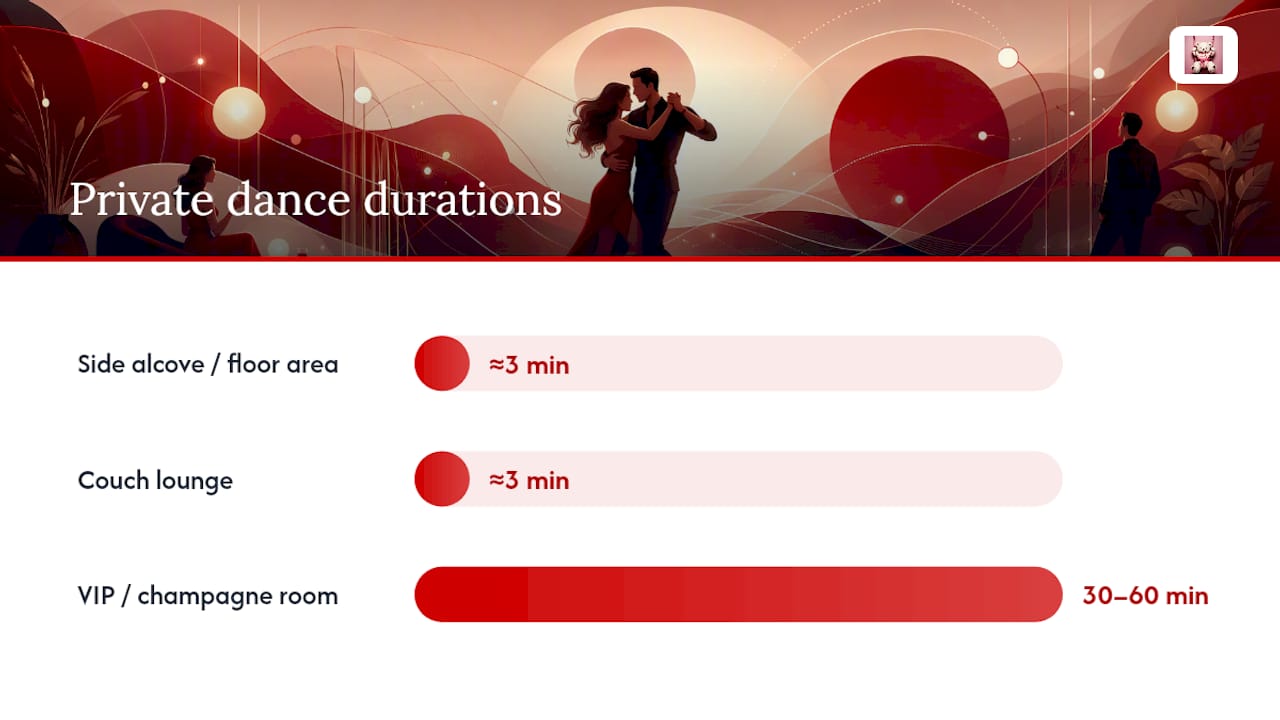
A one-song lap dance in a side alcove is over almost as fast as it starts, which makes it a low-commitment way to see how a club and a particular dancer operate. A 30-minute VIP booking is a different animal entirely, closer to a hosted hangout with dancing worked in than a single choreographed routine.
What Do Lap Dance, Table Dance, and VIP Room Mean?
The vocabulary around private dancing gets used loosely, and that looseness causes real confusion when you're trying to book something specific. Here's the breakdown:
- Lap dance: an erotic performance that typically involves body contact, with the dancer moving against or straddling the seated patron.
- Table dance: dancing close to a seated customer without body contact, essentially the same choreography as a lap dance minus the touch.
- Couch dance: a lap dance performed on a couch or lounge seat rather than a chair, often in a slightly more private corner of the club.
- VIP or champagne room: a private, enclosed space booked for extended one-on-one time, usually sold in time blocks rather than by the song.
- Block session: any private booking sold in a fixed chunk of time (commonly 30 to 60 minutes) instead of per song, giving both parties a clear start and end point.
The gap between these terms matters because privacy and contact level shift with each one. A table dance in one club might be nearly identical to a lap dance in another, and a "VIP room" at a strip club in one state can mean something completely different from a VIP room across state lines. Never assume a term means the same thing everywhere. Ask.
How Do Club Rules and Local Law Shape What's Allowed?
The single most important thing to understand about private dancing: rules vary widely by club and by local jurisdiction, and dancer consent and club policy govern what's allowed far more than whatever expectation you walked in with. This isn't a gray area you can negotiate your way around.
Most clubs share a baseline set of restrictions, even though specifics differ:
- No penetration, ever, under any circumstance.
- Genitals typically stay off limits to touch, on both sides.
- Rules around where and how a customer may touch a dancer, often limited to hips, waist, or not at all.
- Security monitoring or cameras in private rooms, which venues use to enforce these standards and step in fast when someone crosses a line.
Club rules regarding physical contact vary from venue to venue, but violating a dancer's boundaries is commonly grounds for immediate removal. Venues report relying on security staff and cameras specifically to enforce these standards in private rooms.
Pro Tip: Confirm price, duration, and exactly what contact is allowed before you ever step into a private room. A thirty-second conversation up front prevents almost every bad private-dance story you've ever heard.
Pressuring a dancer, trying to negotiate past a boundary she's already stated, or attempting contact she hasn't agreed to is a serious red flag, and clubs treat it that way. Expect immediate removal, and in some cases, police involvement. This isn't the club being uptight. It's the baseline standard the entire industry runs on.
How Much Does a Private Dance Cost and How Do You Book One?
Pricing structures follow a few common patterns, though exact rates vary heavily by city, club, and performer:
- Per-song lap dance: a flat rate covering one track, typically the entry point for private dancing at most clubs.
- Per-minute private room rate: a rate multiplied by however long you stay, common in smaller private areas that aren't full VIP suites.
- Block booking: a flat fee for a fixed window, usually 30 to 60 minutes, in a VIP or champagne room.
Before you agree to anything, run through this checklist:
| Booking Step | What to Confirm |
|---|---|
| Price | Total cost for the song, minute rate, or full block |
| Duration | Exact length of the session and what happens if you want to extend |
| Allowed contact | What touching, if any, is permitted |
| Payment method | Cash, card, or club-specific payment system |
| Tipping | Whether tips are expected on top of the base price, and how |
Cash remains the standard in most clubs, though some now accept card payments through discreet processing systems built for adult businesses. Tipping norms vary by venue, but a tip on top of the agreed price is common practice and appreciated, especially after a VIP block where the dancer has given you sustained attention rather than a single song.
How Should You Behave During a Private Dance?
Mutual respect and the dancer's own boundaries are the entire foundation of a private dance that goes well. Everything else, the pricing, the setting, the small talk, sits on top of that.
The do's are straightforward: ask before you assume anything, negotiate openly, tip when the experience warrants it, and keep any conversation respectful even if the mood in the room is playful or flirtatious. The don'ts matter just as much. Don't take photos or video without explicit permission. Don't try to talk a dancer out of a boundary she's already set. Don't expose yourself. None of this is negotiable, and clubs enforce it because they have to.
Watch for these warning signs before and during a session:
- Management pressuring a dancer to push past her own stated limits.
- No visible security presence in or near private rooms.
- A dancer who seems visibly uncomfortable, rushed, or coerced by staff rather than acting on her own terms.
If something feels off, you have options. Pause the interaction and ask to step back out to the main floor. Flag down security or a manager directly rather than trying to resolve it yourself. Once you've left, document what happened, including names, times, and specifics, in case the club or a regulatory body needs the record later. Reviews on venue safety standards consistently point to isolation and unclear rules as the root cause of most bad private-room experiences, for patrons and performers alike.
How Should You Prepare Before Booking a Private Dance?
A little preparation turns an awkward, uncertain first booking into a smooth one. Run through this short list before you approach a dancer:
- Know your budget for a single song versus a full block session.
- Confirm who enforces the rules in that specific club (usually security or a floor manager).
- Decide your payment method in advance, cash or card, so you're not fumbling at the moment of booking.
- Plan to tip, and have that amount separate from what you're paying for the dance itself.
- Stay sober enough to read cues and follow directions clearly. This one matters more than people expect.
A few sample lines make the negotiation easier than it sounds:
"What's your rate for a private dance, and how long does that cover?"
"Is there anything that's off limits I should know before we start?"
"Can we do one song first before I book a longer block?"
"Who do I talk to if I have a question once we're in the room?"
That last question, about a shorter session first, is worth using even if you're confident. Performers who write about the business consistently emphasize that extras are optional and boundaries are entirely the dancer's call, and a single song is a low-pressure way to learn a specific club's norms before committing to a 60-minute VIP block.
How Do You Find a Reputable Performer or Venue?
Privacy cuts both ways in this industry. You want discretion about your own visit, and dancers want listings that accurately represent what they offer without exposing more than they've chosen to share. A well-built listing signals both. Look for professional photos, a clear service description, explicit statements about boundaries, and transparent pricing instead of vague "contact for rates" language that usually means haggling once you're already committed.
When you're vetting a listing on any marketplace, check for a few concrete signals: verified reviews from real bookings, a verification badge or process the platform actually enforces, clearly stated cancellation or refund terms, and a working contact method for questions before you commit. Listings that dodge all four of these are worth skipping.
Kinkykorner built its marketplace around exactly this kind of transparency, connecting readers with vetted performers and venues where pricing, boundaries, and service details are stated up front rather than buried. The platform's privacy guidance for adult marketplaces covers what to expect from listings that take discretion seriously, and its roundup of inclusive, sex-positive venues gives a sense of what a well-run space actually looks like on the ground.
Pro Tip: Use a marketplace account with its own privacy controls rather than a personal profile, and check how recent and specific a listing's reviews are. A page with dozens of vague five-star reviews all posted the same week is worth a second look before you book anything.
Why Vetted Platforms Matter More Than People Realize
The private dance itself is rarely the part that goes wrong. It's almost always the setup, an unclear price, an assumed boundary, a venue with no real accountability, that turns a good idea into a bad night. That's the part a vetted platform actually solves.
Kinkykorner exists because clear listings and transparent policies prevent the exact misunderstandings that give this whole side of the industry a bad reputation. A performer who states her boundaries up front, a venue that publishes its rules, a marketplace that verifies who it lists: none of that is overhead. It's the difference between an experience both people walk away satisfied with and one that ends with security getting called.
If you're booking a private dance, book through a platform that treats privacy and verification as baseline requirements, not optional extras.
Sources
The facts in this guide draw from industry reporting on club etiquette, an occupational-health review of performer safety in private rooms, an encyclopedic overview of dance terminology, and a performer's own account of what a private dance actually involves. Each source approaches the topic from a different angle, which is exactly why cross-checking them matters before you walk into a club with the wrong expectations.
- 9 Strip Club & Lap Dance Etiquette Rules Explained by Strippers
- Lap dance — Wikipedia
- What Does a Private Dance Involve? — bohemianwritings