

Kink roleplay gets misunderstood constantly. People hear the phrase and picture cheesy costumes or over-the-top acting, but what is roleplay in kink actually about? It's a consensual, negotiated practice where you and your partner temporarily step into defined roles to explore specific dynamics, desires, and psychological territory that everyday sex doesn't always reach. It's theater with stakes. It's fantasy made physical through communication, trust, and deliberate intention. This guide breaks down what it involves, why people do it, and how to approach it without making a mess of your relationship or your head.
Table of Contents
- Key Takeaways
- What roleplay in kink actually means
- Consent, safewords, and scene negotiation
- Roleplay dynamics, intensity levels, and types
- How to start kink roleplay without overthinking it
- My honest take on what makes this complicated
- Explore more at Kinkykorner
- FAQ
Key Takeaways
| Point | Details |
|---|---|
| Roleplay is consensual by design | Every scenario requires explicit, ongoing agreement from all participants before and during play. |
| Safewords are non-negotiable | A traffic-light system gives you a real-time way to pause or stop without breaking the scene awkwardly. |
| Negotiation acts like a contract | Agreeing to a role doesn't mean agreeing to everything that role implies — specifics matter. |
| Start low-stakes to build comfort | Familiar, simple scenarios reduce anxiety and let you find your footing before going deeper. |
| You stay yourself inside the role | Playing a character doesn't dissolve your identity or carry scene dynamics into real life. |
What roleplay in kink actually means
Let's get the definition straight before anything else. Kink roleplay is a consensual BDSM practice where partners temporarily assume different roles to create specific dynamics and heightened excitement. The keyword there is temporary. You're not becoming someone else. You're playing a version of yourself inside an agreed-upon scenario, and when the scene ends, you step back out.
Common scenarios include:
- Mistress and slave: Power exchange with explicit control and submission rituals
- Teacher and student: Authority-based dynamic with discipline elements
- Boss and employee: Workplace power play, often laced with tension and taboo
- Stranger fantasy: Meeting as if for the first time, recapturing newness or forbidden energy
- Captor and captive: High-intensity scenarios requiring careful, detailed negotiation upfront
What separates kink roleplay from just having a fantasy in your head is the physical enactment. Roleplay differs from internal fantasy because it requires deliberate communication, boundary negotiation, and real commitment from both people. You're not just imagining it alone. You're building a shared, ethical sexual performance together, and that requires both people to be active participants, not passive observers.
The narrative matters too. A good scene has a setup, a dynamic, and mutual engagement. It's not just "you wear the costume and I do the thing." It's a co-created experience where both people know what they're walking into and what they want to get out of it.
Consent, safewords, and scene negotiation
This is the part that separates kink from chaos. Consent in BDSM roleplay is ongoing, freely given, specific, and revocable at any point. Not just at the start. Not just in theory. At any moment during the scene, either person can change their mind, and that has to be respected immediately.
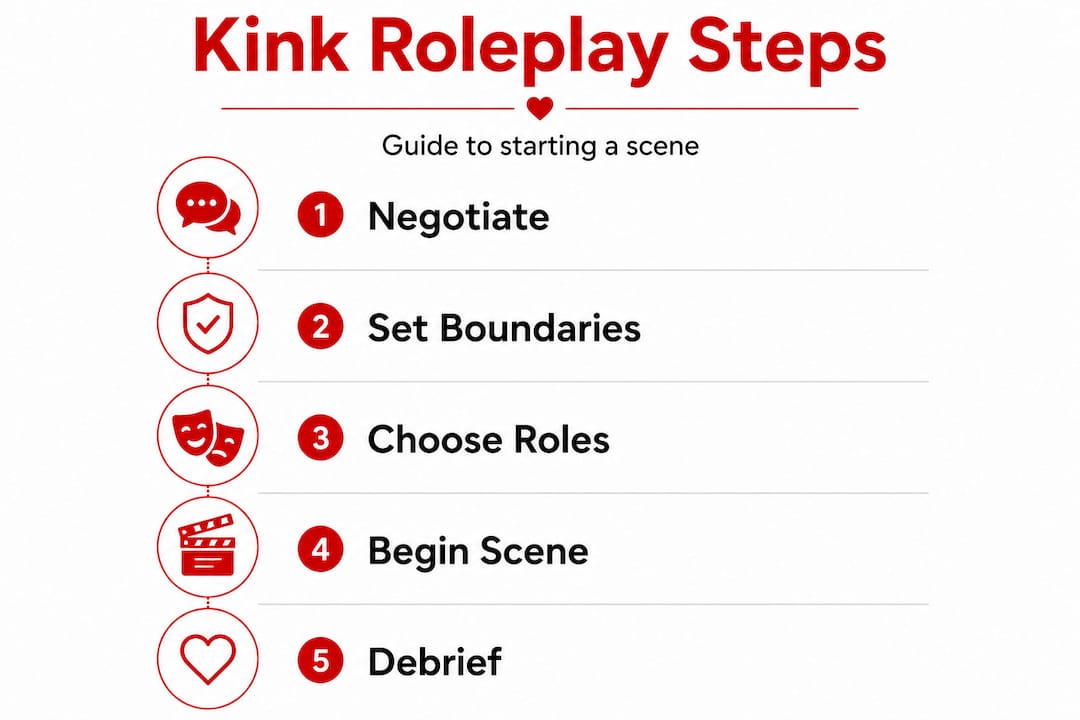
Here's how to build a solid consent framework before you ever start a scene:
- Talk before you play. Discuss what roles you're taking on, what's in bounds, and what's completely off the table. Be specific. "I'm okay with restraint but not blindfolds" is useful. "Do whatever feels right" is a setup for misunderstanding.
- Set a safeword. The traffic-light system is the most widely used: "green" means keep going, "yellow" means slow down or check in, "red" means stop immediately, no questions asked.
- Treat negotiation like a scene contract. Agreeing to a role doesn't mean agreeing to everything that role implies. If you're playing a submissive, that doesn't automatically mean you've consented to every act a dominant might want to try. Specifics matter every single time.
- Distinguish fiction from real consent. What happens in the scene stays in the scene. A scripted act of resistance is not real resistance unless the safeword is used.
- Plan an aftercare routine. After intense play, both people need time to decompress, reconnect, and process. This isn't optional for emotional safety.
Pro Tip: Safewords work especially well in roleplay because they cut through scripted resistance or discomfort and signal real boundaries immediately. Even if your character "wouldn't" stop, you always can.
The negotiation conversation can feel awkward the first time. That's normal. It gets easier, and it makes the actual scene dramatically better because both of you know exactly where you stand.
Roleplay dynamics, intensity levels, and types
Power exchange sits at the heart of most kink roleplay scenarios. One person holds authority, the other submits to it, and the erotic charge lives in that gap. But the spectrum of how that plays out is wide. BDSM roleplay uses power dynamics, costumes, and settings to perform negotiated fantasies of dominance and submission, and no two scenes look exactly alike.
Here's a useful way to think about intensity levels:
| Level | What it looks like | Who it suits |
|---|---|---|
| Light roleplay | Simple scenario, one costume element, minimal scripting | Beginners, curious couples |
| Moderate roleplay | Defined roles, props, some physical elements, more immersion | Intermediate players |
| Immersive roleplay | Full character commitment, elaborate setting, extended scenes | Experienced practitioners |
Beyond power exchange, kink roleplay serves real psychological functions. Participants often show greater openness to experience and higher subjective well-being than non-kink practitioners. Roleplay offers a controlled space for emotional release, catharsis, and self-actualization. Some people use it to process stress. Others use it to explore parts of themselves they can't access in regular life without social judgment.
"Roleplay-based kinks serve as a creative space separate from one's real-world desires or identity, enabling safe exploration without social judgment." — The Feeld Guide to Kink
That last point matters. Playing a dominant character doesn't mean you want to control people in real life. Playing a submissive doesn't mean you're weak or passive outside the bedroom. Maintaining the perspective that you're playing a version of yourself helps you detach emotionally after the scene ends and keeps the dynamics from bleeding into everyday life in ways you didn't sign up for.
The types of roleplay also vary by theme: authority-based scenarios, age-gap dynamics, species or creature play, historical or fantasy settings, and occupation-based setups are all common categories. What they share is the same foundation: two or more people who've talked it through, set their limits, and chosen to step into something together.
How to start kink roleplay without overthinking it
The biggest mistake beginners make is trying to go full cinematic on the first attempt. You don't need a script, a wardrobe budget, or an elaborate backstory. Starting with low-stakes, familiar scenarios reduces performance anxiety and lets you ease in without the cognitive overload of managing a complex narrative while also trying to have a good time.
Some practical ways to get started:
- Pick a scenario you're both genuinely curious about. Not one person's fantasy that the other is tolerating. Mutual interest makes the energy real.
- Use one costume element instead of a full outfit. A single prop or piece of clothing can shift the psychological frame without the pressure of a full costume.
- Set the scene briefly before you start. A two-minute conversation about who you are in the scenario and what the vibe is goes a long way.
- Check in during the scene. A simple "you good?" doesn't kill the mood. It builds trust and keeps both people present.
- Do aftercare every time, especially early on. Talking about what worked, what felt off, and how you both feel after the scene is how you get better at this together.
Pro Tip: Light roleplaying emphasizes flexibility and spontaneity, making it ideal for newcomers who want to explore without pressure. You don't have to commit to an hour-long scene. Ten minutes of intentional play counts.
One thing that trips people up: confusing the scene with real life. Roleplay must maintain a clear boundary between fantasy and reality. If you're playing strangers who meet at a bar, that scenario doesn't give either person license to act outside agreed limits just because "it's part of the game." The fiction lives inside the scene. The consent lives in reality.
For deeper reading on how to structure these conversations, Kinkykorner's guide on kink negotiation is worth your time before you dive into your first scene.
My honest take on what makes this complicated
I've talked to a lot of people about kink roleplay, and the pattern I keep seeing is this: the people who struggle most are the ones who skipped the conversation and went straight to the scene. They figured the energy would carry them through. Sometimes it does. More often, someone ends up feeling weird about something that happened, and neither person knows how to name it because they never agreed on what they were doing in the first place.
What I've learned is that the negotiation isn't the boring part before the fun. It is part of the fun. When you sit down with someone and say, "Here's what I want to try, here's what I'm not okay with, here's what I'm genuinely curious about," you're already building something. You're building trust. And trust is what makes the actual scene feel safe enough to go somewhere real.
The other thing I'd push back on is the idea that roleplay is only for people who are deep into BDSM. It's not. It's for anyone curious about exploring a different dynamic, even once, even lightly. You don't need a dungeon or a title. You need a conversation, a safeword, and a partner who's actually in it with you.
The communication that shapes safe kink is the same communication that makes any intimate experience worth having. Roleplay just makes it impossible to skip.
— Prenston
Explore more at Kinkykorner

If this article got you thinking, you're already doing the most important part: showing up curious and willing to learn. Kinkykorner is built for exactly that. Whether you're looking for erotic literary content that explores kink dynamics in vivid detail, or you want to connect with adult-themed services and communities that take consent seriously, Kinkykorner is the space for it. Browse listings, read stories that don't sanitize the complexity of desire, and find resources that treat you like an adult who can handle real information. No shame, no judgment, just honest content for people who know what they want and want to understand it better.
FAQ
What is the difference between kink roleplay and fantasy?
Fantasy is internal and private. Kink roleplay is a physical, consensual enactment involving communication, negotiated boundaries, and active participation from all partners involved.
Do you need a safeword for kink roleplay?
Yes. A safeword gives both partners a real-time way to pause or stop the scene without ambiguity, especially when scripted resistance is part of the dynamic.
Can beginners try kink roleplay safely?
Absolutely. Starting with simple, low-pressure scenarios and one clear safeword is enough to begin. The key is talking through the scenario before you start, not after.
Does agreeing to a role mean agreeing to everything in it?
No. Agreeing to play a submissive or dominant role doesn't automatically consent to every act that role might imply. Specific limits always take priority over the logic of the scenario.
How do you end a kink roleplay scene properly?
Use your safeword or a pre-agreed signal to close the scene, then move into aftercare. Talk about how both of you feel, what worked, and what you'd do differently next time.