
Creative adult writing is the practice of using imaginative, personal writing to explore identity, sexuality, and emotions in ways that promote self-understanding and healing. It sits apart from technical or professional writing. This is writing that gets raw, gets honest, and sometimes gets explicit. Whether you're journaling about a desire you've never spoken aloud or drafting erotic fiction that finally puts words to something you've felt for years, why creative adult writing matters comes down to one thing: it gives you back your own voice. Research backs this up, and the psychological benefits are real enough to change how you function day to day.
What are the psychological and cognitive benefits of creative adult writing?
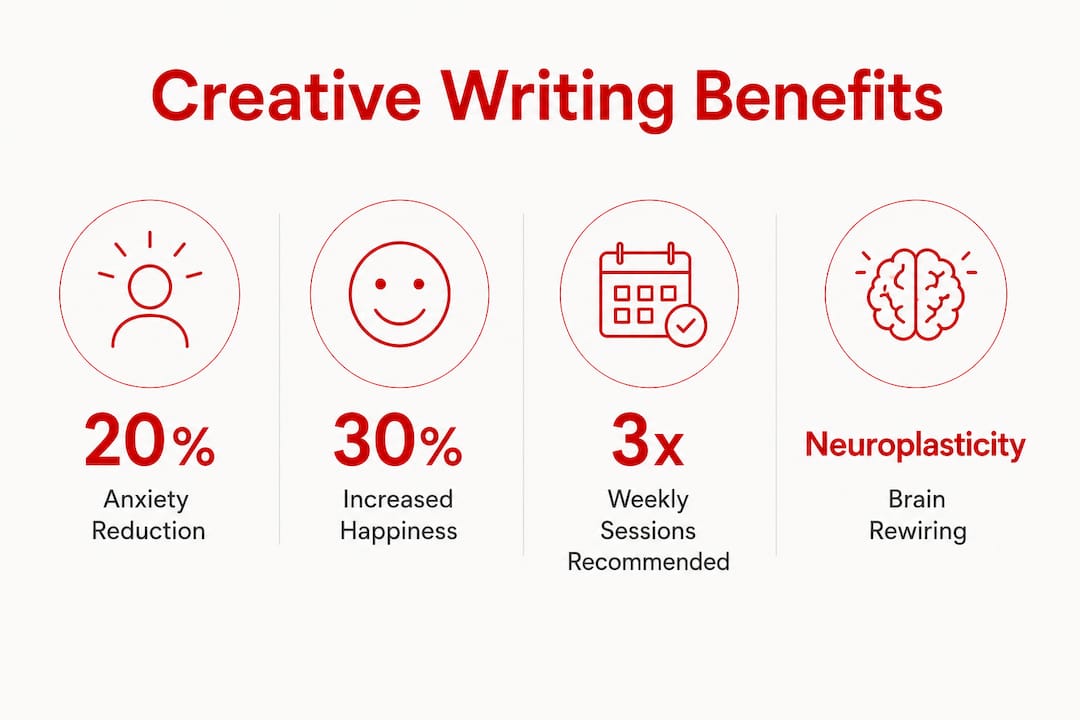
Creative writing rewires your brain. That's not a metaphor. Journaling practice supports neuroplasticity, backed by over 30 years of peer-reviewed research, rewiring the brain for improved emotional regulation and stress management. That means the act of writing consistently is literally reshaping how your nervous system responds to pressure, conflict, and desire.
The numbers are hard to ignore. Consistent journaling reduces depression and anxiety symptoms by 20–45% and lowers stress-related doctor visits by 47%. That's not a minor lifestyle tweak. That's a measurable clinical shift, and it comes from something you can do alone, for free, at midnight in your underwear.
Here's the brain science in plain terms:
- Amygdala calming: Writing labels your emotions. When you name what you feel, writing calms the amygdala and engages the prefrontal cortex, the part of your brain responsible for problem-solving and rational thought.
- Emotional regulation: Writing creates an interruption between experience and reaction. That gap is where clarity lives.
- Memory and attention: Regular creative writing strengthens memory retention and sharpens focus over time.
- Cognitive longevity: Crystallized intelligence increases into one's 60s and 70s, making later life genuinely prime time for creative work. Your brain is not declining. It's deepening.
Thirty percent of people who write for pleasure report doing it specifically because it makes them happy. That's not trivial. Happiness tied to a regular practice compounds. It builds identity. It builds confidence. And for adults exploring sexuality and self-expression, confidence is everything.
Pro Tip: Set a five-minute timer and write without stopping. No editing, no judgment. This single habit, done three times a week, is enough to start shifting your emotional baseline.
How does creative writing help adults explore identity and sexuality?
Writing externalizes what lives inside you. That's the core mechanic. When you put a feeling, a fantasy, or a fear onto a page, it stops being a vague weight in your chest and becomes something you can actually look at. Writing externalizes emotional distress, providing a "disaster preventionist" effect that builds resilience over time.

For adults exploring identity and sexuality, this is especially powerful. A lot of us carry stories we've never told anyone. Desires we've edited out of ourselves because they didn't fit the script we were handed. Writing gives you a private space to tell those stories without consequence. You can write a character who wants what you want. You can write a scene that plays out a fantasy. You can write a letter to a version of yourself you haven't fully met yet.
Creative writing is a transformative practice that can heal, liberate, and support identity reimagination across all life stages. The Oxford Handbook of Creativity and Education frames it not as a hobby but as a core tool for human development. That framing matters. It means your erotic journal isn't frivolous. Your queer fiction isn't self-indulgent. It's identity work.
Common barriers adults face when writing about identity and sexuality:
- Self-criticism: The inner voice that says "this is embarrassing" or "who do you think you are?" That voice is the main obstacle, not talent.
- Fear of judgment: Even in private writing, many people self-censor. Freewriting techniques help break this pattern.
- Shame around desire: Erotic writing, in particular, helps adults build confidence through creative expression by treating desire as something worth articulating, not hiding.
- Perfectionism: The belief that writing must be good to be valid. It doesn't. It just has to be honest.
Pro Tip: Try writing in the third person about an experience you find hard to own directly. "She wanted..." or "He felt..." creates just enough distance to let the truth come through.
What forms and techniques of creative adult writing work best?
The form you choose shapes the experience. Here's how the main options compare:
| Format | Best for | Key benefit |
|---|---|---|
| Journaling | Daily emotional processing | Reduces anxiety, builds self-awareness |
| Erotic fiction | Sexual identity exploration | Externalizes desire, builds confidence |
| Poetry | Intense emotional moments | Distills complex feelings into clarity |
| Freewriting | Breaking creative blocks | Bypasses self-criticism, unlocks raw voice |
| Morning pages | Consistent creative practice | Clears mental clutter before the day starts |
One distinction worth making: handwriting versus typing. Writing by hand activates motor systems more intensively than typing, aiding emotional regulation and critical thinking. Handwriting forces real-time processing. You can't delete what you just wrote. That constraint is actually a feature. It keeps you honest.
Freewriting, as a technique, is exactly what it sounds like. You write continuously for a set time without stopping to edit or judge. The Oxford Handbook of Creativity and Education identifies freewriting and flow-based writing as methods that unlock creativity and deepen self-understanding. For adults writing about sexuality, freewriting often surfaces desires and feelings that more structured writing keeps buried.
Morning pages, popularized by Julia Cameron in The Artist's Way, involve writing three longhand pages first thing in the morning. No topic required. No quality standard. Just output. Many adult writers report that this practice alone shifts their relationship with self-expression within weeks.
Pro Tip: If erotic writing feels intimidating, start with a scene from a book or film that moved you and rewrite it from your own perspective. Borrowing a frame makes it easier to find your voice.
How can adults integrate creative writing into daily life?
Consistency beats intensity every time. The highest quality creative writing emerges through consistent output and revision, not singular moments of inspiration. That means showing up on the days you don't feel like it is more important than the days you do.
Here's a practical framework for building a sustainable writing practice:
- Schedule a non-negotiable slot. Even 15 minutes counts. Morning works best for most people because the day hasn't filled your head with noise yet.
- Create a physical writing space. It doesn't need to be elaborate. A specific chair, a specific notebook, a specific candle. Ritual signals to your brain that it's time to create.
- Use prompts when you're stuck. Adult writing prompts focused on identity and desire are widely available. Kinkykorner's community and erotic literary content offer a rich source of inspiration for adults exploring sexuality through writing.
- Join a writing community. Joining erotic writing communities provides accountability, feedback, and the relief of knowing you're not alone in what you're exploring.
- Set a word count, not a quality standard. Aim for 200 words a day. That's it. Quality follows volume over time.
- Revise with curiosity, not judgment. Revision is where writing becomes craft. Read your old entries not to cringe but to notice what you were trying to say.
Many adults carry the belief that they're too old to start writing creatively. Many adult beginners face internal narratives like "I'm too old" or "I'm not talented" that block their creative potential. Both beliefs are false. Creativity is a way of operating, not a rare talent. The main barrier is accumulated self-criticism, and writing is one of the most direct routes through it.
Apps like Day One, Notion, and Penzu work well for digital journaling. Physical notebooks like Leuchtturm1917 or Moleskine work well for handwriting practice. The tool matters less than the habit.
Key takeaways
Creative adult writing is one of the most research-supported, accessible tools adults have for exploring identity, sexuality, and emotional well-being.
| Point | Details |
|---|---|
| Writing rewires the brain | Journaling reduces anxiety and depression symptoms by 20–45% through neuroplasticity. |
| Creativity peaks later than you think | Crystallized intelligence grows into your 60s and 70s, making now the right time to start. |
| Handwriting beats typing for emotional depth | Writing by hand engages motor systems more intensively, improving emotional regulation. |
| Self-criticism is the only real barrier | Creativity is a practice, not a talent. Consistent output clears the internal critic over time. |
| Community accelerates growth | Erotic writing communities provide accountability and normalize identity exploration through writing. |
Writing changed how I see myself, and I think it'll do the same for you
I've watched a lot of adults talk themselves out of writing before they even start. "I'm not a writer." "I don't have anything interesting to say." "What if someone reads it?" Those fears are real, but they're also the exact reason to write. The stuff you're most afraid to put on paper is usually the stuff that needs to come out the most.
What I've found, both personally and in watching others move through this, is that creative writing for adults isn't about producing something beautiful. It's about producing something true. The erotic story you write at 2 a.m. that you'd never show anyone? That's you getting honest with yourself. That's identity work. That's the kind of writing that changes how you move through the world.
The research on the importance of creative writing confirms what writers have always known intuitively. Writing externalizes the internal. It creates distance from pain and proximity to desire. It lets you try on versions of yourself without consequence. For adults exploring sexuality, gender, kink, or any part of identity that mainstream culture hasn't made room for, writing is one of the few spaces that belongs entirely to you.
Start ugly. Start small. Start tonight. The page doesn't judge you, and neither does the practice.
— Prenston
Explore your creative voice with Kinkykorner

Kinkykorner is built for adults who take their creative expression seriously. Whether you're writing erotic fiction for the first time or you've been journaling about desire for years, Kinkykorner gives you a community and a platform that actually gets it. You can read literary erotic content, connect with other adult creatives, and find services and businesses that support your exploration. No judgment. No sanitized version of who you are. If you're ready to go deeper into adult creative expression, Kinkykorner is where that conversation lives. Check out the erotic content creator guide to see how others are turning their writing into something real.
FAQ
Why does creative writing benefit adults specifically?
Adults carry more accumulated experience, suppressed identity, and emotional complexity than younger writers. Creative writing gives adults a structured outlet to process that material, with research showing 20–45% reductions in anxiety and depression symptoms from consistent journaling practice.
Is erotic writing a legitimate form of creative expression?
Erotic writing is a recognized literary form with a long history. It serves as a tool for sexual empowerment, identity exploration, and emotional processing. The Oxford Handbook of Creativity and Education identifies creative writing broadly as a practice that heals and liberates identity across all life stages.
How often should adults write to see mental health benefits?
Even three sessions per week of 15–20 minutes produces measurable psychological benefits. Consistency matters more than duration. Daily freewriting or journaling accelerates results, particularly for emotional regulation and stress reduction.
What if I've never written creatively before?
Start with freewriting. Set a timer for five minutes and write without stopping or editing. Many adult beginners face internal narratives about not being talented enough, but creativity is a practice, not a fixed trait. The barrier is self-criticism, not ability.
Can writing really help with sexual identity exploration?
Writing externalizes feelings and creates a private, consequence-free space to explore desire and identity. Erotic fiction, journaling, and freewriting all allow adults to articulate experiences they may not yet have language for, building self-awareness and confidence over time.