

You're running an adult business, and you already know the product side. What keeps you up at night is something messier: building trust with kinky customers who've been burned before, judged by vanilla retailers, or just quietly ghosted when they asked about something edgy. That wall they put up? It's not personal. It's protective. And the businesses that learn to work with it, not against it, are the ones that build the kind of loyalty that actually pays.
Table of Contents
- Key Takeaways
- Building trust with kinky customers starts with understanding them
- Preparing your business to actually deserve their trust
- Step-by-step strategies for real trust building
- Common pitfalls that kill client trust fast
- My honest take on trust in this market
- How Kinkykorner helps you connect with kink clients
- FAQ
Key Takeaways
| Point | Details |
|---|---|
| Know your customer's world | Kink clients have high satisfaction potential but face stigma, making nonjudgmental service non-negotiable. |
| Train staff like specialists | Educating your team on materials, safety, and kink culture directly converts browsers into loyal buyers. |
| Use consent frameworks | The Yes, No, Maybe system helps clients communicate limits and makes your service feel safer from the first interaction. |
| Pace your relationship building | Starting small with low-stakes interactions builds the emotional foundation for deeper, repeat client relationships. |
| Aftercare is a business tool | Emotional follow-up after a sale or session signals care, which is the single fastest way to generate repeat bookings. |
Building trust with kinky customers starts with understanding them
Before you can earn a kink client's loyalty, you need to understand what they're actually working with emotionally. Research shows that BDSM practitioners report sexual satisfaction equal to or higher than the general population, which tells you these folks aren't broken or confused. They know what they want. What they don't always know is whether you can be trusted to deliver it without making them feel weird about wanting it.
Kink subcultures are built on three pillars: consent, communication, and clearly negotiated boundaries. These aren't abstract ideals. They are the actual architecture of how kinky people operate with each other. When you mirror those values in your business, clients feel it immediately. When you ignore them, they leave and don't come back.
A few realities to lock in before you go any further:
- Stigma is real and it shapes behavior. Kinky customers often shop with a level of caution that vanilla customers don't. They expect to be judged, and they're watching your staff, your language, and your policies for signs of it.
- Consent is a lived practice, not a buzzword. Understanding consent negotiation in kink means understanding that clients have hard limits and soft limits, and both deserve respect.
- Community matters. Kink clients talk to each other. A bad experience at your store circulates fast. A genuinely respectful one does too.
Pro Tip: Get familiar with kink terminology and safety concepts before your team ever interacts with a client. You don't need to be an expert in everything, but you need to not be confused by the basics.
Preparing your business to actually deserve their trust
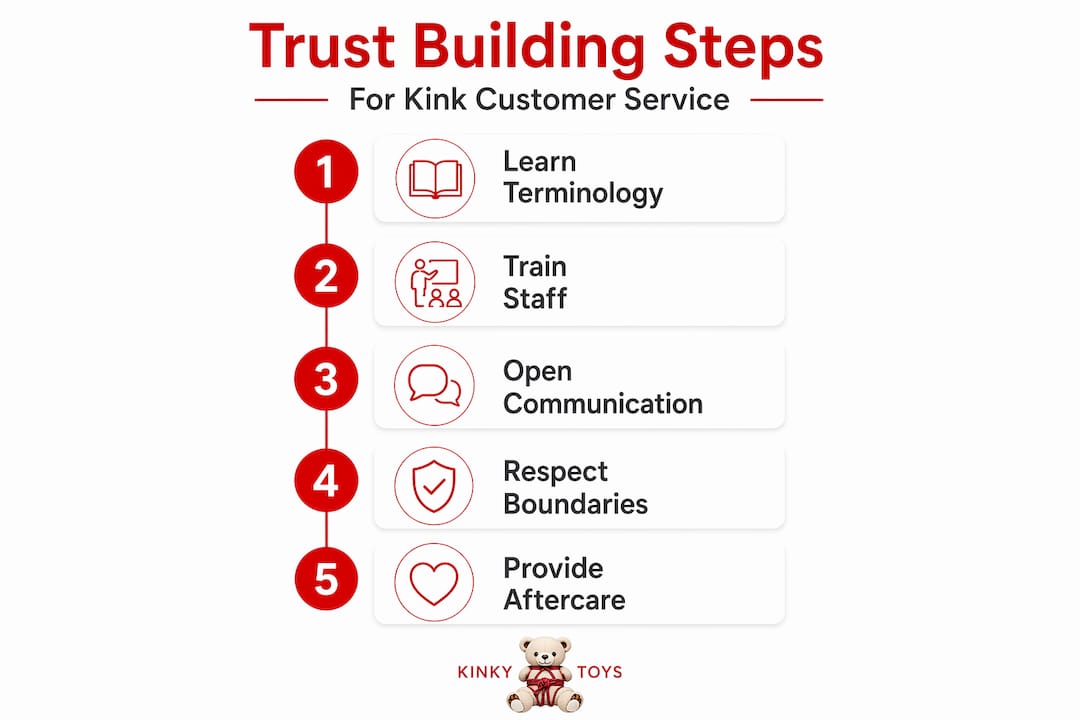
Here's the thing about trust in this space: you can't fake it. Clients know the difference between a business that tolerates kink and one that gets it. That gap is where you either win or lose.
Getting your business ready means thinking about four distinct areas:
-
Staff education on products and safety. Training your team on product safety, materials, and kink sensitivities is a direct investment in customer confidence. A staff member who can explain the difference between silicone and latex, or who understands why a particular restraint design matters for safety, is a trust asset. Someone who giggles or looks uncomfortable is a liability.
-
Discretion policies that are visible and enforced. Privacy is not optional in this market. Your clients need to know that their purchases, their preferences, and their personal details are protected. Put your privacy practices somewhere they can actually see them, and make sure everyone on your team knows them cold.
-
Nonjudgmental service design. This is about more than politeness. It means building a shopping experience, both online and in person, where asking about bondage gear feels as neutral as asking about a kitchen appliance. Your product descriptions, your checkout flow, your customer service scripts — all of it signals judgment or acceptance.
-
Community engagement. Showing up at kink events, sponsoring educational workshops, or engaging genuinely on community platforms builds goodwill that no ad spend can replicate. It signals that you see kinky customers as a community worth respecting, not just a demographic worth extracting money from.
Here's a quick look at what a trust-ready business looks like versus one that isn't:
| Area | Trust-ready | Trust-undermining |
|---|---|---|
| Staff knowledge | Trained on materials, safety, and kink culture | Unfamiliar with products, visibly uncomfortable |
| Privacy policy | Clearly stated, actively enforced | Buried in fine print or nonexistent |
| Service language | Neutral, specific, and respectful | Vague, clinical, or dismissive |
| Community presence | Engaged and visible in kink spaces | Absent or performatively inclusive |

Pro Tip: Position your team as expert guides in adult retail, not just salespeople. When a client feels like they're talking to someone who actually knows the territory, their guard drops.
Step-by-step strategies for real trust building
This is where establishing relationships with kink clients gets practical. Trust in this space doesn't show up all at once. It accumulates. Here's how to build it with intention:
-
Lead with consent-focused communication. The Yes, No, Maybe framework helps clients articulate what they're open to, what's off the table, and what they're curious about but uncertain of. Incorporating this kind of language into your intake process or consultation style immediately signals that you speak their language.
-
Make your service descriptions specific and honest. Vague service descriptions create mismatched expectations and breed frustration. Be explicit about what you offer, what you don't offer, and what clients should realistically expect. Clarity is not just ethical. It's good business.
-
Practice active listening, then follow up. When a client shares something personal about their preferences or concerns, acknowledge it directly. And then follow up after the interaction. That follow-up is what aftercare looks like in a business context: emotional reassurance that the relationship didn't end at the transaction.
-
Start with micro-risk exchanges. Trust in kink is built incrementally, through small moments of vulnerability and reliability. In business terms, this might mean offering a low-stakes consultation before a larger purchase, or following through perfectly on a small order before a client trusts you with something more significant.
-
Personalize your communication over time. A client who mentioned they're new to impact play six months ago should not be getting the same generic newsletter as everyone else. If you're fostering loyalty among kink enthusiasts, you need to treat them like individuals, not a mailing list.
"The first interaction tells me if you're safe. The third one tells me if you're worth staying for." That's how one longtime kink community member described their relationship with the vendors they trust. Keep that in mind every time you think a follow-up email isn't worth writing.
How you communicate shapes everything. A guide on how communication shapes kink breaks down specific frameworks that translate directly into better client interactions.
Common pitfalls that kill client trust fast
When it comes to trust-building in the BDSM community, the mistakes are often subtle. They're not dramatic blowups. They're small, repeated failures that quietly confirm a client's fear that you don't really get it.
Here's what to watch for:
- Mismatched intensity. Skipping emotional groundwork and leading with advanced products or intense service offerings before the relationship is ready creates anxiety, not excitement. Meet clients where they are, not where you assume they want to be.
- Vague promises. If your service description says "discreet packaging" but a client gets something that isn't, that's a trust breach. One broken promise in this space carries more weight than ten kept ones.
- Over-availability blurring into boundary-crossing. Long-term client loyalty starts forming around the second booking, and it requires you to maintain professional boundaries, not collapse them. Being overly available or overly personal too soon creates discomfort, not connection.
- Ignoring aftercare. Aftercare is not just for scenes. It's a philosophy. When a client has a difficult experience or an order goes wrong, how you show up afterward determines whether they stay.
- Failing to repair trust breaches. If something goes sideways, don't minimize it. Acknowledge what happened, explain what you're changing, and give the client a reason to try again.
Pro Tip: When a client signals discomfort, slow down. Don't push through it hoping they'll warm up. In this community, respecting a pause is exactly what builds the confidence to continue.
My honest take on trust in this market
When I look at how most adult businesses approach their kinky clients, I see the same mistake over and over: they treat trust like a checkbox. Get the sale, send the package, done. But what I've learned from watching businesses succeed and fail in this space is that the ones who genuinely win are the ones who commit to the long game.
I've seen operators with mediocre products crush their competition purely because their clients felt seen. That's not magic. It's consistency, nonjudgmental staff, and a willingness to follow up when it would be easier not to. The repeat client rate in adult industries that prioritize honest communication tells you everything about what actually drives revenue.
Most business owners underestimate how much kinky clients want to be educated and respected at the same time. They're not looking for a therapist. They're not looking for a best friend. They want a business that clearly knows its stuff, doesn't flinch, and shows up reliably. That's it. Build that, and the loyalty follows naturally.
— Prenston
How Kinkykorner helps you connect with kink clients
If you've done the internal work of building a nonjudgmental, informed business, the next step is getting in front of the right audience. Kinkykorner is a marketplace built for exactly this kind of connection. It's where kink businesses list their services and where kinky customers actually come to find providers they can trust. You're not competing for attention with vanilla audiences or fighting algorithm changes. You're in a space where the community has already self-selected for exactly what you offer. Join the Kinkykorner network and start building the client relationships that turn first-time buyers into loyal regulars. The infrastructure is already there. You just have to show up for it.
FAQ
What makes kinky customers different to serve?
Kinky customers operate in a stigma-sensitive space and often arrive with a heightened need for privacy, nonjudgmental service, and clear communication about limits. Businesses that understand consent culture and mirror those values in their service design build loyalty faster.
How do I start building trust with a new kink client?
Start small. Low-stakes interactions and specific, honest service descriptions create the initial safety net. Micro-risk trust exchanges build confidence incrementally, making it easier for clients to trust you with more over time.
What is the Yes, No, Maybe framework and how does it apply to business?
The Yes, No, Maybe system helps clients communicate what they're open to, uncertain about, or unwilling to try. Applied to business consultations, it creates a structured, low-pressure way to understand a client's needs without making assumptions.
How important is aftercare in a business context?
Critically important. Aftercare builds emotional connection beyond the transaction, and in kink-adjacent businesses, a thoughtful follow-up after a purchase or service signals that the relationship matters. It is one of the fastest ways to convert a first-time client into a repeat one.
What should I do if I break a client's trust?
Acknowledge it directly, without minimizing. Explain what went wrong and what you are doing differently. Give the client a clear, low-pressure reason to try again, whether that's a policy change or a straightforward apology. In this community, how you handle failure matters as much as how you handle success.