
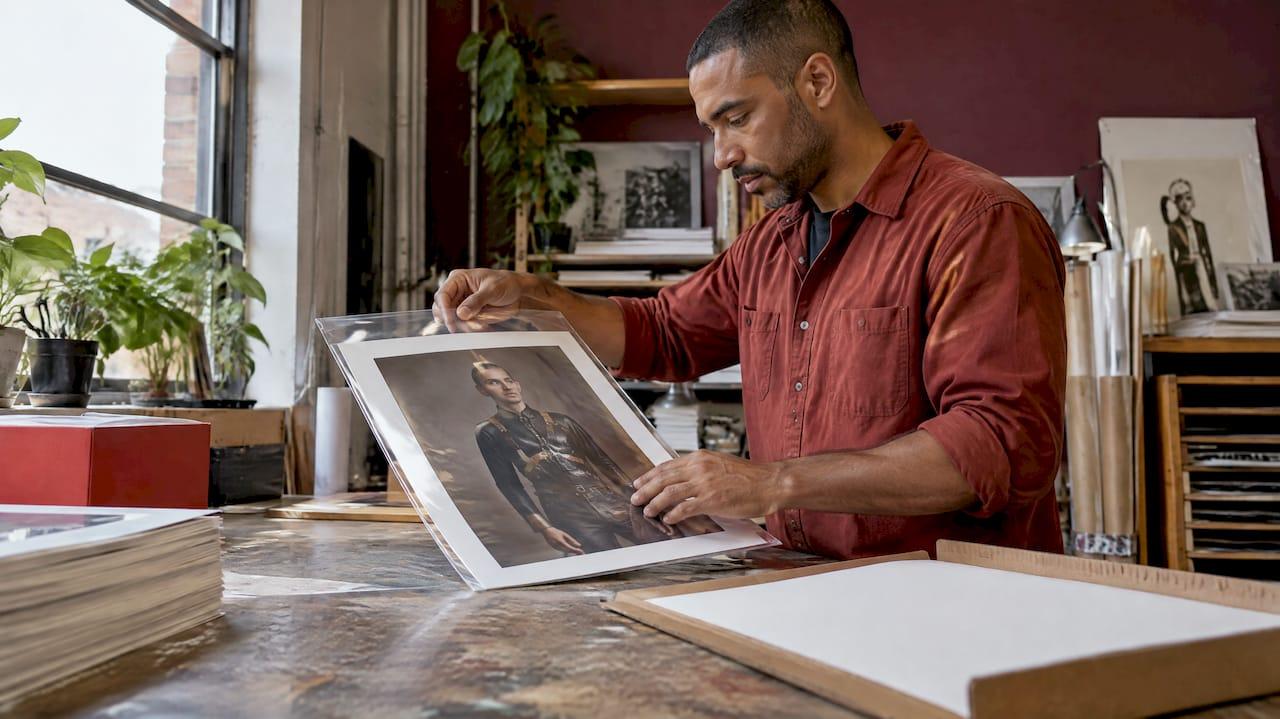
You can sell erotic prints in the U.S. if the work is legal, every model is a documented adult who consented in writing, and you list on venues that actually allow adult art. The part that trips people up isn't the art. It's the plumbing: printers that say no, payment accounts that vanish, and marketplaces that quietly ban you. Here's how to set it up so it keeps running.
TL;DR
- Federal law targets obscene material, not erotic art as a category, but you should know the test and keep paperwork on every model.
- Get a signed model release and proof of age before you make or sell anything depicting a real person.
- Pick a print partner that accepts adult content, and check payment compatibility before you build a store around any one processor.
- Keep your adult identity separate from your legal one, and protect your buyers' data as carefully as your own.
- List where adult art is welcome. A free listing on Kinky Korner costs nothing, and paid tiers start at $4.99 per month.
Table of Contents
- Know the legal line before you print anything
- Paperwork: model releases, age proof and records
- Prepare the files like a print shop will actually reject them
- Choosing how to print and ship
- Pricing, packaging and shipping
- Payments: legal doesn't mean accepted
- Promote without exposing yourself or your buyers
- Where to list your prints
- Perspective
- List your prints on Kinky Korner
- FAQ
- Sources
Know the legal line before you print anything
Erotic isn't the same as obscene. The U.S. Department of Justice describes the Miller Test: a work is obscene when, taken as a whole, it appeals to prurient interests, shows sexual conduct in a patently offensive way, and lacks serious literary, artistic, political, or scientific value. All three have to be true. Most kink art with real craft behind it doesn't get near that, but you're the one who has to understand where the line sits.
The same DOJ guide says federal law prohibits producing obscene matter with intent to sell it, and running a business of selling or transferring it using interstate commerce, including interactive computer services. That covers the internet. Convicted offenders face fines and up to five years in prison under 18 U.S.C. §§ 1465 and 1466.
What does that mean for a working artist? Three practical things:
- Your art is judged as a whole, so a body of work with a clear artistic point of view is on firmer ground than a pile of anonymous images.
- Standards of "patently offensive" are applied to the community, which is another reason to read the rules of each venue and printer you use.
- Nothing involving anyone under 18, ever. Not drawn from a model, not "aged up," not ambiguous. If there's a doubt, you don't make it.
This isn't legal advice. If you work in extreme territory, or you ship across state lines at volume, an attorney who handles First Amendment and adult-industry cases is worth the hourly rate.
Paperwork: model releases, age proof and records
If your prints come from photographs or from drawings based on real people, consent isn't a vibe. It's a document.
Model releases
The Professional Photographers of America recommends a model release before you use an image for advertising or promotion, or before you license or sell copies to a third party. It also makes the point that owning copyright doesn't let you do anything you like with a photo of a person. Selling a print is selling a copy. Get the release.
A useful adult-work release names the model, states the date of birth, says plainly what uses are allowed (prints, web listings, social promotion, limited editions), whether they can be revoked, and whether the model wants a credit or an alias. Both of you sign and date it.

Right of publicity
People have rights in their own likeness, and those rights vary by state. The Graphic Artists Guild explains that these laws are extremely inconsistent. In New York the right extends to any person, not just celebrities, and under both New York and California statutes written consent has to come before the use. Unless a First Amendment exception applies, you need permission. A recognizable face on an erotic print with no signature behind it is exactly the situation that ends in a demand letter.
Federal record-keeping
If your work includes real people engaged in actual or simulated sexually explicit conduct, federal rules may apply to you as a producer. Under 28 C.F.R. § 75.2, producers of covered matter made with materials that moved in interstate or foreign commerce must keep performer records, including legal name and date of birth, taken by examining a picture ID before production. Whether your specific work is covered depends on what it depicts, so this is one for your attorney. The habit is worth building either way:
- Check a government photo ID before the shoot, not after.
- Keep a copy of the ID and the signed release together in secure storage.
- Store them offline or encrypted, never in the same folder as your public files.
Our own guides go deeper on the submission side: how to handle an erotic art submission on an adult marketplace and how to avoid federal legal risk and portal rejection.
Prepare the files like a print shop will actually reject them
Good files save you reprints. Before you upload anywhere:
- Resolution. Export at the final print size, typically at 300 dpi, and keep the originals untouched.
- Color. Dark, saturated kink palettes (deep reds, blacks, latex shine) shift between screen and paper. Order a proof print before you open sales.
- Crops. Decide which aspect ratios you'll sell, and check that nothing important sits too close to the edge.
- Clean metadata. Strip EXIF data from every file you publish. Location and device info doesn't belong in a public adult listing.
- File names. Use an internal naming scheme that doesn't contain model names.
Then write your listing like a gallery label. Say what the piece is, the medium, the size, the paper, whether it's signed, and whether the edition is limited. Plain, accurate titles also help when a moderator is deciding whether your art is art. Our guide to listing photos that pass moderation covers cover images and thumbnails in detail.
Choosing how to print and ship
You have three realistic routes, and each one trades control for effort.
| Route | What you do | Good for | Watch out for |
|---|---|---|---|
| Print at home | Print, sign, pack and post everything | Small limited editions, signed originals | Time, printer costs, consistent quality |
| Local or specialist print shop | Order batches, ship them yourself | Quality control, short runs | Shops may decline adult jobs |
| Print-on-demand | Upload files, a provider prints and ships to the buyer | No inventory, no packing | Content policies, less control over finish |
The hinge is content policy. Take Mixam, a printer with a dedicated page for it: its NSFW printing page says it accepts most NSFW content, but it may reject material it considers hateful, unlawful, threatening, or defamatory, and individual facilities can refuse jobs at their discretion. That's a fair picture of the whole industry. Acceptance isn't a given, so ask in writing before you place an order for a full run, and keep a backup printer.
Print-on-demand has real appeal for adult artists: you upload final files, pick sizes and paper, set a price, and the provider ships directly to the buyer. But some on-demand services won't touch explicit work at all, and some will print it today and flag your account next month. Read the content policy, save a copy, and don't make one provider your single point of failure.
Pricing, packaging and shipping
I won't hand you a magic number, because the right price depends on your name, your edition size and your paper. What works is a structure:
- Start from cost. Add print cost, packaging, shipping materials, platform or processing fees, and a share of your time. If that total isn't comfortably under your price, the price is wrong.
- Create tiers. An open-edition small print, a mid-size limited run with numbering, and a large signed piece give buyers a step up without discounting.
- Limit editions honestly. If you say "edition of 25," stop at 25 and keep a record. Scarcity only works when it's true.
- Set shipping once. Flat rates by size are simpler than calculating every order. Include a tube or rigid mailer cost in the price of larger prints.
- Pack discreetly. Plain outer packaging, a neutral return name, and no explicit wording on the label. Buyers notice, and they come back for it.
If you sell on your own site, ask your state tax authority how sales tax applies to you. Marketplaces may collect it for you in some cases, while an independent store can leave you responsible where you have a tax presence. Rules differ by state, so check with the state directly or with a tax professional.
Payments: legal doesn't mean accepted
This is where most erotic print shops die. Your art can be completely lawful and your payment account can still be closed, because processors set their own rules, and many restrict sexually oriented goods. Mainstream checkout tools often list adult content among restricted categories, so read each provider's acceptable-use policy before you build around it. Don't assume that because a friend sells landscapes through a service, you can sell nudes through it.
A safer approach:
- Confirm in writing that your category is allowed before you launch.
- Keep a second payment method ready.
- Never hold large balances in an account you could lose. Withdraw on a schedule.
- Don't describe an adult sale as something else to get through. Misrepresenting your business is how accounts get frozen with money inside.
We've written up which options actually keep U.S. merchants live in our payment processor guide, and a separate piece on collecting payments discreetly for buyers who want privacy on their statement.
Taxes
Adult-content income is taxable income, full stop. Keep records of every sale and every deductible expense (printing, packaging, shipping, software, fees), and set money aside as you earn. Whether you get a 1099-K from a processor doesn't change what you owe. Self-employed artists generally owe self-employment tax in addition to income tax. Because thresholds and forms change, ask a tax professional, or check the IRS's current guidance, before filing.
Promote without exposing yourself or your buyers
Two privacy problems show up again and again: the artist's real identity leaks, and the buyer's details leak.
For you:
- Work under a business name, with its own email address and phone number.
- Don't link your adult-facing social accounts to your personal ones.
- Remove image metadata before uploading.
- Think about what a reverse image search of your public photos would show.
For your buyers:
- Collect only what you need to ship the order.
- Never post customer names, emails or addresses, even in a screenshot of a nice review.
- Offer anonymous credits for commissions and keep custom work off public galleries unless the buyer says yes.
- Delete order data on a schedule you can defend.
More on this in our piece on privacy in adult marketplaces. For advertising itself, how to advertise adult services legally lays out what platforms and regulators expect. And if you're still building your body of work, the erotic portfolio creation guide helps you present it so a buyer sees an artist, not a random pile.
Where to list your prints
You've got a few types of venue, and most successful artists use more than one:
- Your own store. Full control over content, but you carry payments, tax and traffic.
- General art marketplaces. Big audiences, but many make you censor, hide or drop adult work. Artists in forums describe losing their whole shop over it.
- Adult-friendly marketplaces and directories. Buyers are already looking for what you make, and moderation is written for adult work.
- Social platforms. Useful for discovery, unreliable as a storefront, and prone to takedowns.
Whichever mix you choose, treat your own mailing list or site as the one place you control. Our guide to platforms for adult creators compares the types in more detail, and the successful listing guide shows how to build a listing that gets approved and found.
Perspective
Here's what we see from where we sit. Erotic artists don't struggle because nobody wants the work. They struggle because every mainstream door has a polite sign on it that says "not you." You upload a piece, it gets flagged, you rewrite the title, it gets flagged again, and eventually you're censoring your own art just to stay in the room.
We built Kinky Korner to be the room where that isn't the problem. It's a community hub for adult services, businesses, events, creators and erotic content, with categories like Fetish, Kink Events, Retailers & Studios and Only Fans Creators, so a buyer who lands on your print is already someone who came looking for kink. You don't have to explain yourself first.
Our approach is simple: start free, learn what works, and upgrade when your listing earns it. A print seller doesn't need a giant machine. You need a clear listing, honest photos, paperwork you can stand behind, and people who actually want what you make. That's the job we're here to do.
Prenston
List your prints on Kinky Korner
If you're ready to put your work in front of an audience that came for it, start with a free listing to see how the platform fits. When you want more exposure, the Monthly plan is $4.99 per month and Yearly Premium is $149.95 per year. Pick the category that fits, such as Fetish or Retailers & Studios, in the category list.
You can see the whole platform at Kinky Korner, where businesses, performers and artists list their work and readers browse erotic writing, comics and art.
FAQ
Is it legal to sell erotic prints in the U.S.?
Generally yes, as long as the work isn't legally obscene and involves only consenting, documented adults. Federal law targets obscene material, which the Justice Department's Miller Test defines by three conditions that must all be met. State rules and venue policies add further limits, so talk to an attorney if your work is extreme.
Do I need a model release to sell erotic prints?
If a real person is recognizable in the work, yes, get a signed release before you sell copies. Professional photography groups recommend it before licensing or selling copies to third parties. State right-of-publicity laws can require written consent too, and the rules differ from state to state.
Which print services will print adult artwork?
Some specialist printers accept most NSFW content but keep the right to refuse jobs, and many general on-demand services restrict explicit work. Read the content policy and ask in writing before ordering a full run. Keep a backup printer in case one declines.
How do I get paid without losing my account?
Check each processor's acceptable-use policy for adult content before you launch, and don't disguise what you sell. Keep a second payment method and withdraw funds regularly. Our payment processor guide walks through U.S. options.
Do I owe taxes on erotic print sales?
Yes. Sales are taxable income whether or not a processor sends you a 1099-K. Keep records of income and expenses and ask a tax professional about self-employment tax and sales tax in your state.
Sources
- Citizen's Guide to U.S. Federal Law on Obscenity, U.S. Department of Justice
- 28 CFR § 75.2, Maintenance of records, Cornell Legal Information Institute
- Photography Copyright FAQs, Professional Photographers of America
- Beware the Right of Publicity, Graphic Artists Guild
- NSFW Printing, Mixam