

BDSM education means learning the communication skills, consent frameworks, and physical safety practices that make kink play deliberate instead of accidental. It is not a single class or one steamy movie scene. It is psychological groundwork, relationship skill, and hands-on technique, bundled together, and most people get it wrong by skipping straight to the technique part.
If you are starting from zero tonight, three moves matter more than anything else you will read in this guide:
"The primary purpose of BDSM education is developing communication tools and a consent forward culture, not rushing into play." That single idea, backed by sex educators who study how newcomers actually learn, is the whole foundation of this article. Rushing is the mistake. Slowing down is the skill.
- Learn the vocabulary first. Words like "negotiation," "safeword," and "aftercare" are not decorative. They are the operating system.
- Find a beginner workshop, in person or through a reputable community, before you find a partner to play with.
- Read one solid foundational book, cover to cover, before you touch a single tool. We will name the right ones below.
Key Takeaways
BDSM education works when it prioritizes consent frameworks and community learning over technique demonstrations or entertainment media.
| Point | Details |
|---|---|
| Consent comes first | Negotiate limits, safewords, and aftercare before any scene, every single time. |
| Learn the vocabulary | Understand terms like SSC, RACK, and aftercare before attending events or classes. |
| Start at low intensity | Choose sensory play or light bondage before attempting high-risk practices like breath play. |
| Choose community over porn | Workshops and mentorship build real safety skills that entertainment media skips. |
| Watch for red flags | Coercion, ignored safewords, and secrecy signal abuse, not consensual kink. |
| Build a resource list | Read foundational books and bookmark organizations like NCSF before you need them. |
Table of Contents
- What Is BDSM Education, and What Does It Actually Cover?
- How Does Consent Actually Work in BDSM Education?
- What Roles and Practices Should Beginners Know?
- How Do You Keep BDSM Play Physically and Emotionally Safe?
- What Is the Safest Way to Start Learning BDSM?
- Which Books, Organizations, and Classes Should Beginners Trust?
- What Do Beginners Get Wrong, According to Research?
- Quick Glossary: Terms Every Beginner Should Know
- A Note on Why This Guide Exists
- Sources
What Is BDSM Education, and What Does It Actually Cover?
BDSM education covers three overlapping layers: relational skills like negotiation and boundary-setting, safety knowledge that spans physical first aid and emotional aftercare, and technique, which is the part everyone assumes comes first but should actually come last. A workshop teaching rope bondage that skips consent language has failed at BDSM education even if the knots are perfect.
BDSM itself is a broad umbrella. It stands for Bondage & Discipline (B/D), Dominance & Submission (D/s), and Sadism & Masochism (S/M), and the full definition spans erotic practices, roleplaying, and interpersonal power dynamics that show up across a wide range of relationship styles. "Kink" is the broader umbrella term people use casually to mean any sexual interest outside the mainstream. A "fetish" is narrower: a specific object, body part, or material that is required or strongly preferred for arousal. Not everyone with a fetish practices BDSM, and not everyone into BDSM has a fetish. The two overlap but are not the same thing.
There is also a real difference between a scene and a lifestyle. A scene is a single, bounded episode of play, often negotiated in advance and closed out with aftercare. A D/s lifestyle means the power dynamic runs continuously through daily life, sometimes with agreed rules about chores, communication, or decision making that extend far beyond the bedroom. Most beginners start with scenes. Very few jump straight into 24/7 dynamics, and that is by design, not accident.
A handful of terms come up constantly once you start reading or attending events:
- Kink — any sexual interest or practice outside conventional norms; the broadest umbrella term.
- Fetish — a specific object, material, or body part central to arousal.
- Scene — a single, negotiated episode of BDSM play with a beginning and an end.
- Play — general shorthand for engaging in BDSM activities together.
- Aftercare — the emotional and physical check-in that follows a scene.
- Safe word — an agreed word that stops or pauses play instantly, no explanation needed.
- Vanilla — sex or relationships without kink elements, used as a neutral, non-judgmental term.
- Munch — a casual, clothed, public social meetup for kink-community members, no play involved.
How Does Consent Actually Work in BDSM Education?
Consent is not a one-time checkbox in BDSM. It is ongoing, revocable at any moment, and built through explicit conversation before anything physical happens. Two frameworks anchor almost every serious educational resource on this topic: SSC, which stands for Safe, Sane, and Consensual, and RACK, which stands for Risk-Aware Consensual Kink. SSC insists that activities stay within reasonable safety and rational judgment. RACK acknowledges that some practices, like breath play or heavy impact, carry inherent risk that can never be fully eliminated, and asks participants to understand and accept that risk knowingly rather than pretending it does not exist.
Sexuality education organizations that train professionals on this topic recommend that any introductory curriculum cover terminology, consent frameworks, and basic safety together, not as separate modules. That is the model this guide follows.
Before any scene, cover these five things out loud, every time, even with a long-term partner:
- Limits. What is a hard no, and what is a "maybe, but not tonight"?
- Medical concerns. Any injuries, medications, conditions, or physical restrictions that change what is safe.
- Safewords and signals. A verbal system (stoplight colors work well: green, yellow, red) plus a nonverbal backup for when someone is gagged or can't speak.
- Aftercare needs. Does either person need cuddling, silence, food, water, or space afterward?
- Privacy and recording. Explicit agreement on whether anything is photographed, filmed, or discussed with anyone else afterward.
A verbal safeword works for most scenes. If speech is restricted, agree on something physical instead, like dropping a held object or three taps on a surface. Never assume "no" means "keep going because they secretly want it." That assumption is exactly how consensual kink slides into harm.
What Roles and Practices Should Beginners Know?
The most common role labels are top or Dom/Domme (the one directing or administering the activity), bottom or sub (the one receiving it), and switch (someone comfortable in either role depending on the partner or mood). None of these are personality types carved in stone. Plenty of people top with one partner and bottom with another, and that flexibility is normal, not a sign of confusion.
Practices vary enormously in intensity, and matching your first attempts to a low-risk category matters more than most beginners realize.
| Practice | Intensity Level | Key Safety Consideration |
|---|---|---|
| Sensory play (blindfolds, temperature, feathers) | Low | Check for allergies; keep a safeword active even without pain involved. |
| Light bondage (soft restraints, scarves) | Low to medium | Never restrict circulation or airway; check extremities every few minutes. |
| Impact play (spanking, paddles) | Medium | Avoid the kidneys, spine, and joints; start light and build gradually. |
| Rope bondage (suspension, complex ties) | Medium to high | Requires trained technique; have safety shears within reach at all times. |
| Power exchange dynamics (extended D/s scenes) | Variable | Depends entirely on negotiated scope; revisit limits regularly, not just once. |
| Breath or edge play | High | Carries real medical risk; RACK applies directly here, and many educators recommend against it for beginners entirely. |
Pro Tip: Start at the lowest intensity level that still interests you, run the scene, and talk through what worked and what didn't before you ever attempt the next tier up.
If you want a deeper survey of what falls into each category, Kinkykorner's guide to common BDSM roles and its rundown of types of kink practices both go further into specific activities than this overview can.
How Do You Keep BDSM Play Physically and Emotionally Safe?
Safety in BDSM has two dimensions, physical and emotional, and treating only one of them is how people get hurt even when nobody meant harm. A perfectly executed rope tie can still leave someone feeling used and discarded if aftercare never happens. A warm, loving aftercare routine cannot undo nerve damage from a restraint left on too long.
A working safety checklist looks like this before, during, and after any scene:
- Before: inspect equipment for wear, confirm safewords, agree on limits and aftercare plans, and disclose relevant medical information.
- During: check in verbally at intervals, watch skin color and circulation on any bound limb, and stop immediately if a safeword or signal is given, no questions asked in the moment.
- After: run aftercare (this might mean water, a blanket, quiet conversation, or simply staying present), and check in again the next day once emotions have settled.
First-aid basics matter more than people expect. For bondage, know how to recognize numbness, tingling, or color change in fingers and toes, which signal restricted circulation, and always keep safety shears nearby to cut rope or restraints fast if something goes wrong. For impact play, avoid the kidneys, spine, and back of the knees, and watch for excessive bruising or broken skin that needs medical attention rather than home remedies.
| Situation | Warning Sign | Response |
|---|---|---|
| Bondage | Numbness, tingling, blue or white skin tone | Release immediately; keep shears within arm's reach at all times |
| Impact play | Broken skin, excessive swelling | Stop the scene; clean the area; seek medical care if bleeding persists |
| Emotional aftermath | Withdrawal, tearfulness, or shutdown | Slow down, offer aftercare, revisit consent and comfort the next day |
Red flags deserve their own attention because they get confused with normal kink dynamics constantly. Coercion disguised as "just pushing your limits," secrecy that involves minors, ignoring a safeword even once, or isolating a partner from friends and community are not BDSM. They are abuse wearing BDSM language as camouflage. The National Coalition for Sexual Freedom runs programs specifically to help people tell the difference between consensual kink and abuse, and their resources are worth bookmarking before you need them.
Pro Tip: Write down relevant health information, allergies, medications, past injuries, in a private note before a scene with a new partner. It sounds clinical, but it takes thirty seconds and it removes guesswork exactly when guesswork is most dangerous.
What Is the Safest Way to Start Learning BDSM?
The safest path into BDSM is learning, observing, and negotiating in low-stakes settings well before any physical play happens. Beginners who rush toward a scene before they understand the vocabulary or the safety checklist are the ones most likely to get hurt or hurt someone else.
Here is a practical sequence that works for most newcomers:
- Read one foundational book cover to cover before attending anything in person.
- Attend a munch, a casual, clothed social meetup where nobody expects you to play, just to meet people and ask questions.
- Practice negotiation in a nonsexual context, like planning a trip or dividing chores, to build the muscle of stating needs directly.
- Attend an introductory workshop focused specifically on consent and terminology rather than technique demonstrations.
- Try one low-risk scene with a partner you already trust, then debrief honestly afterward.
Reputable introductory classes never require you to undress, disclose personal history, or participate in physical demonstrations. If a "workshop" pressures attendees into any of that, it is not education, and you should leave.
For in-person events, a short safety checklist protects you regardless of how experienced the organizers seem: confirm who is running the event and whether it has an established reputation, arrive somewhere public rather than a private residence for your first visit, tell a friend where you're going and when to expect a check-in text, and read posted venue rules before you walk in. Kinkykorner's beginner kink checklist walks through this in more detail if you want a printable version.
Pro Tip: Bring a friend to your first event, or pick a purely educational gathering where play is explicitly off the table. Either choice removes the social pressure that trips up most first-timers.
Which Books, Organizations, and Classes Should Beginners Trust?
A short, curated list of books and organizations will teach you more in a month than years of scattered internet browsing. The names below show up again and again in reputable BDSM education because they were written specifically to fill the safety gaps that entertainment media leaves behind.
Books worth reading in full:
- The New Topping Book and The New Bottoming Book by Janet W. Hardy and Dossie Easton, published by Greenery Press, remain the standard introduction to both sides of a scene, written with warmth and zero judgment.
- SM 101 by Jay Wiseman is the closest thing the community has to a comprehensive technical manual, covering everything from rope safety to negotiation scripts.
- Screw the Roses, Send Me the Thorns by Molly Devon (with Philip Miller) is often recommended as a gentler on-ramp for couples exploring together for the first time.
Organizations and directories worth bookmarking:
- The National Coalition for Sexual Freedom offers consent-versus-abuse resources and a Kink-Aware Professionals directory to help you find therapists and doctors who won't flinch at your disclosures.
- FetLife functions as the largest social network built specifically for the kink community, useful for finding local munches, events, and educators once you're ready to connect.
Different learning formats suit different people, and none of them is strictly better across the board.
| Format | Best For | Tradeoff |
|---|---|---|
| Workshops | Structured intro to terminology and safety | Often one-time; limited follow-up support |
| Mentorship | Ongoing, personalized guidance | Requires finding someone trustworthy and experienced |
| Munches | Low-pressure community connection | Social, not instructional; no formal curriculum |
| Online courses | Self-paced, private learning | Lacks in-person feedback on technique |
Introductory workshops commonly run 60 to 90 minutes and are structured around modules covering definitions, safety procedures, negotiation, and aftercare, which makes them a manageable first commitment even for someone who feels nervous about walking into a kink space for the first time.
What Do Beginners Get Wrong, According to Research?
Research on how people actually learn BDSM points to one consistent finding: community-based education outperforms entertainment-based learning when it comes to actual safety proficiency. That gap is not small, and it explains most of the avoidable mistakes new practitioners make.
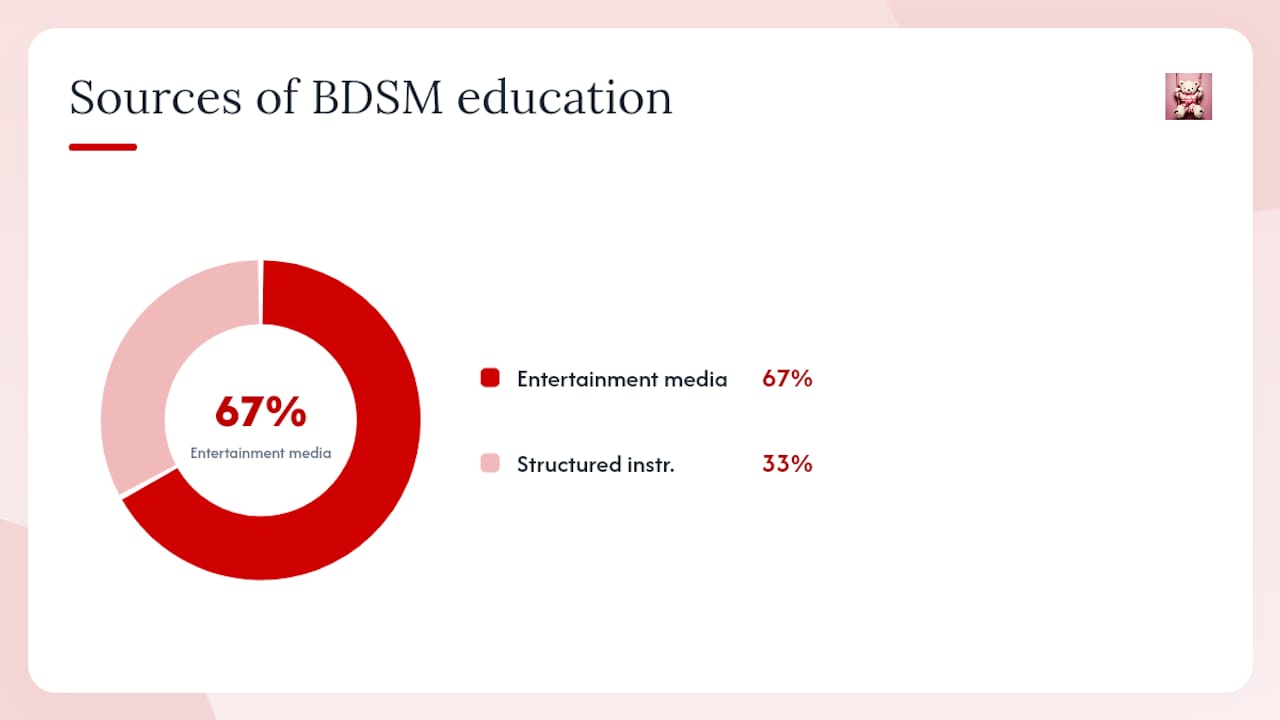
A large share of people exploring BDSM turn first to porn, novels, or online forums for their education, and 67% of people who explore BDSM rely on entertainment media rather than structured instruction. The problem is not that porn exists. The problem is that porn is choreographed for visual drama, not safety, and it routinely skips negotiation, safewords, and aftercare entirely because none of that is arousing to watch. Viewers absorb the aesthetics without absorbing the actual skill.
Common beginner mistakes and their fixes:
- Relying on porn as a technique guide. Fix: treat porn as fantasy, not instruction, and get actual technique from a book or workshop instead.
- Skipping aftercare because the scene "went fine." Fix: run aftercare every time, even after a low-intensity scene; emotional drops can hit hours later.
- Not disclosing medical conditions out of embarrassment. Fix: write it down privately beforehand so you don't have to say it out loud under pressure.
- Treating negotiation as a one-time conversation. Fix: revisit limits and comfort levels regularly, especially as a relationship or dynamic evolves.
Community involvement, munches, workshops, mentorship, gives people reality-based learning that measurably reduces dependence on media as a primary teacher and improves how confidently people handle real safety situations.
Pro Tip: Treat a single workshop or mentorship conversation as worth more than a month of solo reading online. Live feedback catches mistakes that no article, including this one, can catch for you.
Quick Glossary: Terms Every Beginner Should Know
- Dom/Domme — the partner directing or administering activity in a scene.
- Sub — the partner receiving direction or sensation.
- Top — the partner performing an action (spanking, tying, etc.), sometimes distinct from "Dom."
- Bottom — the partner receiving the action.
- Switch — someone who moves between top/Dom and bottom/sub roles.
- Scene — a single, bounded episode of BDSM activity.
- Play — general term for engaging in kink activities.
- Aftercare — physical and emotional check-in following a scene.
- Safeword — an agreed word that halts play instantly.
- SSC — Safe, Sane, and Consensual; a foundational consent framework.
- RACK — Risk-Aware Consensual Kink; a framework acknowledging inherent risk.
- Munch — a casual, clothed social gathering for kink-community members.
- Rope — shorthand for rope bondage, sometimes called Shibari or Kinbaku.
- Impact play — spanking, paddling, or flogging as a category of activity.
- Fetish — a specific object or trait central to someone's arousal.
- Kink — broad umbrella term for any non-mainstream sexual interest.
- Negotiation — the conversation establishing limits, safewords, and expectations before play.
- Limits — hard boundaries (never) versus soft boundaries (maybe, later).
- Vanilla — non-kink sex or relationships, used neutrally.
- Consent — ongoing, informed, revocable agreement to participate.
A Note on Why This Guide Exists
I built this guide around one conviction: nobody should have to learn BDSM safety by trial and error, and nobody should feel ashamed for wanting to learn it at all. Too much of what circulates online treats kink as either a punchline or a performance, and neither framing helps someone standing at the beginning, curious and a little nervous, trying to figure out where to start.
The research backs up what educators have said for years, that therapists and instructors should meet newcomers with acceptance and psychoeducation rather than judgment, because plenty of people carry quiet shame about interests that are, frankly, common and manageable with the right information. Kinkykorner exists as a marketplace and resource hub precisely because the community deserves better than scattered forum threads and adult videos as its only teachers. If you're looking for vetted service providers, educators, or events in your area, browse listings on Kinkykorner built specifically for that discovery, and the site's guide on trust in BDSM relationships is a good next stop after this one.
Sources
- Sex Education (journal article)
- An Introduction to BDSM for Psychotherapists
- BDSM 101: What sexuality educators should know — AASECT