

BDSM kitten play is a consensual adult dynamic where one person adopts a feline persona (the kitten) and another takes the role of owner or handler. It is adult role-play between humans. Full stop. No animals involved, no ambiguity. Before you do anything else, run through this quick checklist:
- Negotiate first. Talk through roles, limits, and what you both actually want before a single collar goes on.
- Set safewords. Pick a verbal safeword and a nonverbal signal for when speech isn't possible.
- Test your gear outside the scene. Collars, mitts, and tail plugs all need a dry run before play starts.
- Run a short test scene. Keep your first session under 30 minutes and debrief immediately after.
- Plan aftercare. Decide who does what when the scene ends, before it begins.
The spectrum here is wide. Some people do kitten play as a purely playful, non-sexual headspace. Others weave it into explicitly erotic power exchange. Both are valid. Where you land on that spectrum is something you figure out through honest conversation with your partner, not through guessing.
Table of Contents
- What is BDSM kitten play, really?
- How do you negotiate kitten play before a scene?
- How do you actually start a kitten play scene?
- What gear do you need for kitten play?
- How do bondage and restraint work safely in kitten play?
- How does consensual "training" work in kitten play?
- What does good aftercare look like after a kitten scene?
- Where can you find kitten play communities and resources?
- What does research actually say about the psychology of kitten play?
- Key Takeaways
- Why responsible kitten play education actually matters
- Kinkykorner: find vetted kitten play providers and resources
- Useful sources and further reading
What is BDSM kitten play, really?
Kitten play is one of the most popular forms of BDSM pet play, and it has a specific flavor that sets it apart from other pet-play archetypes. The kitten persona is sensual, independent, and selectively affectionate. A kitten doesn't heel on command the way a puppy does. A kitten decides when to curl up in your lap, when to bat at a toy, and when to simply ignore you. That independence is the whole point.
The core characteristics you'll see across most kitten play dynamics:
- Playfulness. Pouncing, chasing, batting at toys, and investigative sniffing are all drawn from real feline play behaviors — stalking, chasing, and object play that roleplayers translate into scene behavior.
How kitten play compares to other pet-play types
| Feature | Kitten play | Puppy play | Pony play |
|---|---|---|---|
| Core trait | Independent, sensual | Eager, obedient | Athletic, disciplined |
| Vocalization | Purring, meowing | Barking, whimpering | Whinnying, snorting |
| Typical activities | Batting toys, curling up, grooming | Fetch, tricks, pack bonding | Dressage, pulling, tack work |
| Power dynamic feel | Soft dominance, negotiated | Clear obedience structure | Performance and control |
| Gear focus | Ears, collar, tail, mitts | Hood, collar, mitts, tail | Bit, bridle, saddle, hooves |
You can also find kitten play across a range of kink lifestyle structures. Some people do a single scene lasting an hour. Others maintain a 24/7 dynamic where the kitten persona is woven into daily life. Some keep it entirely non-sexual, using kitten space purely for stress relief and emotional connection. Others make it explicitly erotic. Animal roleplay in BDSM spans that full spectrum, and kitten play sits comfortably at every point on it.
What kitten play is not: it is not interaction with animals, it is not a fetish for actual cats, and it is not bestiality in any form. It is adult humans consensually playing with power, persona, and intimacy.
How do you negotiate kitten play before a scene?
Consent, capacity, and clear safewords are the non-negotiables. Everything else is negotiable. Communication in BDSM isn't a formality you rush through — it's the actual foundation the scene runs on.
Pre-play consent checklist
- Both partners are sober and not under the influence of substances that impair judgment.
- No medications that affect circulation, sensation, or consciousness are active.
- Explicit anal consent has been given if tail plugs are planned.
- Collar fit has been tested for circulation (two-finger rule: two fingers should slide under the collar easily).
- Restraint release point is agreed and accessible.
- Safewords are confirmed and understood by both people.
Understanding negotiation in kink goes deeper on scripting these conversations if you want a fuller template.
How do you actually start a kitten play scene?
The simplest starter scene is a 20-minute, gear-light session focused on persona entry, one or two play activities, and a clean exit. That's it. You don't need a full kit or an elaborate setup for a first run. Roleplay in kink works best when you start small and build from what actually felt good.
Nonverbal communication during a scene
Feline play signals in actual cats include relaxed body posture, open-mouth play faces, and soft vocalizations that distinguish play from aggression. Roleplayers borrow these cues directly. A kitten in a good headspace typically shows loose, fluid movement, soft eye contact, and responsive vocalization. Tension, stillness, or avoidance of touch are signals worth pausing for.
Pro Tip: Agree on a "pause" signal that's different from the full safeword. Something like two taps means "I need a moment" without ending the scene entirely. It gives the kitten a way to regulate without breaking the dynamic completely.
What gear do you need for kitten play?
Most common kitten play gear falls into a few categories, and each one has specific safety considerations you need to know before you buy. Kitten play gear culture is rich and creative, but the rule is always: test outside a scene first.
Core gear and what it does
- Collar and bell. The collar is the central symbol of the dynamic. It signals the relationship and can deepen headspace significantly. The bell adds a sensory element. Safety: use a breakaway or quick-release collar, never a fixed buckle that can't be removed fast. Check circulation with the two-finger rule. Small bells pose a choking hazard if they detach — inspect regularly.
- Cat ears. Headbands or clip-on ears are the most accessible entry point. No safety concerns beyond comfort.
- Clip-on tail. A tail attached to a waistband or harness. Simple, safe, and doesn't require any body modification or insertion.
- Tail plug. A butt plug with an attached tail. This is where explicit anal consent is non-negotiable. Use body-safe silicone, stainless steel, or glass. Never use anything without a flared base. Clean before and after every use. Do not use a tail plug if anal consent has not been explicitly negotiated.
- Paw mitts. Mittens that limit hand dexterity and reinforce the kitten persona. Safety: mitts reduce the kitten's ability to use their hands for balance or self-protection. Never leave a mitted kitten unsupervised. Check that circulation isn't restricted at the wrist.
- Food and water bowls. Ceramic or stainless steel pet bowls used for feeding during a scene. Purely sensory and symbolic — no safety concerns beyond hygiene.
- Toys. Feather wands, small balls, crinkle toys. These anchor the play behavior and give the handler a tool for engagement.
A note on materials: For anything that touches skin for extended periods (collars, mitts) or goes inside the body (tail plugs), body-safe materials matter. Silicone, stainless steel, and glass are the standard for insertables. Avoid jelly rubber or PVC for anything worn against sensitive skin.
Practical gear safety guidance from the pet play community consistently flags tail plugs and collars as the two items most likely to cause harm when used without proper vetting.
How do bondage and restraint work safely in kitten play?
Short answer: restraint in kitten play should always prioritize circulation, breathing, and a single, accessible release point. The submissive kitten role and restraint can combine powerfully, but the combination requires more preparation, not less.
Restraint safety checklist
- Time limit agreed in advance (15–20 minutes maximum for beginners).
- Circulation check every 5 minutes: press a fingernail briefly to the skin below the restraint and watch for color return.
- Handler stays present and attentive for the entire duration. No leaving the room.
- Single point of release is accessible and tested before the scene starts.
- Nonverbal safeword is confirmed and both partners know it.
Red flags that mean stop immediately
- Skin turning blue, white, or mottled below the restraint.
- Numbness or tingling reported (or signaled nonverbally).
- Difficulty breathing or labored breath sounds.
- Prolonged silence in deep kitten space with no response to touch or the check-in signal.
- Any sign of distress that doesn't resolve within seconds of a check-in.
When to skip restraint entirely: if either partner has taken medications that affect circulation or consciousness, if either person is intoxicated, or if a medical condition affects sensation in the hands or feet.
Pro Tip: Keep safety scissors (EMT shears) clipped to the handler's belt during any scene involving rope or cuffs. They cut through most bondage materials in under three seconds and cost less than $10.
Kink safety fundamentals cover restraint principles in more depth if you want a broader reference.
How does consensual "training" work in kitten play?
Training in kitten play means consensual, reversible behavior shaping using praise, rewards, and agreed cues. It is not coercion. It is not punishment outside negotiated limits. The kitten agrees to respond to certain commands or cues, and the handler uses positive reinforcement to encourage those responses. That's the whole structure.
Do and don't list for handlers
Do:
- Check consent continuously, especially before escalating intensity.
- Use play cues (toys, sounds, treats) as the primary reinforcement tool.
- Respect a "no" or a safeword immediately and without negotiation.
- Celebrate small wins — positive reinforcement works because it feels good.
Don't:
- Punish outside agreed limits. If physical correction wasn't negotiated, it doesn't happen.
- Escalate pain or intensity without explicit in-scene consent.
- Use training as a cover for coercion. If the kitten isn't genuinely choosing to participate, it's not consensual training.
- Ignore signs of discomfort because "they're in character."
The BDSM roles framework puts training dynamics in a broader context if you want to understand how handler/kitten fits into the wider D/s landscape.
What does good aftercare look like after a kitten scene?
Aftercare repairs the boundaries between persona and self, and supports the transition out of kitten space. Skip it and you risk drop — a crash of mood, confusion, or emotional rawness that can hit hours after a scene ends.
Debrief questions for after the scene
- What felt really good in that scene?
- Was there anything that felt off, uncomfortable, or confusing?
- Did your body feel okay throughout? Any soreness, numbness, or discomfort?
- Did the safeword system feel accessible if you'd needed it?
- What would you want to do differently next time?
Timing guidance
For a short, low-intensity scene (20–30 minutes, no restraint, no deep persona), 15–20 minutes of aftercare is usually enough. For a longer scene or deep persona immersion where the kitten was non-verbal for an extended period, plan for at least 30–45 minutes of aftercare and check in again the following day. Drop can be delayed. A text the next morning asking "how are you feeling today?" costs nothing and matters more than most people expect.
Building trust in kinky relationships goes deeper on the emotional architecture of aftercare if you want a fuller picture.
Where can you find kitten play communities and resources?
Reputable resources and groups exist across the US, and the vetting process for finding them safely is straightforward: always meet organizers in public first, check event reputations through multiple sources, and never share personal information before you've verified who you're dealing with.
Where to look
- Online guides and forums — Reddit communities like r/BDSMcommunity and r/petplay offer peer advice, gear recommendations, and scene feedback.
Vetting checklist for events and play partners
- Organizer has a verifiable reputation across multiple platforms (not just their own page).
- Event has published rules, a dungeon monitor system, and a clear consent violation process.
- Venue is a known, established space (not a private home for a first meeting).
- You've spoken with the organizer or a trusted community member who has attended before.
- You have a check-in plan with someone outside the event.
First-time attendee etiquette
- Ask before touching anyone or their gear. Always.
- Read the event rules before you arrive and follow them without exception.
- Wear an ID tag or wristband if the event requires it.
- Watch before you participate. There's no pressure to play at a first event.
Pro Tip: Most munches have a "greeter" or host whose job is to welcome newcomers. Introduce yourself to them first — they can point you toward the right people and help you avoid common first-timer mistakes.
Safe spaces in the adult industry covers venue vetting in more detail for anyone navigating in-person events for the first time.
What does research actually say about the psychology of kitten play?
Qualitative research on pet play participants finds that the appeal goes well beyond sexuality. Participants report relaxation, escape from adult responsibilities, a sense of community belonging, and personal exploration as primary motivations. These findings likely generalize to kitten play participants, given the structural similarities between pet-play archetypes.
The concept of "kitten space" or "pet space" describes a psychological state where the participant drops their human persona and operates from a more instinctive, sensory-focused place. Practitioners and community guides describe this headspace as restorative when properly negotiated and monitored. The psychological benefits of exploring fetishes align with what researchers find in broader BDSM literature: reduced stress, increased intimacy, and a sense of personal agency.
What the research actually shows
| Study / Source | Focus | Key finding |
|---|---|---|
| Qualitative pet play study (PMC) | Puppy/pet play participants | Motivations include stress relief, escape from adult roles, community, and sexual pleasure |
| Feline play behavior (Mendoza & Ramirez) | Kitten social play timelines | Social play peaks in kittens during early kittenhood, typically in the weeks after they begin engaging with littermates., informing how roleplayers model feline behavior |
| Feline play signal review (Frontiers in Veterinary Science) | Play vs. agonistic signals in cats | Relaxed body signals distinguish play from aggression — directly applicable to reading nonverbal cues in kitten roleplay |
Caveats worth knowing
- Most research on pet play uses small, qualitative samples. The findings are meaningful but not statistically generalizable.
- Benefits are personal and not universal. Kitten space is restorative for many people and overwhelming for others.
- The research base is growing but still limited. Community-sourced guidance often outpaces academic literature on practical specifics.
The honest takeaway: kitten play isn't just a quirky kink. For many participants, it's a genuine tool for stress relief, intimacy, and identity exploration. But it works because of the structure around it — consent, negotiation, and aftercare — not despite it.
Key Takeaways
BDSM kitten play is safe, satisfying, and genuinely therapeutic for many adults when built on explicit consent, clear safewords, tested gear, and structured aftercare.
| Point | Details |
|---|---|
| Negotiate everything first | Agree on roles, hard/soft limits, safewords, and aftercare before any gear goes on. |
| Test gear outside the scene | Collars, tail plugs, and mitts all need a dry run to check fit, circulation, and comfort. |
| Use nonverbal safewords | Deep kitten space reduces speech — agree on a physical signal (three taps) before you start. |
| Restraint needs constant monitoring | Check circulation every 5 minutes and keep safety scissors within reach during any tied scene. |
| Aftercare is not optional | Plan at least 15–45 minutes of warmth, hydration, and check-ins depending on scene depth, and follow up the next day. |
| Kinkykorner connects you to vetted resources | The Kinkykorner marketplace lists providers, educators, and community spaces relevant to kitten play and broader kink exploration. |
Why responsible kitten play education actually matters
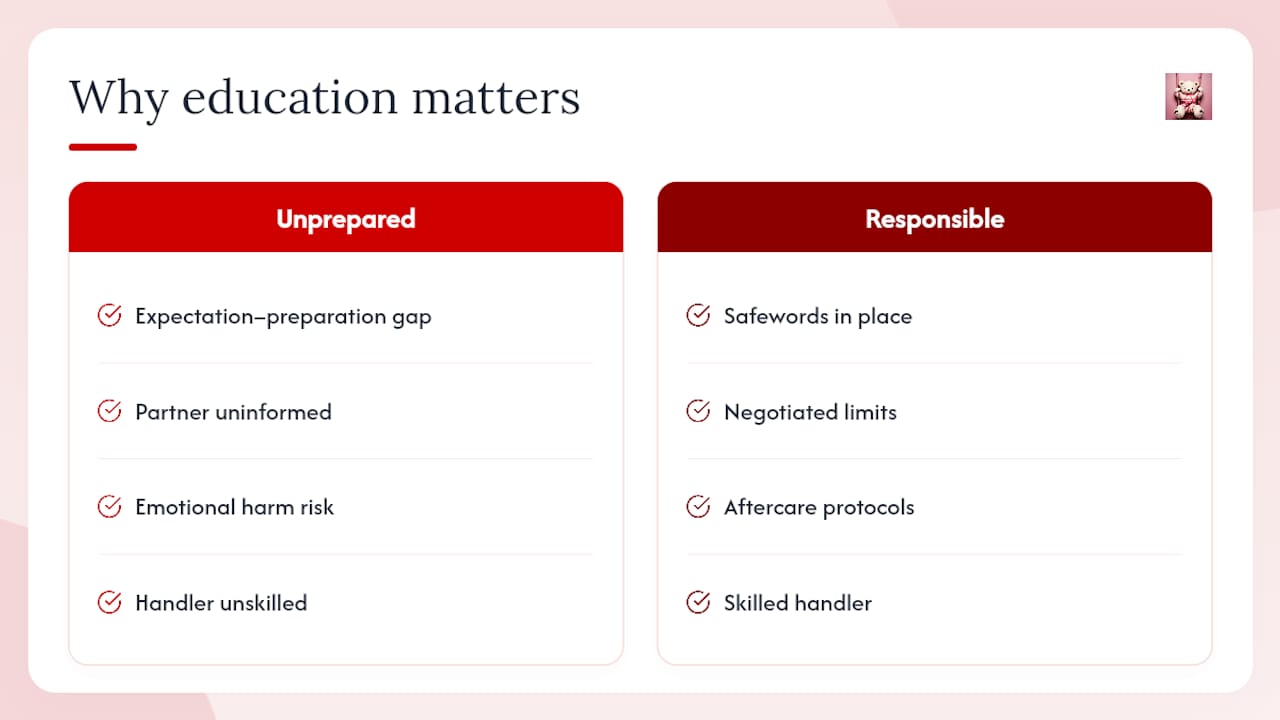
Here's the thing most guides won't say plainly: the biggest risk in kitten play isn't the gear or the dynamic. It's the gap between what people imagine the scene will be and what they've actually prepared for. Someone puts on a collar for the first time, drops into a headspace they didn't expect, and their partner has no idea what just happened or what to do about it. That's where things go sideways.
The kink community has spent decades building frameworks — safewords, negotiation scripts, aftercare protocols — precisely because these dynamics are powerful. The submissive kitten role isn't a passive experience. It's an active psychological state that takes real skill to enter and exit safely. Treating it like a costume you put on and take off without preparation is how people get hurt, not physically necessarily, but emotionally in ways that take a long time to untangle.
What I find genuinely underestimated is how much the handler's skill matters. Most beginner content focuses on the kitten's experience, which makes sense. But the handler is running the scene, monitoring consent nonverbally, managing gear safety, and holding the emotional container for the whole thing. That's a real responsibility. A handler who hasn't thought through what they're doing is a liability, not a partner.
The research backs this up. Qualitative findings on pet play consistently point to the quality of the relational container — trust, communication, and aftercare — as the variable that determines whether the experience is restorative or damaging. The kink itself is almost incidental.
Kinkykorner: find vetted kitten play providers and resources

If you've read this far and you're thinking "okay, but where do I actually find people who know what they're doing," that's exactly what Kinkykorner is built for. The marketplace connects adults with vetted providers, educators, and community spaces across the US who specialize in kink lifestyle services — including pet play workshops, gear consultants, and experienced handlers who teach beginner-friendly sessions.
Unlike a generic search, Kinkykorner listings come from providers who've put their services on record. You can browse discreetly, read erotic and educational content on kitten play dynamics, and find local or online resources without handing your information to an algorithm that doesn't know a munch from a munching. Privacy and discretion are built into how the platform works.
Ready to find your people? Browse the Kinkykorner marketplace and search for kitten play, pet play, or BDSM education listings near you.
Useful sources and further reading
- Pet Play in BDSM | Complete Practice Guide - BDSM Path
- Qualitative research on puppy play and participant experiences (PMC)
- Kitten Play in BDSM: Guide to Feline Pet Play — KinkCodex
- Animal Roleplay in BDSM: Pet Play & Consent | KinkCodex
- Kitten behavior and training - Play and investigative behaviors | VCA Hospitals
- Play in kittens (Felis domesticus) and its association with cohesion and aggression (Mendoza & Ramirez, DOI)
- Play in felids and signal use — Frontiers in Veterinary Science
- Pet Play: Types, Psychology & Getting Started | SYNR
This article is general educational information, not professional legal, medical, or psychological advice. Confirm any health or safety concerns with a qualified professional before engaging in BDSM activities.