

Common BDSM roles refer to how individuals consensually negotiate power exchanges within BDSM relationships, primarily categorized as Dominant, submissive, and Switch. These roles are defined by psychological dynamics, not just physical acts. If you've been curious about understanding BDSM dynamics but found most guides either too clinical or too vague, this is the real talk you've been looking for. The community is bigger and more nuanced than most people realize, and getting the common BDSM roles explained clearly is the first step toward knowing where you actually fit.
What distinguishes Dominant, submissive, and Switch roles in BDSM?
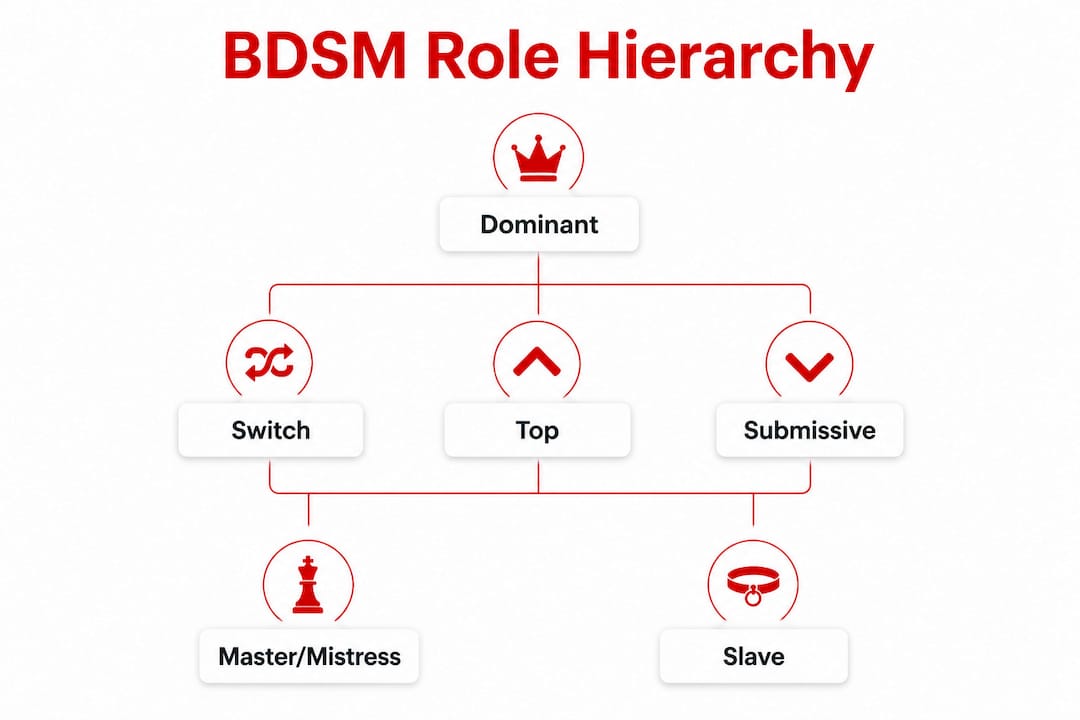
The three core BDSM roles are Dominant, submissive, and Switch, each defined by how power is exchanged rather than by any specific act. This is the part most beginners miss. You can have a perfectly vanilla dinner and still be in a Dominant/submissive dynamic. The role lives in the relationship structure, not just the bedroom.
The Dominant role carries real weight. A Dominant holds authority within a negotiated dynamic, but that authority comes with responsibility for their partner's physical and emotional wellbeing. Think of it less like a boss and more like a pilot. You're in control, yes, but you're also accountable for everyone on board. Dominants set the tone, enforce agreed-upon rules, and carry the emotional labor of holding the space safely.

The submissive role is where the biggest misconception lives. Submission is active and chosen, not passive. A submissive sets their own limits, provides ongoing feedback, and makes a deliberate, courageous choice to yield power. That choice is the foundation of the entire dynamic. Without it, there's no dynamic at all.
The Switch role is exactly what it sounds like. Switches move between Dominant and submissive positions depending on the partner, the scene, or their mood that day. Between 18% and 50% of BDSM practitioners identify as Switches. That's a massive range, and it reflects how genuinely fluid role identity can be. Switches require strong communication skills because their dynamics shift regularly, and both partners need to track where they are at any given moment.
- Dominants hold authority and carry responsibility for partner wellbeing
- Submissives actively set limits and choose to yield power
- Switches move fluidly between roles and need clear communication protocols
- None of these roles require specific acts to be valid
Pro Tip: If you're new and unsure where you fall, try journaling about which scenarios feel exciting versus which feel uncomfortable. Your gut reaction to imagined scenarios tells you more than any online quiz.
How do BDSM roles differ from Top, Bottom, and scene-based roles?
D/s denotes psychological power exchange, while Top and Bottom describe physical roles during a scene. This distinction trips up a lot of beginners, and honestly, even some experienced players blur the lines. Getting this clear saves a lot of confusion and miscommunication.
A Top is the person doing the physical action in a scene. Spanking, tying, flogging. A Bottom receives those actions. Neither label says anything about who holds authority in the relationship. A submissive can Top in a scene. A Dominant can Bottom. The psychological role and the physical role are separate tracks.
| Role | Type | What it describes |
|---|---|---|
| Dominant | Psychological | Holds relational authority and responsibility |
| Submissive | Psychological | Yields authority by conscious choice |
| Top | Physical/scene | Performs actions during a scene |
| Bottom | Physical/scene | Receives actions during a scene |
| Switch | Both | Moves between Dominant or submissive, Top or Bottom |
Two terms worth knowing here are Service Top and Topping from the Bottom. A Service Top performs actions at the direction of the Bottom, meaning the Bottom is actually calling the shots. Topping from the Bottom describes a submissive who tries to control the scene through manipulation rather than direct negotiation. The community generally views the latter as a communication failure, not a power move.
These distinctions matter because they protect everyone involved. When you know what role you're actually playing, you can negotiate kink more clearly and avoid mismatched expectations that kill the mood or, worse, cause real harm.
What lifestyle variations exist in BDSM dynamics?
BDSM dynamics range from scene-based to continuous 24/7 arrangements, and the difference between them is enormous. Knowing which structure fits your life is as practical as knowing your role.
Scene-based dynamics are contained. Two people negotiate a specific encounter, play it out, and then return to their regular relationship structure. This works well for people who want to explore without restructuring their entire lives. It's also the most common entry point for beginners.
24/7 dynamics are a different animal entirely. In a 24/7 arrangement, the power exchange is continuous. A submissive might follow daily protocols, use specific forms of address, or maintain agreed-upon behaviors around the clock. This requires a level of trust, communication, and logistical planning that most people underestimate going in.
Here's how to build a sustainable dynamic, whether it's scene-based or ongoing:
- Negotiate explicitly before anything starts. Cover hard limits, soft limits, health considerations, and emotional triggers. Write it down if the dynamic is ongoing.
- Establish a safeword system. The traffic light system (red, yellow, green) works well because it gives nuance beyond a binary stop or continue.
- Schedule regular check-ins. Dynamics shift. What felt right three months ago may not fit now. Build in time to revisit agreements without it feeling like a crisis.
- Define what the dynamic looks like outside of scenes. For 24/7 arrangements, this means agreeing on rituals, protocols, and how the dynamic pauses for real-world demands like work or family.
- Plan aftercare from the start. Aftercare is not optional. It's the part that makes the rest sustainable.
Pro Tip: For 24/7 dynamics, treat your first three months as a trial period with a scheduled review. Most dynamics that collapse do so because people locked in too fast without room to adjust.
What advanced BDSM roles should curious adults know about?
Beyond the core three, the community recognizes several more specialized roles. These are not beginner territory, but knowing they exist helps you understand the full range of what BDSM relationships can look like.
Master/Mistress and slave represent the deepest end of authority-based dynamics. Master/slave roles require extensive experience and structured agreements to sustain safely. The authority in these dynamics is broad and often formalized through written contracts, rituals, and explicit protocols. Entering this kind of dynamic without a strong foundation in communication and consent is genuinely risky.
Caregiver/little dynamics sit at a different point on the spectrum. The Caregiver (sometimes called a Daddy Dom or Mommy Domme) takes a nurturing, protective role. The "little" engages in age regression or childlike behavior as a form of stress relief and intimacy. This dynamic is often misunderstood by outsiders, but within the community it is recognized as a legitimate and deeply emotional form of power exchange.
Service submissives express their submission through acts of care and service rather than physical play. Cooking, cleaning, organizing, running errands. The submission is in the devotion and attention, not in a scene. This role suits people whose love language is acts of service and who find deep satisfaction in caring for their Dominant.
- Master/Mistress and slave dynamics require written agreements and significant prior experience
- Caregiver dynamics center on nurturing authority and emotional intimacy
- Service submission expresses devotion through care rather than physical scenes
- All advanced roles require the same foundation: explicit negotiation and ongoing consent
The diversity here is the point. BDSM is not one thing. It's a framework for consensual power exchange that people adapt to fit their actual desires and relationship styles.
How do negotiation, communication, and aftercare support healthy dynamics?
Aftercare is a critical phase that Dominants carry responsibility for, and it's the part most guides gloss over. A scene can be technically perfect and still leave someone emotionally wrecked if aftercare is skipped. Physical touch, verbal reassurance, food, water, and quiet time together are all common aftercare practices.
Safewords and protocols like the traffic light system enable real freedom within consensual limits. The traffic light system works like this: green means continue, yellow means slow down or check in, red means stop completely. This gives both partners a shared language that works even when verbal communication is limited by the scene itself.
Communication shapes every safe and satisfying kink experience. Before a scene, negotiate explicitly. During a scene, use your safeword system. After a scene, check in emotionally and physically. This three-part rhythm is the backbone of healthy BDSM dynamics at any level.
Pro Tip: Write a simple one-page negotiation document before your first scene with a new partner. Cover hard limits, soft limits, preferred aftercare, and your safeword. It feels formal until the moment you actually need it.
Key Takeaways
BDSM roles are defined by consensual power exchange, not specific acts, and understanding the distinctions between psychological roles and physical roles is the foundation of safe, satisfying dynamics.
| Point | Details |
|---|---|
| Core roles are Dominant, submissive, and Switch | Each role is defined by how power is exchanged, not by any specific physical act. |
| D/s and Top/Bottom are separate tracks | Psychological authority and physical scene roles can overlap or diverge independently. |
| Switches are common and require strong communication | Between 18% and 50% of practitioners identify as Switches, making fluidity the norm. |
| Advanced roles need experience and written agreements | Master/slave and caregiver dynamics require structured negotiation before entering. |
| Aftercare and safewords are non-negotiable | The traffic light system and consistent aftercare protect both partners emotionally and physically. |
What I've learned about BDSM roles after years of watching dynamics evolve
Here's the thing nobody tells you when you first start exploring: the role you think you are at the beginning is almost never the role you settle into. I've watched confident self-identified Dominants discover a deep hunger to submit. I've seen people who swore they were pure bottoms find genuine satisfaction in holding authority. Roles in BDSM are fluid tools, not fixed identities, and the sooner you internalize that, the healthier your dynamics will be.
The emotional labor of Dominants is wildly underestimated. Holding space for someone's vulnerability, tracking their physical and emotional state, making real-time decisions about safety. That's not a power trip. That's work. And submissives carry their own weight too. Submissives hold power through their choice to surrender, and that choice requires self-knowledge, courage, and ongoing communication. Neither role is passive.
The biggest mistake I see beginners make is locking their identity too early. They read a definition, decide "that's me," and then feel like failures when the reality is more complicated. Give yourself permission to be in process. Try things. Talk about what worked and what didn't. The most fulfilling dynamics I've ever seen are built by people who stayed curious about themselves and each other, not by people who performed a role they thought they were supposed to want.
— Prenston
Explore Kinkykorner and find your people
If this article cracked something open for you, the next step is finding a community that actually gets it.

Kinkykorner is a marketplace and community platform where adults can connect with BDSM-friendly service providers, read erotic literary and artistic content, and explore their desires with real support behind them. Whether you're figuring out your role for the first time or deepening an existing dynamic, Kinkykorner gives you a space to do it without judgment. The platform lists adult-themed services and businesses alongside content that reflects the full, honest range of kink. You deserve a community that meets you where you are. This is it.
FAQ
What are the main roles in BDSM relationships?
The three primary roles in BDSM relationships are Dominant, submissive, and Switch, each defined by how power is consensually exchanged rather than by specific physical acts.
What is the difference between a Dominant and a Top?
A Dominant holds psychological authority within a relationship dynamic. A Top performs physical actions during a scene. These roles can overlap but are not the same thing.
What does it mean to be a Switch in BDSM?
A Switch moves between Dominant and submissive roles depending on the partner or scene. Between 18% and 50% of BDSM practitioners identify as Switches.
Are submissives passive in BDSM dynamics?
No. Submission is an active, chosen role. Submissives set their own limits, provide feedback, and hold real power through their decision to yield authority.
What is aftercare and why does it matter?
Aftercare is the physical and emotional care that follows a BDSM scene. It supports recovery, reinforces trust, and is a responsibility that Dominants carry for their partners' wellbeing.