

Ethical porn is adult content produced with enthusiastic consent, fair pay, safe working conditions, and genuine inclusivity. It's not a legal certification or a government-regulated category. Think of it more as a code of conduct, a set of values that producers and performers actually commit to before the cameras roll. The term signals a real departure from mainstream porn's long history of exploitation, opacity, and harmful stereotypes.
Here's what separates ethical pornography from the rest:
- Enthusiastic, documented consent from every performer before and during filming
- Fair wages for performers and crew, not the race-to-the-bottom rates common on free tube sites
- Safe sex practices on set, including regular STI testing and the right to use protection
- On-screen consent negotiation, where performers discuss boundaries openly, sometimes as part of the scene itself
- Diverse representation across body types, races, genders, and sexualities
- Performer agency over scripts, acts, and the right to stop at any point
A team of international experts led by the University of Sydney identified these six criteria as the foundation for healthy, ethical adult content. Dr. David Ley, a clinical psychologist and sex researcher, has been vocal about ethical porn's potential to reshape how we consume sexual media. The term itself lacks legal standardization, which means the burden falls on you as a viewer to look past the marketing and assess what's actually happening behind the scenes.
Why ethical porn matters for performers and viewers alike
Mainstream porn has a documented exploitation problem. Performers, particularly women, have historically faced coercive contracts, unsafe sets, and wages that don't reflect the industry's enormous revenue. Ethical porn directly addresses that gap by treating production as a workplace with real standards.

Rowntree's framing cuts to the core of it. This isn't just about what you see on screen. It's about what happens before the shoot, during it, and after. Fair wages, scheduled breaks, a comfortable filming environment, and a genuine say for performers in what they do and don't do.

Dr. Gloria Brame, PhD, adds another layer. She points out that ethical adult content honors body size, age, skin color, and more, which is a sharp contrast to the narrow physical standards mainstream porn has pushed for decades. That inclusivity isn't just feel-good politics. It actively challenges the unrealistic body image and sexual expectations that mainstream content has normalized for millions of viewers.
Paying for content is also part of the ethical equation. Free adult content typically relies on ad revenue and volume, which creates pressure to cut corners on performer pay and safety. When you pay, you fund the conditions that make ethical production possible.
How to identify ethically produced porn
No universal certification body exists for ethical porn, so you have to do some homework. Here's a practical checklist:
Look for transparency first. Ethical producers typically publish their code of conduct, consent policies, and performer rights on their sites. If that information is buried or absent, that's a red flag.
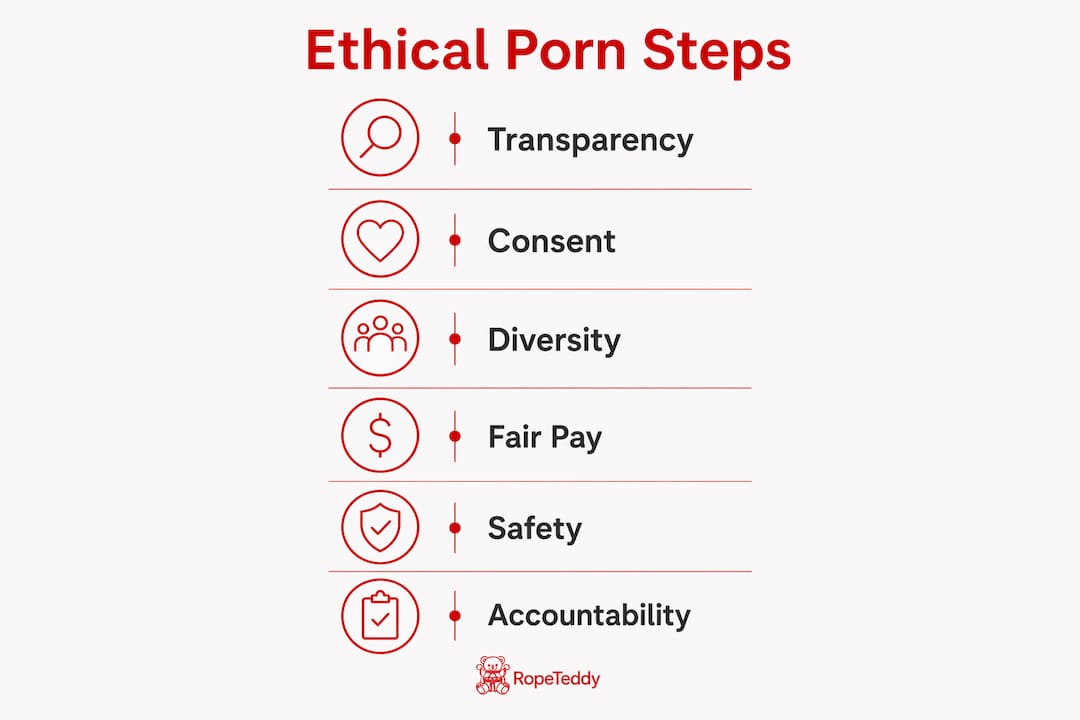
Check for on-screen consent negotiation. Some ethical studios include pre-scene conversations where performers discuss boundaries openly. It's one of the clearest signals that consent is baked into the production, not just assumed.
Assess diversity. As Dr. Brame puts it, if you don't see much diversity in the performers, it may not be ethical porn. Ethical content features diverse bodies, sexual orientations, and genders rather than a narrow template.
Verify the business model. Ethical platforms almost always charge for content. Paid subscriptions or per-scene purchases fund fair wages and safe sets. Free content rarely does.
Watch the content itself. Ethical porn focuses on authentic chemistry and mutual pleasure, not scripted performance for the male gaze alone. The University of Sydney criteria specifically include a focus on pleasure for all participants, not just one.
A quick numbered checklist for your own due diligence:
- Does the site publish a clear consent and ethics policy?
- Are performers credited by name and given agency over their content?
- Is the content behind a paywall rather than ad-supported?
- Does the content show diverse body types, races, and sexualities?
- Are safe sex practices depicted or documented?
- Can performers request content removal?
Producers labeling content "ethical" carry no legal obligation to back that claim up, so transparency and performer agency are your real benchmarks, not the marketing copy.
Where to find ethical porn in 2026
Ethical porn platforms run on a fundamentally different business model than mainstream tube sites. They prioritize performer safety and fair pay through paid subscriptions or direct purchases, which keeps the financial incentive aligned with quality and dignity rather than raw traffic volume.
A few things to look for when choosing a platform:
- Paid content only. Platforms that charge for access are far more likely to compensate performers fairly.
- Published ethics statements. The best studios are upfront about their production values, consent protocols, and performer rights.
- Performer-led content. Some studios give performers creative control, including script input and scene negotiation, which produces noticeably different content.
- Content removal rights. Ethical platforms allow performers to request removal of their content, a basic dignity protection mainstream sites often ignore.
Kinkykorner operates as a marketplace where adults can discover ethical adult-themed services, businesses, and erotic literary and artistic content from creators who take these standards seriously. If you're looking for a starting point that connects you with producers and creators who operate with transparency, it's worth exploring what's listed there.
Pro Tip: Before subscribing to any adult platform, search the studio name alongside terms like "performer rights" or "consent policy." What comes up in that search tells you far more than the site's own marketing does.
Expert perspectives and critiques on ethical porn
Not everyone buys the concept. The debate is real, and it's worth understanding both sides.
Dr. David Ley frames consumer choice as a form of civic participation. Paying for ethical content is, in his words, like voting for better standards in the industry. Every purchase signals to producers that audiences want content made with dignity and care.
That's the supportive camp. Then there's the opposition, and it's not shy.
CAPP-USA argues that no amount of fair wages or consent protocols changes the fundamental nature of pornography. Their position: commodifying human beings for sexual content cannot be made ethical, full stop. The Catholic Church holds the same line, rejecting the concept entirely on the grounds that pornography objectifies people regardless of production conditions.
These critiques aren't fringe. They represent a coherent philosophical position that the "ethical" label is a marketing reframe rather than a genuine moral category. The honest answer is that whether ethical porn is truly possible depends heavily on your underlying values about sexuality, labor, and human dignity. What the critics and supporters do agree on: mainstream porn, as it typically operates, causes real harm.
The practical challenge is that without a universal certification body, "ethical" remains a self-applied label. Studios with genuine commitments and studios using the term as a sales pitch look identical from the outside. That's why the identification checklist above matters more than any label a producer puts on their own content.
How ethical porn evolved over time
The concept didn't appear overnight. Feminist filmmakers in the 1980s, particularly in San Francisco, began producing adult content explicitly designed to center female pleasure and challenge the male-gaze conventions that dominated the industry. Directors like Candida Royalle, who founded Femme Productions in 1984, were among the first to argue that porn could be made differently, with performers treated as collaborators rather than props.
The internet changed everything, and not always for the better. The explosion of free tube sites in the late 2000s gutted performer pay and flooded the market with content that had no accountability attached to it. That race to the bottom actually accelerated the ethical porn conversation, because the contrast became impossible to ignore.
By the 2010s, the term "feminist porn" had gained enough traction that the Feminist Porn Awards in Toronto ran annually from 2006 to 2015, recognizing studios and performers who met specific production criteria. "Ethical porn" emerged as a broader, less politically loaded term that could encompass feminist, queer, and mainstream-adjacent studios alike, all committed to the same core standards.
The 2020s brought increased performer advocacy, with organizations pushing for industry-wide standards on consent, pay, and working conditions. The adult content ethics conversation has only grown louder since, particularly as mainstream platforms have faced public scrutiny over content moderation and performer exploitation.
Common ethical standards and certifications in the industry
No single governing body certifies ethical porn in the United States or globally. That's the honest starting point. What exists instead is a patchwork of self-imposed standards, advocacy frameworks, and production codes that studios adopt voluntarily.
The Free Speech Coalition, the adult industry's primary trade association in the US, maintains performer testing protocols through the PASS (Performer Availability Screening Services) system, which tracks STI testing compliance across participating studios. It's not an ethics certification, but it addresses one concrete safety dimension.
Some studios publish their own codes of conduct that cover consent documentation, performer rights to refuse acts, fair wage commitments, and content removal policies. Pink & White Productions, known for queer and feminist adult content, has long been cited as a model for transparent, performer-centered production.
The University of Sydney's six-criteria framework, developed with an international panel of adolescent health experts, sexual health researchers, and sex educators, offers the closest thing to an academically grounded standard currently available. Those criteria, covering consent, safe sex, pleasure equity, fair wages, and diversity, function as a practical benchmark even without regulatory force behind them.
What this means for you as a viewer: the absence of certification puts the responsibility squarely on your own research. Look for studios that publish their standards publicly, credit their performers, and operate paid models that make fair compensation financially viable.
Key Takeaways
Ethical porn is defined by consent, fair pay, safe conditions, and inclusivity, and no legal certification currently exists to verify those claims, making viewer due diligence the only reliable filter.
| Point | Details |
|---|---|
| Core definition | Ethical porn prioritizes enthusiastic consent, fair wages, safe sets, and diverse representation. |
| No legal certification | "Ethical" is a self-applied label; transparency and performer agency are the real markers to assess. |
| Pay to support ethics | Paid content funds fair wages and safe conditions; free tube sites rarely do. |
| University of Sydney criteria | Six expert-identified criteria cover consent, safe sex, pleasure, wages, and diversity. |
| Critiques are real | CAPP-USA and the Catholic Church reject the concept entirely, arguing commodification cannot be made ethical. |