

Vanilla sex is consensual sexual activity that falls within what most people consider conventional — no kink, no BDSM, no fetish elements required. That's the whole definition. If you and a partner are having sex that doesn't involve negotiated power dynamics, safewords, or fetish play, you're probably doing what the kink community calls "vanilla." And before you read anything else: that label is neutral. It's not a dig. It's not a consolation prize.
A few things to get straight right away:
- "Vanilla" was coined by kink communities as a shorthand for non-kink sex, not as an insult. Women's Health confirms the term originated as a neutral differentiator, not a judgment.
- Wikipedia's entry on vanilla sex defines it as sexual behavior within a culture's accepted range of normality — which means the line shifts depending on who and where you are.
- Kinkykorner covers the full spectrum of adult sexuality, from the most conventional to the most adventurous. This guide is for anyone who wants to understand where vanilla fits in that picture.
Key Takeaways
Vanilla sex is consensual, conventional sexual activity that excludes kink, BDSM, and fetish elements — and it's a fully valid, often deeply satisfying choice for millions of people.
| Point | Details |
|---|---|
| Clear definition | Vanilla sex means consensual, conventional sex without kink, BDSM, or fetish elements. |
| Not a judgment | The term originated in kink communities as a neutral label, not an insult or a measure of passion. |
| Consent still matters | Vanilla sex requires the same ongoing consent and communication as any other sexual encounter. |
| The spectrum is real | Many people blend vanilla and kink elements; the binary is descriptive, not prescriptive. |
| Kinkykorner as a resource | Kinkykorner covers the full adult spectrum — from conventional to kink — with articles, listings, and erotic content for every preference. |
Table of Contents
- What is vanilla sex, exactly — and what counts?
- How does vanilla sex differ from kink and BDSM?
- Consent and communication: talking about sex before, during, and after
- Why people choose vanilla sex — and why "boring" is the wrong word
- What does it mean to have a "vanilla partner"?
- How to safely explore beyond your usual sexual repertoire
- Where did the term "vanilla sex" actually come from?
- The psychology of vanilla sex: intimacy, comfort, and what it actually feels like
- Common misconceptions about vanilla sex and the people who prefer it
- A note from me, before you go
- Sources
What is vanilla sex, exactly — and what counts?
Conventional sexual activity covers a wider range than most people assume. Wikipedia notes that common examples include penetrative sex (missionary and other positions), oral sex, and mutual masturbation. Those are the usual suspects. But the list doesn't stop there, and it's not fixed.
What makes something "vanilla" isn't the act itself — it's the absence of kink elements. Slow, tender sex is vanilla. Passionate, loud, sweaty sex is also vanilla. Intensity and emotion don't move the needle. What matters is whether the encounter involves fetish objects, negotiated power exchange, or BDSM dynamics. No safewords, no scene-setting, no role assignment? Vanilla.
Pro Tip: If you and your partner never use the word "vanilla" to describe your sex life, that's actually the norm. Sexologist Sarah Melancon points out that people who prefer conventional sex rarely label it at all — it's just sex to them. The label mostly lives in kink spaces.
One thing worth saying plainly: vanilla sex applies across all orientations. Cosmopolitan notes that queer couples practice vanilla sex too — mutual masturbation, oral sex, and penetrative acts where applicable all qualify. The term doesn't belong to heterosexual norms. It belongs to anyone having sex without kink elements.
Cultural context matters here. What one community considers completely conventional, another might see as adventurous. These lines shift over time and across communities, which is why Wikipedia's framing of "within a culture's range of normality" is more accurate than any fixed list.
How does vanilla sex differ from kink and BDSM?
The clearest way to see the difference is in the structure of the encounter. Kink and BDSM involve explicit pre-negotiation: partners discuss roles, limits, and signals before anything starts. Safewords are agreed upon. Power dynamics are intentional and negotiated. Women's Health identifies safewords and explicit negotiation as routine elements in kink scenes — features that are typically absent from vanilla encounters.

That doesn't mean vanilla sex skips consent. It means the consent conversation looks different: less formal, less structured, but no less real.
| Feature | Vanilla sex | Kink / BDSM |
|---|---|---|
| Power dynamics | Absent or informal | Explicit, negotiated |
| Safewords | Rarely used | Standard practice |
| Fetish elements | Not present | Central or present |
| Pre-scene negotiation | Casual or minimal | Detailed and required |
| Aftercare | Informal | Often structured |
Here's the thing, though: the vanilla-vs-kink binary is a bit of a fiction. Cosmopolitan makes the point that many people exist on a spectrum, blending conventional acts with occasional kink elements. Sex educator Justin Hancock argues that sexual satisfaction depends on consent and shared enjoyment far more than on fitting a label. You can have a mostly vanilla sex life and occasionally experiment. That's not a contradiction. That's just how most people actually live.
For a deeper look at how BDSM roles and dynamics work, Common BDSM Roles Explained for Curious Adults is a solid starting point.
Consent and communication: talking about sex before, during, and after
Consent isn't a kink-only concept. It's the foundation of any sexual encounter, vanilla or otherwise. The difference is that kink communities have developed more formalized scripts for it — which, honestly, vanilla couples could learn from.
- Before: Open with something direct and low-pressure. "What are you into?" works. So does "Is there anything you want to try, or anything that's off the table?" You're not writing a contract — you're having a conversation. Ask about pace, preferences, and any hard limits.
- During: Check in briefly. "Is this okay?" or "Do you want to keep going?" takes three seconds and matters enormously. Watch for non-verbal cues too — tension, hesitation, or a change in energy are signals worth pausing for.
- After: A short debrief is underrated. "How was that for you?" or "Was there anything you wanted more or less of?" keeps the communication loop open and builds trust over time.
Pro Tip: If talking about sex feels awkward, start outside the bedroom. A casual conversation over coffee about preferences and limits is far less charged than trying to negotiate mid-encounter. The more you practice it, the less weird it gets.
Post-sex check-ins aren't just for kink scenes. They're how you learn what your partner actually enjoyed, not just what they tolerated. That feedback loop is what makes sex better over time.
Why people choose vanilla sex — and why "boring" is the wrong word
Sex educators are consistent on this point: vanilla is a valid preference, not a failure of imagination. Business Insider reports that sexologists and journalists explicitly frame vanilla as a legitimate choice, not evidence of low desire or creativity.
Sex educator Gigi Engle emphasizes that preferring conventional sex deserves the same normalization as any other consensual preference. The "boring" label says more about cultural bias than it does about the actual experience.
Peer-reviewed academic literature backs the broader point that sexual behavior is diverse and personal. PubMed-indexed research on sexual preferences confirms that no single style of sex is inherently superior — what matters is that it's consensual and satisfying for the people involved.
"Vanilla-shaming" — judging someone for preferring conventional sex — is a real social phenomenon. Women's Health calls it out directly as a harmful cultural script. If someone makes you feel lesser for not being into kink, that's their bias talking.
What does it mean to have a "vanilla partner"?
The phrase "vanilla partner" usually describes someone who prefers conventional sex when their partner wants to explore kink. It can be said neutrally or, unfortunately, as a subtle put-down. Either way, it's a label that flattens a real person into a single preference.
Business Insider notes that mismatched preferences are common and negotiable. Here's how couples actually navigate it:
- The one-new-thing agreement: Each partner proposes one low-stakes experiment per month. Both have full veto power, no explanation required.
- Scheduled exploration: Set aside a specific night to try something slightly outside the usual — different location, different pace, a new position. Low pressure, clear opt-in.
- Separate opt-in/opt-out rules: Agree in advance that either person can pause or stop anything without it becoming a conversation about the relationship itself.
- Honest preference mapping: Each partner writes down what they enjoy, what they're curious about, and what's a hard no. Compare lists without judgment.
The goal isn't to convert a vanilla partner into a kink enthusiast. It's to find the overlap where both people feel good. That's where the real intimacy lives. The Real Role of Diversity in Adult Content explores how mismatched desires play out in adult content — worth a read for perspective on how these dynamics are portrayed.
How to safely explore beyond your usual sexual repertoire
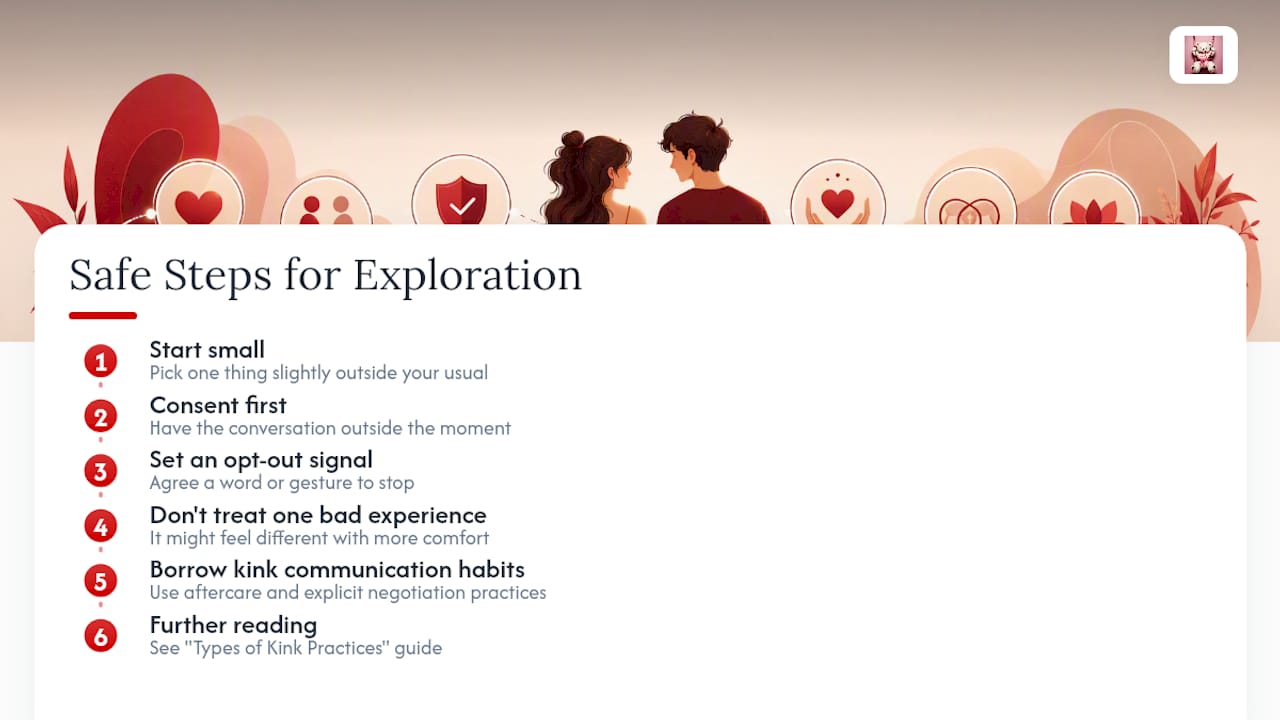
Wanting to try something new doesn't mean abandoning what works. It means adding to it. Here's a low-pressure starting framework:
Start small. Pick one thing that's slightly outside your usual — a new position, a different setting, light sensory play like a blindfold. Nothing that requires equipment or a negotiation manual.
Consent first, always. Before trying anything new, have the conversation outside the moment. "I've been curious about X — would you be open to trying it?" gives your partner space to think without pressure.
Set a clear opt-out signal. Even for low-stakes experiments, agree on a word or gesture that means "let's stop this and go back to what we know." It removes the awkwardness of mid-encounter course corrections.
Don't treat one bad experience as a verdict. Something that felt weird once might feel different with more comfort and communication. Or it might just not be for you. Both outcomes are fine.
Pro Tip: Types of Kink Practices: A Real Guide to Exploring More is a practical next step if you're curious about what's out there. It's written for people who are exploring, not for people who've already decided.
Kink communities have developed practices like aftercare and explicit negotiation specifically because they work. Even if you never go near BDSM, borrowing those communication habits makes any sexual exploration safer and more satisfying.
Where did the term "vanilla sex" actually come from?
The word "vanilla" as a metaphor for the conventional or plain has a long cultural history — it's the default ice cream flavor, the baseline against which everything else is measured. In sexual contexts, Wikipedia traces the term's usage back to at least the mid-20th century, with the kink community adopting it widely through the 1970s and 1980s as a neutral shorthand for non-kink sex.
The Oxford English Dictionary recognized the sexual usage later, which tells you something: the word traveled from subculture to mainstream gradually, carrying its neutral connotation with it. It wasn't invented as an insult. It was a practical label for a category of sex that kink practitioners needed a word for.
That origin matters because it explains why the term still carries a faint whiff of "lesser than" in some circles — it came from a community that was defining itself against conventional norms. But that context is descriptive, not prescriptive.
The psychology of vanilla sex: intimacy, comfort, and what it actually feels like
Conventional sex tends to build on familiarity. There's a reason long-term couples often gravitate toward what they know works — it's not laziness, it's trust. When you know your partner's body and they know yours, the sex can be deeply connected in a way that novelty-seeking doesn't always replicate.
Psychologically, the comfort of conventional sex can lower anxiety and increase presence. You're not managing a scene or tracking a checklist. You're just there, with another person. That kind of intimacy has real value.
None of this means vanilla sex is automatically more emotionally meaningful than kink. It means the emotional texture is different. Kink can be profoundly intimate too — the vulnerability of negotiating limits and trusting a partner with power is its own form of closeness. The point is that neither style has a monopoly on depth.
What matters, as peer-reviewed research on sexual behavior consistently suggests, is that the sex is consensual and satisfying for everyone involved. The label on it is secondary.
Common misconceptions about vanilla sex and the people who prefer it
A few things people get wrong, stated plainly:
Vanilla sex is boring. No. Boring sex is boring. Vanilla sex can be passionate, creative, and deeply satisfying. The absence of kink elements doesn't cap the ceiling on pleasure or connection.
Vanilla people have low libidos or low curiosity. Also wrong. Preferring conventional sex says nothing about how much someone wants sex or how open they are to variety within conventional acts. There's enormous range inside "vanilla."
If you're vanilla, you're missing out. This one's the most insidious. Business Insider directly addresses vanilla-shaming as a cultural script that pressures people into feeling inadequate for their preferences. Your sex life doesn't need external validation.
Vanilla is a permanent identity. Preferences shift. Someone who's been exclusively vanilla might get curious about kink. Someone who's explored kink might settle back into conventional sex. Neither shift means anything is wrong.
A note from me, before you go
Look, I think the most honest thing anyone can say about sex is this: what you like is what you like, and that's enough. Vanilla, kinky, somewhere in between — none of it needs defending. The only real requirement is that everyone involved is genuinely on board.
Consent isn't a formality. It's the whole point. And whether you're having the most conventional sex imaginable or negotiating a complex kink scene, the same principle applies: check in, listen, and respect the answer.
Sources
These sources are worth bookmarking if you want to go deeper on any part of this topic.
- What Is Vanilla Sex? Experts debunk the biggest myths - Women's Health
- Vanilla sex - Wikipedia
- Don't Feel Ashamed If You Love 'Vanilla Sex' - Business Insider
- Vanilla sex - Cosmopolitan
- PubMed listing (example of peer-reviewed research on sexual behavior)