

Trust is the foundation of every BDSM dynamic. Without it, power exchange collapses, consent becomes meaningless, and what should feel electric instead feels dangerous. The role of trust in BDSM is not a soft, optional add-on. It is the structural load-bearing wall. BDSM practitioners often report equal or higher emotional intimacy compared to non-practitioners, largely because of the intentionality and explicit communication that trust demands. That is not a coincidence. That is the whole point.
How trust in BDSM differs from trust in traditional relationships
Most relationships build trust slowly. You share a meal, then a secret, then a year. BDSM compresses that timeline and raises the stakes immediately. You might be restrained, blindfolded, or psychologically vulnerable with someone in the first few scenes. That requires a different kind of trust. It has to be explicit, negotiated, and mutual before anything physical happens.
The consent frameworks SSC (Safe, Sane, and Consensual) and RACK (Risk-Aware Consensual Kink) exist precisely to formalize that trust. They are not bureaucratic checklists. They are the difference between BDSM and abuse. BDSM practice improves psychological well-being by fostering trust, explicit consent, and self-awareness. Participants show lower anxiety and higher intimacy than the general population. That outcome does not happen by accident. It happens because the community takes trust seriously in ways that vanilla relationships often do not.
Trust in BDSM covers three distinct layers:
- Emotional safety. Your partner will not use your vulnerabilities against you outside the scene.
- Physical safety. Agreed limits will be respected. Safewords will be honored. No one pushes past a hard limit.
- Psychological safety. The power exchange stays consensual. Dominance does not bleed into coercion. Submission does not become exploitation.
These layers do not develop in isolation. They reinforce each other. When a dominant stops a scene the moment a submissive uses a safeword, that single act deposits more trust than a hundred conversations about intentions. Behavior is the proof. Words are just the setup.
Why communication is the engine of trust in BDSM

Negotiation in BDSM is not a formality you rush through to get to the fun part. Negotiation is an intimate bonding experience that increases trust and comfort. It shapes the entire scene. Treating it like a chore to skip is how people get hurt, physically and emotionally.
Here is what a real negotiation process looks like:
- Pre-scene conversation. Discuss desires, hard limits, soft limits, and physical health considerations. Negotiations can last 30+ minutes to ensure boundary clarity before play. That time is not wasted. It is the foundation.
- Safeword agreement. Establish a clear safeword system before anything starts. The Traffic Light protocol (red to stop, yellow to slow, green to continue) is widely used because it works in real time without breaking the scene's energy.
- Check-ins during the scene. Verbal and non-verbal cues both matter. Experienced practitioners read subtle non-verbal signals and recalibrate dynamically rather than relying solely on formal lists. A flinch, a change in breathing, a shift in body language. All of it counts.
- Post-scene debrief. Talk about what worked, what did not, and what you want to adjust. This is where trust compounds.
Pro Tip: Do not treat negotiation as a one-time event. Boundaries evolve as partners grow together. Schedule a check-in conversation every few months, even in established dynamics. What felt exciting six months ago might feel different now, and that is completely normal.
Communication also functions as its own form of intimacy. Telling someone your deepest desires and your hardest limits is vulnerable. Receiving that information with care and respect builds a bond that most relationships never reach. That is one reason BDSM relationships can feel so intense so quickly. The communication in BDSM is not just functional. It is connective.
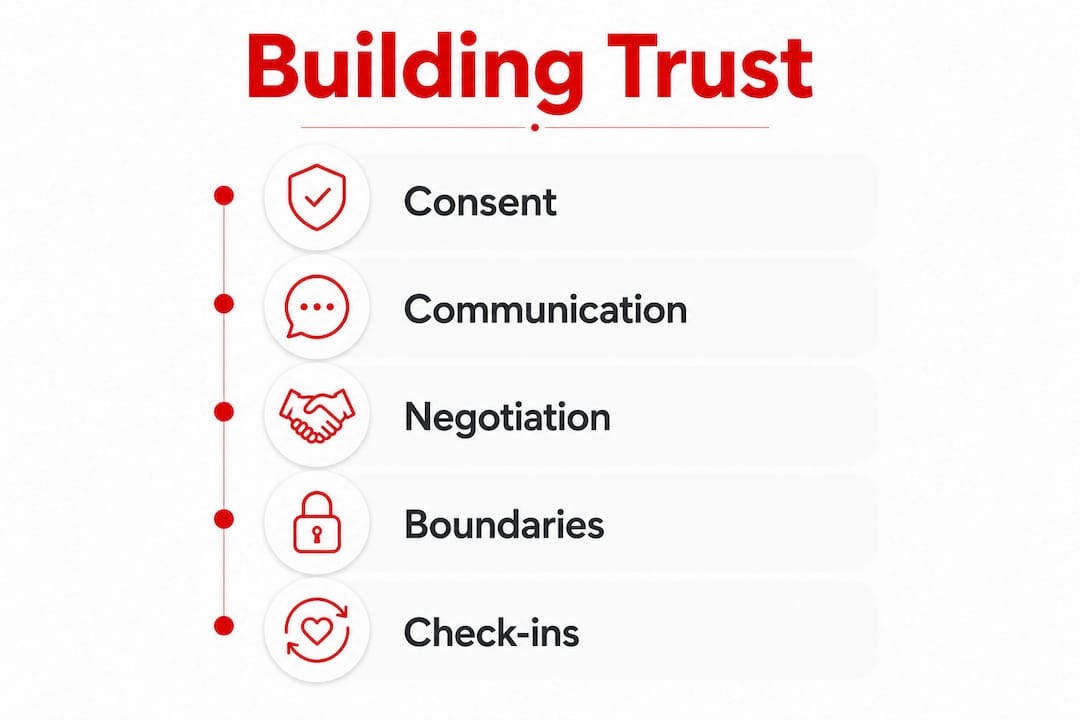
Practical ways to build and maintain trust in kink relationships
Trust is not a feeling you wait for. It is a practice you build through consistent, specific actions. The good news is that the actions themselves are not complicated. The commitment to them is what matters.
Here is what actually works:
- Honor every agreement, no matter how small. If you said you would check in after a scene, check in. If you agreed to a hard limit, treat it as permanent unless your partner explicitly revisits it. Trust often takes months or years to build but can be quickly lost if boundaries are violated. Small violations compound.
- Practice boundary-testing exercises. Start with lower-intensity scenarios and demonstrate that you will stop when asked. This is not about proving you are capable of restraint. It is about giving your partner lived evidence that their limits are safe with you.
- Prioritize aftercare. Aftercare is the physical and emotional care that follows a scene. It might be a blanket and water, or it might be an hour of talking. Daily non-erotic communication and aftercare build trust more than scene intensity alone. The scene is the peak. Aftercare is what makes the peak feel safe to reach again.
- Do repair work when you mess up. Mistakes happen. A dominant misreads a cue. A submissive does not speak up clearly. The relationship does not end there. What matters is the repair. Acknowledge the mistake, apologize without deflecting, and make a concrete change. Trust functions like a cumulative bank account. Violations make withdrawals. Repair work makes deposits.
Pro Tip: Build a shared kink checklist with your partner. Go through it together, not just as a practical tool, but as a conversation starter. The discussion it generates often reveals desires and limits that neither person knew how to bring up directly.
How to spot red flags that destroy trust and safety
The line between BDSM and abuse is drawn by informed, enthusiastic consent and genuine respect for limits. That line is not blurry. Certain behaviors are red flags regardless of how they are framed.
Watch for these warning signs:
- Ignoring or punishing safeword use. A safeword is not a challenge to overcome. Using one is not weakness. If a partner mocks, ignores, or penalizes safeword use, that is abuse. Full stop.
- Pressure to skip negotiation. "Real subs don't need safewords" or "If you trusted me, you wouldn't need limits" are manipulation tactics. Consent frameworks like SSC and RACK exist because trust requires structure, not blind faith.
- Secrecy and isolation. Healthy BDSM dynamics do not require hiding from friends, family, or community. If a partner insists on total secrecy or discourages outside relationships, that is a control pattern, not a kink dynamic.
- Boundary violations framed as accidents. One genuine mistake, addressed and repaired, is human. A pattern of "accidents" that always push past your limits is not accidental.
"The presence of a safeword does not make a dynamic safe. The willingness to honor it does."
If you recognize these patterns in your current dynamic, the BDSM community has resources. Peer support groups, kink-aware therapists, and online communities can help you assess what you are experiencing and find a path forward. Leaving an unsafe dynamic is not a failure of kink. It is an act of self-respect.
Key takeaways
Trust in BDSM is a lived practice built through explicit communication, consistent behavior, and honest repair work, not a feeling that arrives on its own.
| Point | Details |
|---|---|
| Trust requires explicit consent | SSC and RACK frameworks formalize trust before any scene begins. |
| Negotiation builds intimacy | Pre-scene conversations lasting 30+ minutes create the foundation for safe play. |
| Behavior proves trust | Honoring limits and safewords deposits more trust than any verbal promise. |
| Aftercare sustains the dynamic | Non-erotic communication and care after scenes build long-term emotional safety. |
| Red flags have clear patterns | Ignoring safewords, skipping negotiation, and boundary violations signal abuse, not kink. |
Trust is a practice, not a destination
Here is what I have come to understand after years of thinking and writing about BDSM dynamics: most people approach trust like it is a threshold you cross once. You do the negotiation, you establish the safeword, and then you are done. Trust achieved. Move on.
That is not how it works. Trust in BDSM is more like physical fitness. You build it through repetition. You maintain it through consistency. And you can lose it faster than you built it if you stop paying attention.
The part that surprises people is how much trust lives outside the scene. The texts you send after. The way you handle a disagreement about something completely unrelated to kink. Whether you show up when you said you would. These moments are not separate from the dynamic. They are the dynamic. A dominant who is careless with small commitments outside the bedroom will eventually be careless inside it too.
What I find genuinely beautiful about BDSM relationships, when they are done well, is that the structure forces a level of honesty most people never practice. You cannot fake your way through a negotiation with someone who is paying attention. You cannot hide your real limits for long. The dynamic pulls the truth out of you. And when both people meet that truth with care, what you get is not just a hot scene. It is one of the most intimate connections a person can have.
— Prenston
Where to go deeper on trust and consent in kink
Building trust in a BDSM dynamic takes more than good intentions. It takes education, community, and honest conversation with people who get it.

Kinkykorner is a space where adults exploring kink can find erotic content and community that takes consent and safety seriously. Whether you are new to power exchange or years into a dynamic, the Kinkykorner blog covers everything from building trust and deepening consent to understanding negotiation and aftercare. Real talk, no judgment, and a community that knows the difference between kink and harm.
FAQ
What is the role of trust in BDSM?
Trust is the foundation that makes consensual power exchange possible. Without it, vulnerability becomes danger and submission becomes exploitation.
How do SSC and RACK relate to trust?
SSC (Safe, Sane, and Consensual) and RACK (Risk-Aware Consensual Kink) are consent frameworks that formalize trust by requiring explicit agreement on limits, risks, and safewords before any scene begins.
How long should BDSM negotiation take?
Pre-scene negotiations can last 30 minutes or more, especially early in a dynamic. The goal is complete clarity on desires, hard limits, and safewords, not speed.
What is the biggest red flag in a BDSM dynamic?
Ignoring or punishing safeword use is the clearest red flag. It signals that a partner prioritizes their own desires over your safety and consent.
Does trust in BDSM need to be rebuilt after a mistake?
Yes. Trust functions like a bank account and boundary violations make withdrawals. Honest acknowledgment, apology, and behavioral change are the only way to rebuild it.