

Submissive dynamics, at their core, are a consensual exchange of power between two or more people, where one person deliberately yields control to another within agreed-upon boundaries. This isn't about weakness or dysfunction. It's a negotiated, often deeply intimate arrangement that can be sexual, emotional, or purely structural, depending on what the people involved actually want.
Here's what this guide covers:
- Roles and labels: dominant, submissive, switch, top, bottom, and the subtypes that actually matter
- Safety and consent: safewords, negotiation checklists, aftercare, and red flags
- How to explore: a practical step-by-step plan for beginners, plus a starter script
Whether you're brand new to D/s, curious after a conversation with a partner, or just trying to understand what you've been feeling for years, this is written for you.
Key Takeaways
Consensual submissive dynamics require explicit negotiation, agreed safewords, and planned aftercare before any power exchange begins.
| Point | Details |
|---|---|
| D/s is consensual by definition | The submissive sets the terms and holds the right to stop the exchange at any time. |
| Labels are communication tools | Dominant, submissive, switch, top, and bottom signal preferences, not permanent identities. |
| Safety requires preparation | Negotiate limits, safewords, and aftercare needs before every scene, not during. |
| Psychology matters | Submission can be behavioral or identity-deep; knowing the difference shapes how you approach the dynamic. |
| Start slow, document everything | A low-stakes first scene plus a written agreement protects both partners and builds real trust. |
Table of Contents
- What D/s actually is and how it fits within BDSM
- Common roles, labels, and what they actually mean in practice
- How D/s shows up across real relationships and scenes
- Core consent and safety practices you genuinely need
- Why people are drawn to submission: the psychology behind it
- How to actually start exploring submissive dynamics safely
- Rituals, symbols, and protocols: what they actually mean
- Straight rebuttals to the most common myths about submission
- Practical tips from the kink community that actually hold up
- An honest word from the author
- Sources
What D/s actually is and how it fits within BDSM
A dominant–submissive relationship is a consensual, eroticized exchange of power in which the submissive deliberately transfers control to the dominant. That transfer can be narrow (just during a scene) or broad (woven into daily life). Crucially, the submissive holds the real power here: they set the terms, they can stop the exchange, and they choose what they give.
D/s is one layer within the larger umbrella of BDSM, which covers Bondage/Discipline, Dominance/Submission, and Sadism/Masochism. You can do D/s without any physical pain or restraint. You can do bondage without any power-exchange dynamic. These categories overlap, but they're not the same thing. Kink educator Julieta Chiaramonte describes D/s as a foundational layer of kink that functions as the container for many BDSM activities, one that depends entirely on negotiation and trust rather than coercion.
| Concept | What it means | Overlaps with D/s? |
|---|---|---|
| D/s (Dominant/Submissive) | Consensual power exchange; one leads, one yields | Yes, this IS D/s |
| Top/Bottom | Physical role in a scene (giver/receiver of sensation) | Often, but not always |
| Sadomasochism (S/M) | Erotic exchange involving pain or humiliation | Frequently, not required |
| Roleplay | Adopting fictional personas or scenarios | Sometimes, not inherently |
| Lifestyle D/s | Power exchange lived outside scenes, in daily routines | Yes, a specific form of D/s |
The scene-versus-lifestyle distinction matters. A scene-only arrangement means the D/s dynamic exists only during a defined, time-limited encounter. Lifestyle D/s bleeds into everyday life: a submissive might follow daily protocols, use specific titles, or defer to their dominant's decisions in domestic matters, all by mutual agreement. Neither form is more legitimate than the other. Wikipedia's overview of dominance and submission notes that D/s can be sexual or non-sexual and ranges from single scenes to full-time relationship structures.
Common roles, labels, and what they actually mean in practice
Labels in D/s aren't rigid boxes. They're shorthand for communication, a way to signal what you want and how you want to be approached. Here's how the main ones break down:
- Dominant (Dom/Domme): Takes the lead, holds the authority within the agreed dynamic. A healthy dominant is service-oriented, meaning their control is received from the submissive's consent, not seized.
- Submissive (sub): Yields control within negotiated limits. Submission is an active, chosen act, not passivity.
- Switch: Moves between dominant and submissive roles, sometimes within a single relationship or scene. Common and completely valid.
- Top: The person physically giving sensation or action in a scene. A top isn't automatically a dominant.
- Bottom: The person physically receiving. A bottom isn't automatically a submissive.
- Service sub: Finds fulfillment in acts of service (cooking, organizing, caretaking) as their primary expression of submission.
- Scene sub: Submissive only within defined scenes; outside of them, the dynamic doesn't apply.
- Submissive-for-life (or 24/7 sub): Submission is a core identity and a constant relational structure, not just a scene activity.
The distinction between behavioral submission and identity-based submission is worth sitting with. Behavioral submission is something a person does in specific contexts. Identity-based submission is something a person is, a fundamental orientation that shapes how they relate to partners and structure their relationships. Conflating the two leads to mismatched expectations and real hurt.
For a deeper look at how these roles play out across different kink contexts, Kinkykorner's role guide breaks down the subtypes with real-world examples.
Pro Tip: When you're getting to know someone new in a kink context, ask "What roles do you tend to explore?" rather than "Are you a Dom or sub?" The open framing invites nuance and signals that you understand labels aren't fixed.
How D/s shows up across real relationships and scenes
D/s doesn't look one way. Here are three concrete examples of how it actually appears in people's lives.
Scene-only D/s: Two people who are otherwise equals in their relationship carve out a Saturday evening. One takes the role of dominant, gives instructions, and controls the pace. The other follows, surrenders decision-making for those hours, and finds relief in the structure. When the scene ends, they debrief over takeout and split the check.
Lifestyle D/s: A couple negotiates a dynamic where one partner holds authority over household decisions and daily routines. The submissive partner follows agreed-upon protocols, uses a specific title when addressing their dominant at home, and checks in before making certain choices. This isn't coercion. It's a structure they built together, reviewed regularly, and can renegotiate at any time.
Non-sexual power exchange: A person who identifies as a service submissive finds deep satisfaction in managing a dominant partner's schedule, preparing their space, and completing tasks assigned to them. No sex involved. The exchange is about structure, care, and the particular peace that comes from having a clear role.
Common formats you'll encounter include rituals (repeated actions that mark transitions into or out of a dynamic), protocols (rules governing behavior within the dynamic), sensory play (using sensation to deepen presence and surrender), and service arrangements. Intensity, frequency, and form vary enormously. What matters is that both people designed it together.

Core consent and safety practices you genuinely need
This is the part that separates D/s from harm. Get this right and everything else becomes possible. Skip it and you're not doing D/s, you're just doing damage.
Before any scene: your negotiation checklist
- Hard limits: What is completely off the table, no exceptions, no negotiation?
- Soft limits: What are you willing to try cautiously, with extra check-ins?
- Medical and psychological concerns: Injuries, triggers, medications, mental health history that affects play.
- Safewords: Agree on them before you start, not during.
- Aftercare needs: What does each person need when the scene ends? Physical comfort, verbal reassurance, alone time?
- Scene boundaries: Duration, location, who else is present, what activities are in scope.
Safewords and the traffic-light model
The traffic-light system is the most widely used framework in kink communities:
- Green: Everything's good, keep going.
- Yellow: Slow down, check in, something needs attention.
- Red: Stop completely, right now, no questions.
For situations where speaking isn't possible (gags, intense headspace), agree on a physical signal in advance: dropping an object, tapping three times, or a hand squeeze. Safe D/s depends on negotiation, safewords, and ongoing consent, and new submissives are specifically advised to move slowly and document their boundaries before diving into more intense dynamics.
Red flags that signal coercion, not D/s
- Pressure to skip negotiation because it "ruins the mood"
- Safewords being ignored or mocked
- Isolation from friends, family, or community
- Shame or punishment outside of agreed-upon dynamic structures
- Escalation without consent
If you recognize these patterns, Psychology Today's clinical commentary on power dynamics in everyday relationships is a useful read. Unexamined power patterns can slide into parentalized and infantilized roles without either person noticing, especially in long-term relationships.
Aftercare
Aftercare is the care that follows a scene: physical (blankets, water, touch), emotional (verbal reassurance, checking in), and logistical (getting home safely). Both dominants and submissives can experience a drop after intense play, a sudden emotional low as adrenaline fades. Plan for it. For practical safety checklists you can use before and after scenes, Kinkykorner's safety guide is a solid starting point.
Legal note: For activities carrying significant physical risk, or if you're ever unsure whether an incident crossed into non-consensual territory, consult a qualified attorney. Consent is a legal concept as well as an ethical one, and its limits vary by jurisdiction.
Why people are drawn to submission: the psychology behind it
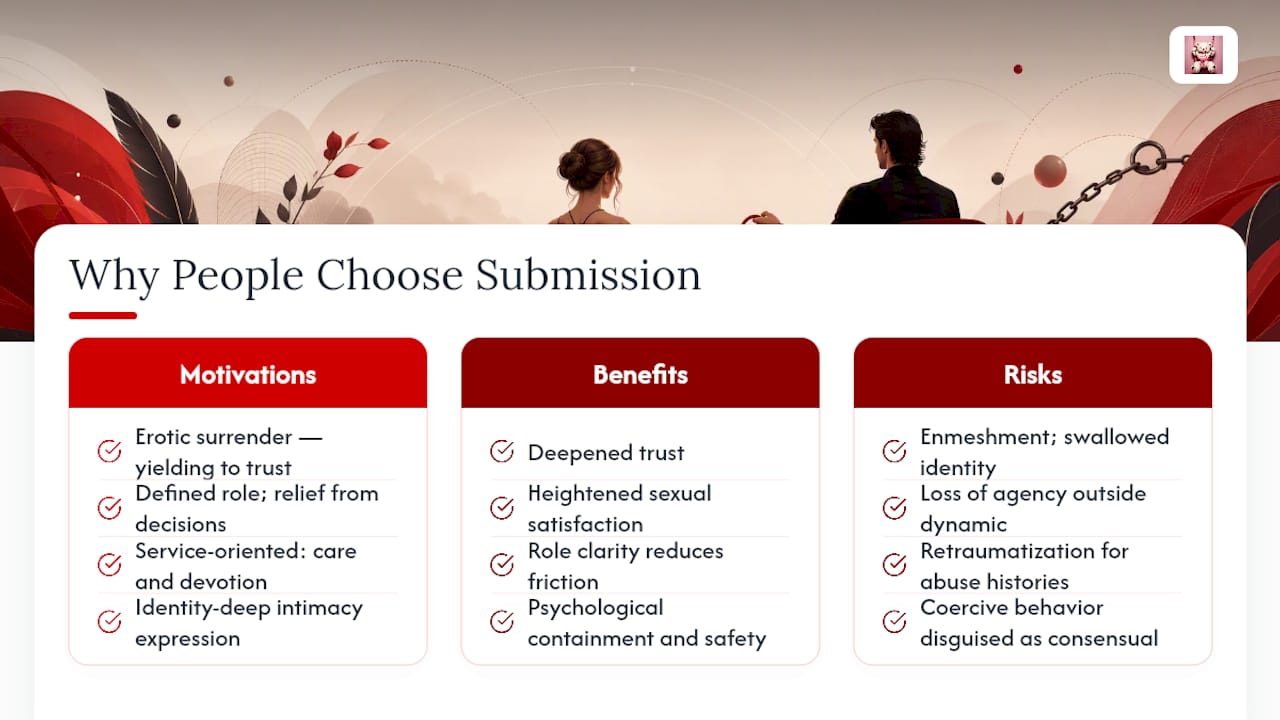
The motivations are more varied than most people expect. Some submissives describe it as erotic surrender, the specific thrill of yielding control to someone they trust completely. Others are drawn to the clarity of a defined role, the relief of not having to make every decision. Service-oriented submissives find meaning in care and devotion. For some, it's identity-deep: submission is how they experience intimacy at its most real.
Research supports the diversity of healthy expressions. A study analyzing sexual power profiles found that participants with more egalitarian gender-role beliefs and flexible sexual preferences reported higher relationship satisfaction, suggesting that conscious, negotiated power exchange tends to produce better outcomes than rigid or unexamined hierarchies.
The emotional benefits reported in D/s communities include deepened trust, heightened sexual satisfaction, role clarity that reduces relational friction, and a sense of psychological containment. These aren't trivial. For many people, a well-negotiated D/s dynamic is the most honest relationship structure they've ever been in.
The risks are real too. Enmeshment (where the dynamic swallows individual identity), loss of agency outside the negotiated structure, and retraumatization for people with histories of abuse or control are genuine concerns. Peer-reviewed analysis of sadomasochistic and authoritarian behavior patterns shows how harmful dynamics can masquerade as consensual ones when narcissistic or defensive motivations drive the dominant's behavior. If you're noticing that the dynamic feels compulsive, destabilizing, or that you've lost your sense of self outside it, a kink-affirming therapist is worth finding. The Psychology Today directory and AASECT (American Association of Sexuality Educators, Counselors and Therapists) are good starting points for locating one.
For more on the real benefits of consensual kink exploration, Kinkykorner's piece on fetish benefits covers the well-being research in plain language.
How to actually start exploring submissive dynamics safely
Here's a practical plan. Not theoretical. Not overwhelming. Just the steps that work.
- Discover your own wants first. Before you involve anyone else, spend time with your own desires. Journaling, reading (more on resources below), and fantasy exploration help you identify what draws you to submission specifically.
- Have the conversation. Bring it up outside of a sexual context, when both of you are calm and not in the middle of anything charged. Use "I've been curious about..." framing rather than "I want you to..."
- Negotiate explicitly. Use the checklist from the consent section above. Write it down. A shared document or even a text thread works fine.
- Start with a low-stakes scene. Pick something with minimal physical risk and a clear endpoint. A short protocol, a simple instruction to follow, a defined role for an hour. Debrief immediately after.
- Debrief honestly. What worked? What felt off? What do you want more of? This conversation is where the dynamic actually gets built.
- Revisit and revise. Agreements aren't permanent. Check in regularly, especially in the first few months.
Pro Tip: Document your negotiated agreements in writing, even informally. A shared note that says "we agreed X is off the table and Y is our safeword" protects both of you and makes future renegotiation easier.
For a deeper negotiation framework with sample scripts, Kinkykorner's negotiation guide has fillable templates you can adapt.
Starter script: "I've been thinking about exploring some power exchange with you. I'm curious about [specific thing]. I'd want to talk through what we're both comfortable with before we try anything. Can we set aside some time for that conversation?"
Rituals, symbols, and protocols: what they actually mean
D/s rituals aren't theater for theater's sake. They create containment, mark transitions, and reinforce the meaning of the dynamic in a tangible way.
Common symbols and what they carry:
- Collars: The most recognized D/s symbol. A collar can mean anything from "we're in a scene right now" to "this is a committed, long-term dynamic." Context and explicit conversation determine the meaning. Never assume.
- Collars as jewelry: Some submissives wear a discreet collar (a choker, a locking necklace) in public as a private symbol of their dynamic. It's personal and meaningful without being visible to outsiders.
- Titles: Using "Sir," "Ma'am," "Daddy," "Master," or other titles within the dynamic marks the power structure and can deepen psychological immersion.
- Rules: Agreed-upon behavioral guidelines (asking permission before certain actions, specific postures, communication protocols) that structure the dynamic day-to-day.
- Rituals: Repeated actions that signal transitions, like kneeling when a dominant enters the room, or a specific phrase used to open or close a scene.
A simple collaring ceremony might look like this: both partners write out the terms of their dynamic, read them aloud to each other, and the dominant places the collar on the submissive as a physical marker of the agreement. It's not legally binding. It's emotionally significant, a way of saying "we both chose this, deliberately."
Straight rebuttals to the most common myths about submission
Let's clear the air.
- Myth: Submissives are weak. Reality: Submission is a negotiated expression of agency. It takes significant self-awareness and trust to yield control deliberately.
- Myth: D/s is just abuse with a kink label. Reality: Consensual D/s is defined by negotiation, safewords, and the submissive's ongoing right to withdraw. Abuse involves coercion and the removal of that right.
- Myth: Only women are submissive. Reality: Submission has no gender. Men, women, nonbinary people, and people of every orientation explore submissive dynamics.
- Myth: If you're submissive in bed, you're submissive everywhere. Reality: Many people are dominant in their professional lives and submissive in their intimate relationships, or vice versa. Role and identity don't bleed automatically across contexts.
- Myth: D/s is a phase or a pathology. Reality: For many people, it's a stable, long-term orientation. The American Psychological Association removed consensual BDSM from its list of disorders in the DSM-5 revision.
- Myth: Dominants are always in control and never vulnerable. Reality: Dominants carry real responsibility and can experience their own emotional drops and vulnerabilities. The dynamic is mutual even when the roles aren't symmetrical.
Practical tips from the kink community that actually hold up
These aren't theoretical. They come from practitioners, educators, and community spaces that have been doing this for years.
Vetting a teacher or educator: Look for someone who names their own limits, welcomes questions about their approach, and doesn't pressure attendance or participation. Legitimate kink educators are transparent about their background and don't position themselves as the only authority.
Red-flag checklist for events and workshops:
- No posted consent policy or safety protocol
- Organizers who dismiss questions about safety as "ruining the vibe"
- Pressure to participate beyond your stated comfort level
- No clear process for reporting concerns
Safe contact practices: When meeting someone new from an online kink community, meet first in a public, neutral space. Tell a trusted friend where you're going and when you expect to be back. Share a photo of the person if you can.
On vetting online groups: Look for communities that have explicit rules against harassment, visible moderation, and a culture of asking before touching or engaging. Kinkykorner's marketplace connects you with vetted adult service providers and community content, so you're not starting from scratch in an unmoderated corner of the internet.
For guidance on how communication shapes safe kink, Kinkykorner's communication guide covers the negotiation and consent strategies that experienced practitioners actually use.
An honest word from the author
Here's what I keep coming back to: the people who struggle most with D/s aren't the ones who go in with too much curiosity. They're the ones who go in without enough honesty, about what they want, what they're afraid of, and what they're actually agreeing to.
The framework matters. The conversation matters. And the community you learn from matters enormously. Kinkykorner exists as a marketplace where adults can find vetted service providers, read real kink content, and connect with a community that takes consent seriously. If you're figuring out where to start, it's a better entry point than a random forum with no moderation and no accountability.
Submissive dynamics, done right, can be some of the most honest and intentional relating you'll ever do. Done carelessly, they can cause real harm. The difference is almost always in the preparation.
Sources
- Peer-reviewed article discussing sadomasochism and related dynamics — PMC
- Dominant/submissive dynamics explained — Mashable
- Dom and sub relationships: what they are, how they work — MindBodyGreen
- A New Sub’s Guide to Building Trust, Safety, and Desire — Feeld
- Dominance and submission — Wikipedia