

There's a lazy assumption floating around that if you're uncomfortable hearing about someone's kinks, you're automatically shaming them. Not true. Kink shaming is a specific kind of harm, and understanding what it actually is matters a lot if you're part of the BDSM world or just kink-curious. Kink shaming is defined as judging, ridiculing, or embarrassing someone for their consensual sexual interests, making them feel abnormal or morally wrong. It's more than awkward. It lives inside jokes, media portrayals, and conversations you didn't even know were doing damage.
Table of Contents
- What is kink shaming?
- How does kink shaming appear in daily life?
- The roots of kink shaming: Social and psychological factors
- How kink shaming affects identity and mental health
- Moving toward acceptance: Healthy responses to kink shaming
- A real-world perspective: Kink shaming is more common and subtle than you think
- Explore and connect: Find your community with Kinky Korner
- Frequently asked questions
Key Takeaways
| Point | Details |
|---|---|
| Kink shaming defined | Judging consensual sexual interests is shaming and impacts mental health. |
| Subtle forms matter | Casual jokes and stereotypes can be as harmful as open discrimination. |
| Origins are deep | Stigma comes from long-lasting moral, cultural, and psychological biases. |
| Community and support | Finding like-minded allies and sex-positive spaces builds resilience and acceptance. |
| Healing is possible | Kink-aware therapy and supportive communities help overcome internalized shame. |
What is kink shaming?
Let's get precise about this. Kink shaming isn't just a dramatic confrontation where someone screams "that's disgusting!" at you across a dungeon. Most of the time it's quieter, sneakier, and wrapped in a smirk or an offhand comment. According to the clearest definition out there, kink shaming means ridiculing someone for consensual sexual interests like BDSM, fetishes, or role-play in ways that make them feel abnormal or morally wrong.
It's worth separating that from simple curiosity or a genuine "not my thing" response. Those aren't shaming. The line is condemnation. The line is making someone feel broken. If you want to understand the full vocabulary around kinks and why certain interests exist, checking out kink terms explained gives you a solid baseline before going any deeper into this conversation.
The mechanics of shaming are varied. Kink shaming often stems from casual jokes, media stereotypes, moral condemnation rooted in religious or cultural norms, and outright discrimination. Historically, early psychology actually labeled kinks as disorders, which gave social stigma a medical costume to wear. That gave everyday judgment a false air of authority.
The tricky part is that not all discomfort is shaming. Someone saying "that's genuinely not for me but I respect that you're into it" is not shaming you. Someone saying "you're disgusting for liking that" absolutely is. The intent, the tone, and the impact all matter. Here's a breakdown:
| Form of kink shaming | Context | Example |
|---|---|---|
| Casual jokes | Social settings, online | "You're into what? Haha, weirdo." |
| Media stereotypes | Films, TV, news | Portraying BDSM practitioners as unstable |
| Moral condemnation | Religious or cultural settings | "That's sinful and deviant" |
| Professional discrimination | Workplace, medical settings | Judging someone's lifestyle in a clinical context |
| Online harassment | Social media, forums | Doxing or mocking someone's kink profile |
| Internalized shaming | Personal thoughts | Believing your own desires are wrong |
One more thing worth noting: consensual humiliation kinks exist. In those dynamics, someone wants to be called degrading things as part of an agreed-upon scene. That's a completely different beast. The power is with the person experiencing it, not being taken from them. Context and consent flip the whole meaning. Understanding kink culture explained helps you see why those distinctions aren't just semantic, they're foundational.
Pro Tip: Before assuming someone is shaming you, ask yourself whether they expressed actual condemnation or just confusion. If it's confusion, that's a teachable moment. If it's condemnation, that's a boundary to enforce.
How does kink shaming appear in daily life?
Now that we've defined kink shaming, let's see how it shows up in everyday interactions, both public and private. Because it's not always someone spitting venom at you. Sometimes it's a GIF your coworker shares in the group chat with a laughing emoji. Sometimes it's a "joke" your partner makes at a dinner party that makes you go quiet for the rest of the night.
Casual shaming and overt shaming are both real, but they hit differently. Casual shaming hides in humor. It feels like "relax, it's just a joke," which makes it harder to challenge without being labeled oversensitive. Overt shaming is direct condemnation, the kind where someone tells you to your face that what you're into is sick or wrong. Both do damage. They just wear different clothes.
Here are real-life situations where kink shaming shows up:
- A sex toy shows up in someone's luggage at work and colleagues spend the next week making "jokes" about it
- Someone comes out as polyamorous and kinky in a vanilla relationship and their partner calls it "an obsession that needs therapy"
- A submissive woman is told she's "setting feminism back" by enjoying power exchange dynamics
- A kink practitioner is treated condescendingly by a healthcare provider who spots a bruise and assumes abuse
- An online post in a supposedly sex-positive community gets mocked because the kink is deemed "too extreme"
- A male dominant gets called "abusive" by people who don't understand the consent frameworks in place
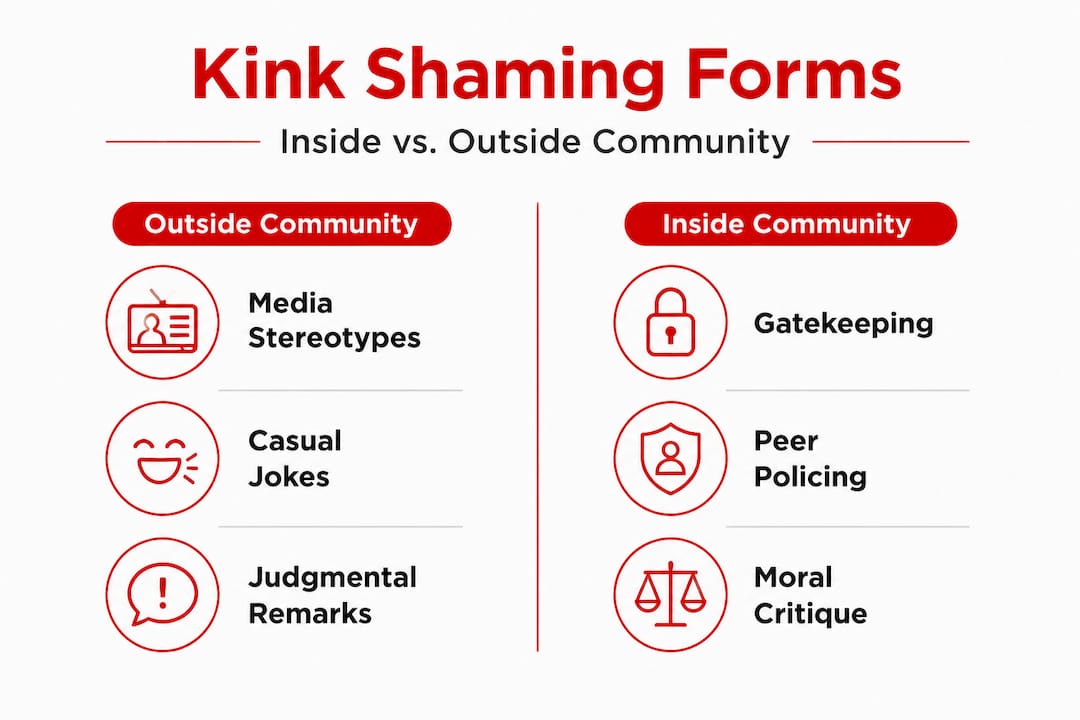
The kink shaming pattern is consistent across these examples: judgment without context, condemnation without consent to weigh in. And it's not just coming from outside the community.
| Setting | Outside community | Inside community |
|---|---|---|
| Who shames | Vanilla peers, family, media | Other kinksters, community gatekeepers |
| How it shows | Disgust, jokes, pathologizing | Policing "real" kink, extreme play judgment |
| Who's targeted | Anyone openly kinky | Edge players, switches, female doms |
| Impact | Closeting, shame, silence | Exclusion, imposter syndrome, self-doubt |
That internal shaming is brutal because you expect safety in your own community. Within kink communities, shaming occurs through gatekeeping, sexism like shaming female dominants or switches, and harsh judgments on edge play or "extreme" kinks. Basically, even among people who should know better, hierarchies and biases show up. If you want to understand how to find or build a kinky community that actually holds these values, it requires intentional effort.

Pro Tip: When you hear an offhand kink joke, you don't have to go silent. A simple "I don't really think that's funny" is enough to interrupt the pattern without turning it into a lecture.
The roots of kink shaming: Social and psychological factors
Understanding present-day shaming means looking at its origins. How did these biases develop, and why do they endure? Spoiler: it didn't happen by accident. It was built systematically.
Here's a rough timeline of how kink shaming got baked into culture:
- Early psychology pathologized kinks. Figures like Richard von Krafft-Ebing classified consensual sexual interests as disorders in the 1800s, giving shame an academic stamp of approval.
- Religion reinforced moral condemnation. Purity doctrines in many religious traditions framed non-procreative or "deviant" sex as sinful, shaping cultural attitudes across generations.
- Legal frameworks criminalized non-normative sex. Many consensual acts were illegal well into the 20th century, and some still carry social or legal consequences in certain jurisdictions.
- Mainstream media created stereotypes. Films and TV repeatedly portrayed BDSM practitioners as unstable, violent, or traumatized, encoding these associations into popular consciousness.
- Social media amplified judgment. The internet made it easier to mock and target people for their private interests at scale, with kink communities frequently targeted for harassment rooted in those old prejudices.
The deeper driver is power. Social dynamics and power structures reinforce stigma by maintaining the idea that certain forms of desire are legitimate while others are not. That's not about safety or ethics. It's about control.
"Sex-positive approaches and community support are essential to countering the effects of stigma on personal identity. Shame doesn't live in what you want. It lives in what you've been told to want."
This is why evolving attitudes toward kink matter so much. Every generation that pushes back on these embedded assumptions makes it slightly easier for the next person to live openly without that crushing weight.
How kink shaming affects identity and mental health
With the roots of stigma clear, let's explore the deeply personal impacts kink shaming leaves behind. Because the effects aren't abstract. They're felt in the body, in relationships, in the quiet moments when someone questions whether they're fundamentally broken.
Kink shaming causes guilt, anxiety, depression, self-doubt, and isolation, suppresses desires, and makes accessing supportive communities harder. This is the real cost. It's not just hurt feelings. It's a disrupted sense of self.
Here's what that typically looks like in practice:
- Hiding interests from partners, leading to dishonesty and disconnection
- Avoiding the kink community out of fear of being "found out" by vanilla social circles
- Experiencing sexual guilt even during consensual, safe, satisfying encounters
- Seeking therapy but feeling unable to disclose kink-related concerns to a non-affirming therapist
- Overcompensating by adopting an intensely "normal" persona in everyday life
- Developing anxiety specifically tied to sexual expression and identity
The suppression aspect is particularly destructive. When someone spends years telling themselves their desires are wrong, they don't just lose access to pleasure. They lose access to a part of their identity. That's a significant psychological cost. Sex-positivity and kink-aware therapy are among the most effective tools for rebuilding self-acceptance after that kind of damage.
Understanding how communication shapes kink also plays a role here. When people develop the language to talk about what they want and why, the shame loses some of its grip. You can't un-know something you've articulated clearly to yourself and others.
Pro Tip: If you're struggling with internalized shame about your kinks, look specifically for a therapist certified or trained in sex-positive or kink-affirming approaches. A therapist who pathologizes BDSM can actually make things significantly worse.
Moving toward acceptance: Healthy responses to kink shaming
Knowing the harm kink shaming can cause, it's genuinely empowering to know there are solid responses. For yourself. And for people you care about.
First, learn to distinguish shaming from respectful disagreement. Someone who says "I'm not into that, but I'm glad it works for you" is not shaming you. The key marker is whether they're trying to make you feel wrong for wanting what you want. Judgment aimed at changing you or punishing you for your desires is shaming. An honest "no thanks" is not.
Here are steps for responding to kink shaming:
- Name what's happening. Say plainly: "That comment felt like you were judging me for something consensual I do in private." Clarity matters.
- Set a boundary. "I'm not going to discuss this if it comes with condemnation" is a complete sentence and a fully valid boundary.
- Seek affirming community. Sex-positive approaches and community support are key to rebuilding a sense of self after being shamed.
- Educate selectively. You don't owe anyone an explanation, but if someone is genuinely curious rather than hostile, sharing information can shift the dynamic.
- Find kink-aware therapy or peer support. Kink-aware therapy builds self-acceptance in ways that generic therapy often can't.
- Give yourself permission to disengage. Some people are not interested in understanding. Protecting your energy is valid.
Connecting with supportive kinky communities isn't a luxury, it's often a lifeline. Knowing other people share your interests and navigate the same stigma without collapsing under it does something real for the psyche.
Pro Tip: Keep a few grounded scripts ready for when shaming catches you off guard: "That's a private part of my life I don't need to justify," or "I'm into consensual adult things, and that's not a problem." Having words ready takes the sting out of the moment.
A real-world perspective: Kink shaming is more common and subtle than you think
I'll be straight with you: the loudest, most obvious forms of kink shaming are almost not the problem anymore. Or at least, they're not the only problem. The real damage is being done in the quiet stuff. The pause before someone answers when you mention your kink. The article that uses "BDSM practitioner" as shorthand for "definitely unstable." The kink community forum where someone's rope suspension photos get sidelined because the moderator finds it "too edgy."
Most people, including people who are kinky themselves, have internalized some level of shame without realizing it. I've seen it happen in myself. That little flicker of "wait, is that okay?" when a friend mentions something more intense than I'm used to. That's not virtue. That's conditioning.
Sex-positivity isn't just about being cool with whatever someone else is doing. It means actively catching yourself when you reflexively judge something because it doesn't match your personal spectrum. The kink world doesn't need more people who tolerate mainstream kinks while quietly policing the edges. It needs people who genuinely examine their own gatekeeping.
Progress here is slow and it's community-driven. No single act of open-mindedness changes the whole landscape. But every person who understands kink curiosity statistics, who challenges a lazy joke, who refuses to shame someone for consenting adult behavior, that adds up. Real acceptance isn't a destination. It's a practice.
Explore and connect: Find your community with Kinky Korner
Shame has less power in the right room. And finding that room, whether online or in person, makes a real difference when you're figuring out who you are and what you want.

At the Kinky Korner network, there's space for curiosity and community. Whether you're looking for adult services, erotic creative content, or simply a place where your interests aren't treated like a punchline, Kinky Korner exists to connect people in a judgment-free environment. Businesses and individuals can list their services, explore literary and artistic content, and find others who get it. After everything you've just read about how isolating kink shaming can be, the antidote is connection. Come find yours.
Frequently asked questions
What exactly counts as kink shaming?
Kink shaming involves judging or ridiculing someone for consensual sexual interests, making them feel abnormal or morally wrong, whether through jokes, condemnation, or discrimination.
Can you ask about someone's kink without shaming them?
Yes. Curiosity without condemnation is not shaming. Saying "not for me but I'm curious how that works" is very different from saying "that's disgusting."
Does kink shaming happen in kink-friendly spaces?
Absolutely. Shaming within kink communities happens through gatekeeping, sexism toward female dominants or switches, and harsh judgments about edge play or extreme preferences.
How does kink shaming actually harm someone?
It creates guilt, anxiety, depression, and isolation, making self-acceptance much harder and sometimes blocking access to community and affirming support.
What's the best way to respond if you've been shamed for your kinks?
Seek sex-positive community support, consider kink-aware therapy, set clear boundaries, and remember that consensual adult desires are valid and not yours to justify to anyone.